Get Full Government Meeting Transcripts, Videos, & Alerts Forever!
Get email alerts on the Wsda Confirmation topic
No spam. Unsubscribe anytime.
Derek Sanderson testifies on farm economy, food access ahead of WSDA confirmation
Summary
Derek Sanderson, director of the Washington State Department of Agriculture, testified under oath before the Senate committee about farm income declines, the need to support farms of all scales, food‑system initiatives such as We Feed Washington, and the department's focus on rebuilding the agricultural economy.
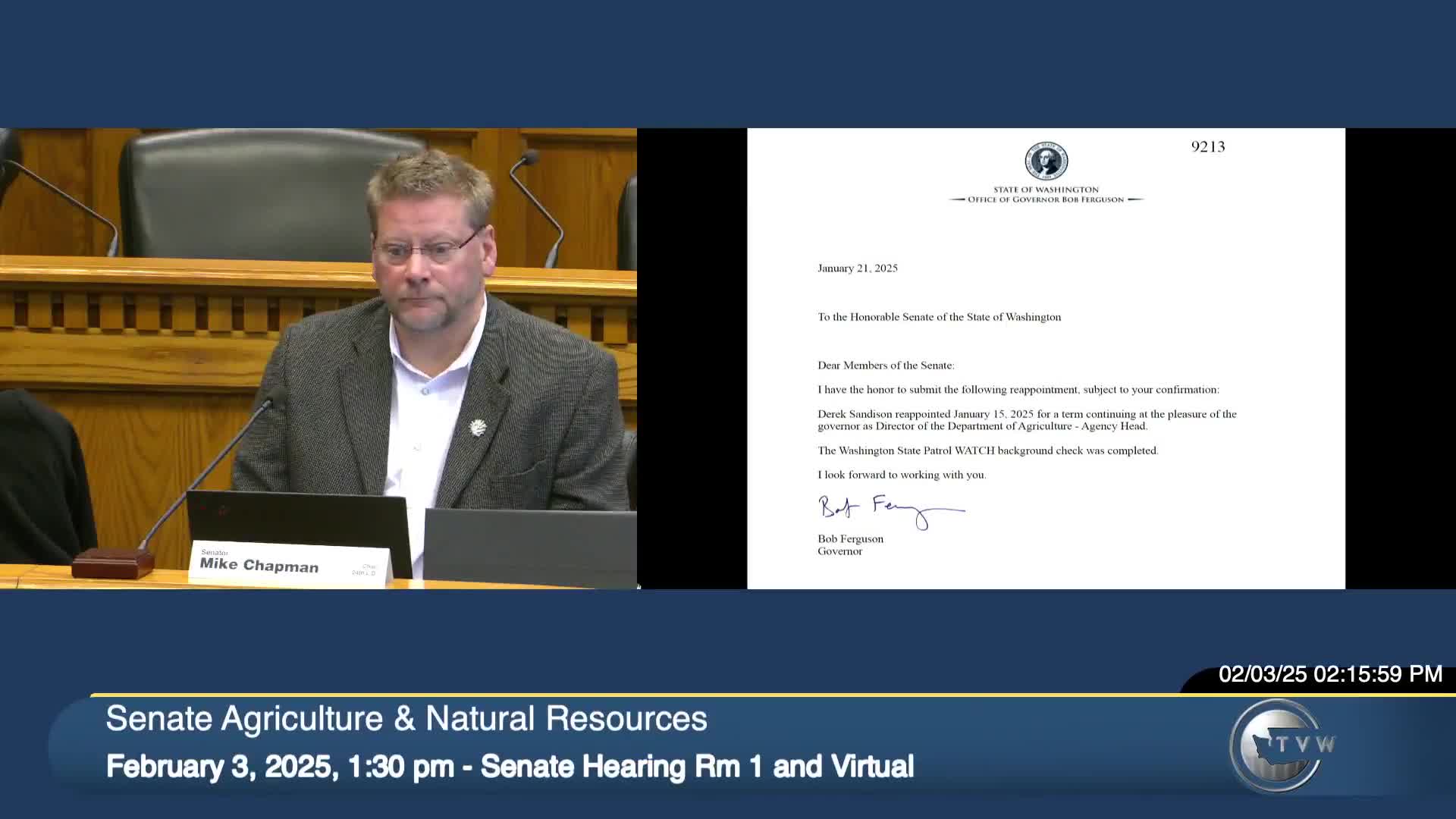
Derek Sanderson, director of the Washington State Department of Agriculture, appeared under oath before the Washington State Senate Agricultural and Natural Resources Committee for a confirmation hearing.
Sanderson described his 10 years as WSDA director and framed his testimony around the economic stress facing the state’s farms. “Farm incomes in this state on average are down by 42%,” he told the committee, and he said rising input costs and low commodity prices have squeezed producers of all scales. Sanderson cited the 2022 Census of Agriculture figure used in testimony — about 32,500 farms statewide — and characterized the typical Washington farm as a small, family operation: “If you take those 32,500 farms, space them out, pick the one in the middle, it's about a 30‑acre farm and makes about $5,000,” he said, to illustrate the small scale of many operations and the department’s work across farm sizes.
Sanderson outlined WSDA programs to support food access and local purchasing. He referenced initiatives such as “We Feed Washington,” efforts to use Washington farmers when the state makes food purchases for assistance programs, and federal grants the department has administered for food‑system infrastructure and aggregation to connect small farms to broader markets. He told the committee WSDA is working on resilient food‑system infrastructure and food‑purchasing assistance grants to help small producers access institutional buyers.
During questioning, members asked about consolidation, foreign ownership and program priorities. Sanderson said consolidation has been observed, particularly in some sectors such as tree fruit, and that new ownership patterns — including out‑of‑state equity firms — have changed the sector’s character. On tribal, local and other partnerships his testimony referenced WSDA work that aims to support food access and local sourcing.
Committee members thanked Sanderson for his remarks. The committee did not vote on his confirmation during this hearing; members indicated they plan to take up the confirmation at a later committee meeting.