Get Full Government Meeting Transcripts, Videos, & Alerts Forever!
Get email alerts on the Juvenile Sentencing Reform topic
No spam. Unsubscribe anytime.
Senate bill would expand judicial discretion, add review hearings and alternatives to reduce juvenile incarceration
Summary
Senate Bill 5296 would require judges to make an independent finding, using clear-and-convincing evidence, that an institutional juvenile rehabilitation (JR) commitment is needed for most cases; expand disposition alternatives; create periodic review hearings; and remove the 10% minimum-served rule. Supporters say it would reduce overcrowding and
Senate Bill 5296 would change Washington’s juvenile sentencing scheme by giving juvenile court judges more discretion to keep many youth in their communities while preserving commitment for those the court finds, by clear and convincing evidence, cannot be safely supervised outside JR.
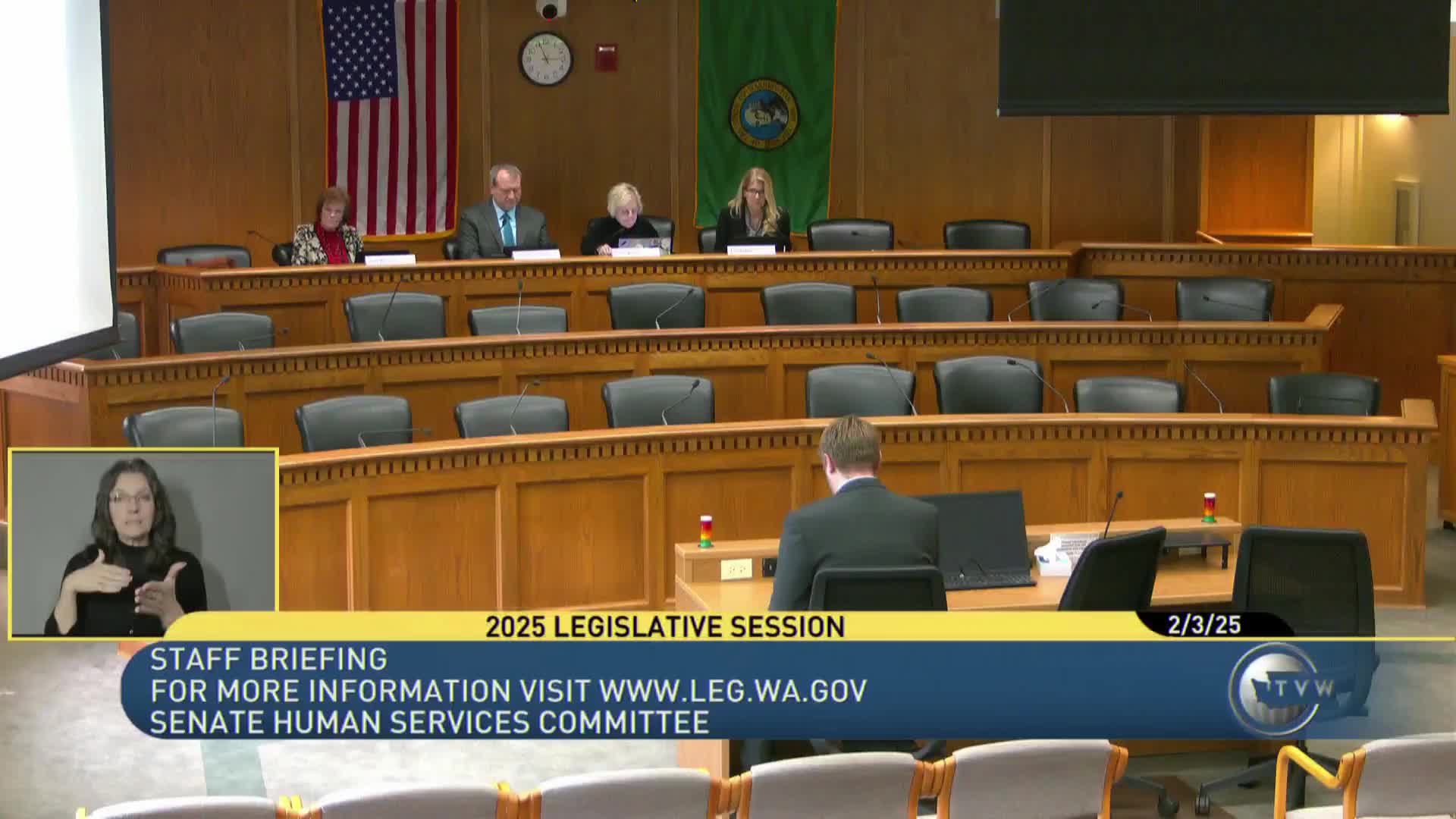
Will Tronson, committee staff, told the Human Services Committee that the bill would require an independent judicial finding — supported by clear and convincing evidence — that a commitment to a state juvenile institution is needed because a community placement would not adequately protect public safety, except for a limited set of serious offenses. The bill would expand eligibility for suspended dispositions and other alternatives (including electronic monitoring), remove the statutory requirement that youth serve at least 10% of their sentence (but not less than 30 days in any case), and add a requirement that youth who receive JR time over six months have a six-month review hearing that would result in release on community supervision unless the court made specific findings to retain the youth.
Sen. Claire Wilson, sponsor of the bill, framed the measure as an ‘‘upstream’’ approach to reduce overcrowding by increasing diversion and community-based options. ‘‘We need to address this by finding solutions that meet the needs of our young adults and keep them from being in the deep end of the juvenile justice system in the first place,’’ Wilson said during her opening remarks.
Support came from juvenile-defender and advocacy organizations. Emily Justin of TeamChild told the committee that TeamChild has helped young people avoid JR by arranging housing, extended family supports and behavioral-health treatment and that community-based responses lead to lower recidivism. Katie Hurley, special counsel for criminal practice and policy with King County Department of Public Defense, said the bill would safely reduce admissions and short stays and estimated that the changes could lower JR average daily population by roughly 50 youth; DCYF witnesses said the likely population impact from the bill’s construction would be smaller, on the order of one to four youth, and stressed that local investments in community alternatives are needed for the approach to be effective.
Prosecutors and juvenile-court administrators voiced concerns about the bill’s scope and implementation. Russell Brown, executive director of the Washington Association of Prosecuting Attorneys, cautioned that the proposal shifts substantial discretion to local courts and could produce inconsistent outcomes across jurisdictions; he also said the mandatory six-month reviews with presumptive release could be disruptive for victims and create new costs. Jack Murphy of the Washington Association of Juvenile Court Administrators said the bill contains ‘‘good ideas’’ but is large in scope and warned that option B (a disposition alternative for higher-risk youth) has historically been under-resourced; he urged working through operational details before enactment.
Other testimony stressed the scientific basis for treating youth differently from adults. Dr. Esther Matthews, a criminology researcher with lived experience of juvenile incarceration, said confinement is often ‘‘criminogenic’’ and advocated for policies that keep youth in community settings that support development. The ACLU’s Sandra Toussaint urged alignment of policy with adolescent brain science and said the evidence shows youth kept close to home are less likely to reoffend.
Committee questions focused on implementation details, funding, impacts on repeat offenders and victim-notification consequences. DCYF officials said they expect implementation workload and concurrent-jurisdiction reviews but provided a data-backed estimate that immediate population impacts would be modest under the bill’s current text. Supporters and administrators both emphasized that community-based alternatives must be funded and scaled to realize the bill’s goals.
The committee heard a broad range of stakeholders and flagged further technical and fiscal work; the hearing record does not show a committee vote during the session.