Get Full Government Meeting Transcripts, Videos, & Alerts Forever!
Get email alerts on the Higher Education Student Safety topic
No spam. Unsubscribe anytime.
Senate hearing spotlights Bill 5355 to tighten Title IX processes, expand survivor supports at public colleges
Summary
A Senate Higher Education Committee public hearing drew students, campus Title IX staff and survivors to support substitute Senate Bill 5355, which would set statewide timelines, require trainings, add campus safety committees and expand student access to services; college system leaders urged additional funding for implementation.
Senate Higher Education & Workforce Development Committee members held a public hearing on a proposed substitute to Senate Bill 5355, an act the prime sponsor said is aimed at "improving safety at institutions of higher education while supporting student survivors of sexual assault." Kelly Gunn, committee staff, briefed members on the substitute before hundreds of students and campus representatives testified.
The bill would: enumerate specified rights for sexual-assault survivors at public baccalaureate institutions and community and technical colleges (CTCs) with enrollments above 8,000; require creation of student health and safety committees at flagship campuses and larger regionals/CTCs; mandate employee training and student education focused on survivor-centered response, with certain higher-risk student groups required to take some training in person; place the telephone number for a 24/7 support organization on the back of student ID cards; prohibit nondisclosure agreements on student complaints filed under Title IX; and set a statutory cap of 180 days for a Title IX process with required investigation steps specified in the bill language.
The bill’s sponsor, Senator Tina Orwell, said students led listening tours across campuses and asked lawmakers to close gaps in resources and timelines. "We want every student to be successful and...most of all, you want to be safe," Orwell said, adding students reported slow access to care and confusion about procedures.
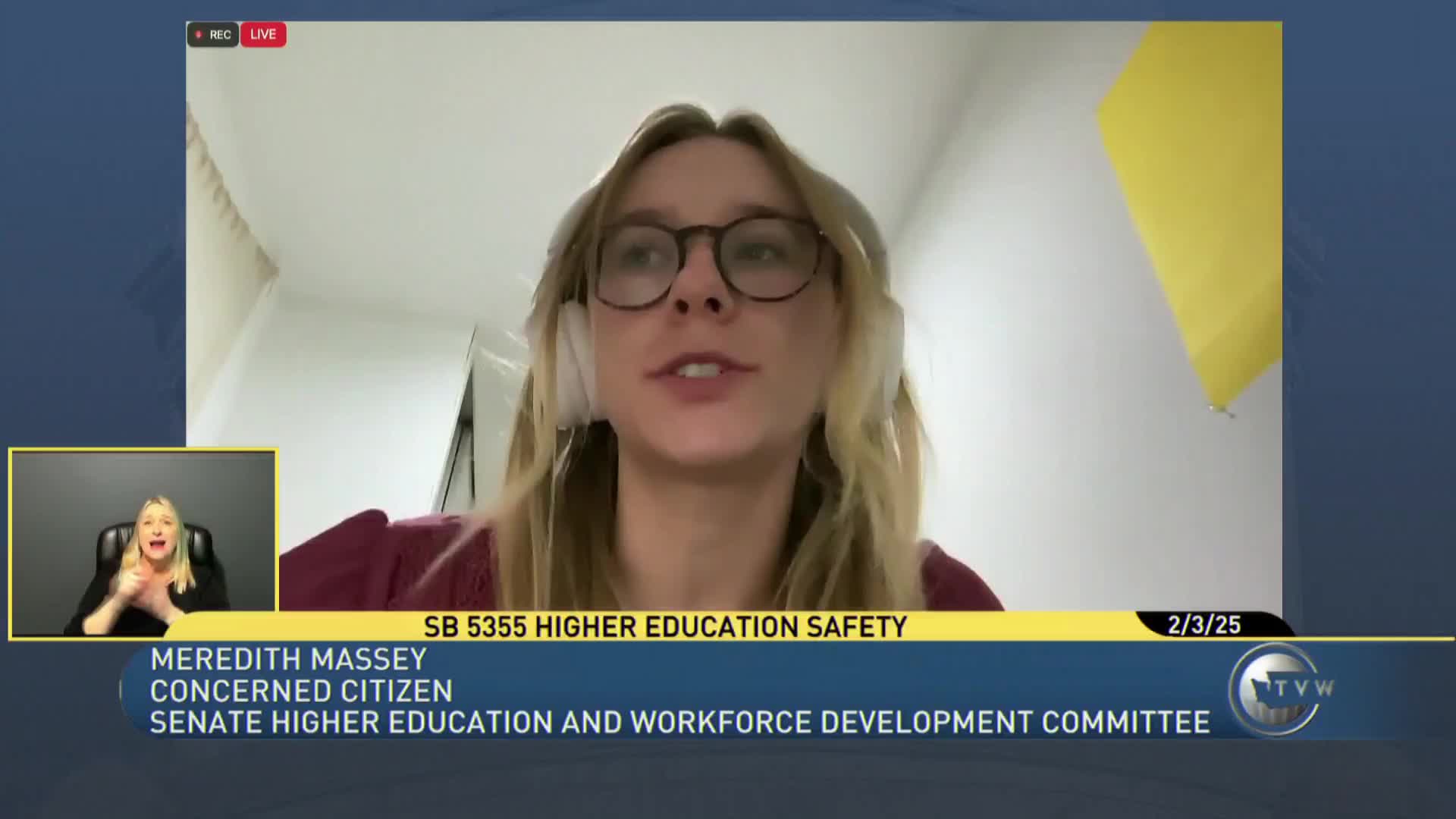
Student advocates and survivors gave the committee examples they said demonstrate uneven campus practices and long timelines. Colin Banister, president of the Washington Student Association, cited a 2022 Seattle Times report showing 2,500 reports of sexual misconduct across public four‑year institutions in a five‑year span and urged the committee to adopt the bill’s changes. Student and survivor testimony described delayed notifications, poor coordination of medical and counseling care, inconsistent information from Title IX offices, and pressure to mediate instead of receive supportive services.
Campus officials expressed conditional support for the policy goals but emphasized it will require additional resources. Christine McMullen of the State Board for Community and Technical Colleges testified that roughly half of the system’s colleges (17 colleges with enrollment over 8,000) would be affected and warned that "to successfully achieve the goals of this bill, further investment in mental health counseling must be made at our colleges." Kayana Swearingen, deputy Title IX coordinator at the University of Washington, echoed that several requirements align with campus priorities but said campuses lack capacity now and urged funding from the Legislature.
Legal and survivor-advocacy groups supporting the bill argued state codification would reduce confusion caused by shifting federal Title IX guidance and would standardize survivor rights and timelines across institutions. A victims’‑rights attorney from the Violence Law Center said state-level standards can "minimize state liability" and provide clearer protections than inconsistent campus practices.
Committee staff told members a fiscal note for the underlying bill is available; a fiscal note on the proposed substitute was requested but not available at the hearing. No committee vote on the bill was recorded during the session. The committee closed the public hearing after the panel of student, campus and advocacy witnesses completed testimony.
The hearing highlighted three consistent themes: students and survivors pressing for faster, clearer Title IX processes and more on‑campus access to trauma‑informed care; campus leaders endorsing the bill’s goals while requesting state funding to implement them; and advocates seeking statutory limits (180 days) and procedural safeguards such as prohibition of nondisclosure agreements and mandated 24/7 support contact information on ID cards.
Implementation questions remain: how many additional counselors campuses would need, the fiscal impact of required trainings and in‑person education for specified groups, and administrative changes to meet the statutory 180‑day timeline. Several witnesses asked the Legislature to provide earmarked operating funds to meet the bill’s mandates.
The committee did not take final action on SB 5355 at the hearing; staff and senators indicated follow‑up work and potential technical amendments may be necessary before a markup. Supporters urged the committee to consider both the policy text and the funding requirements together.