Get Full Government Meeting Transcripts, Videos, & Alerts Forever!
Get email alerts on the Voluntary Transfers Jr To Doc topic
No spam. Unsubscribe anytime.
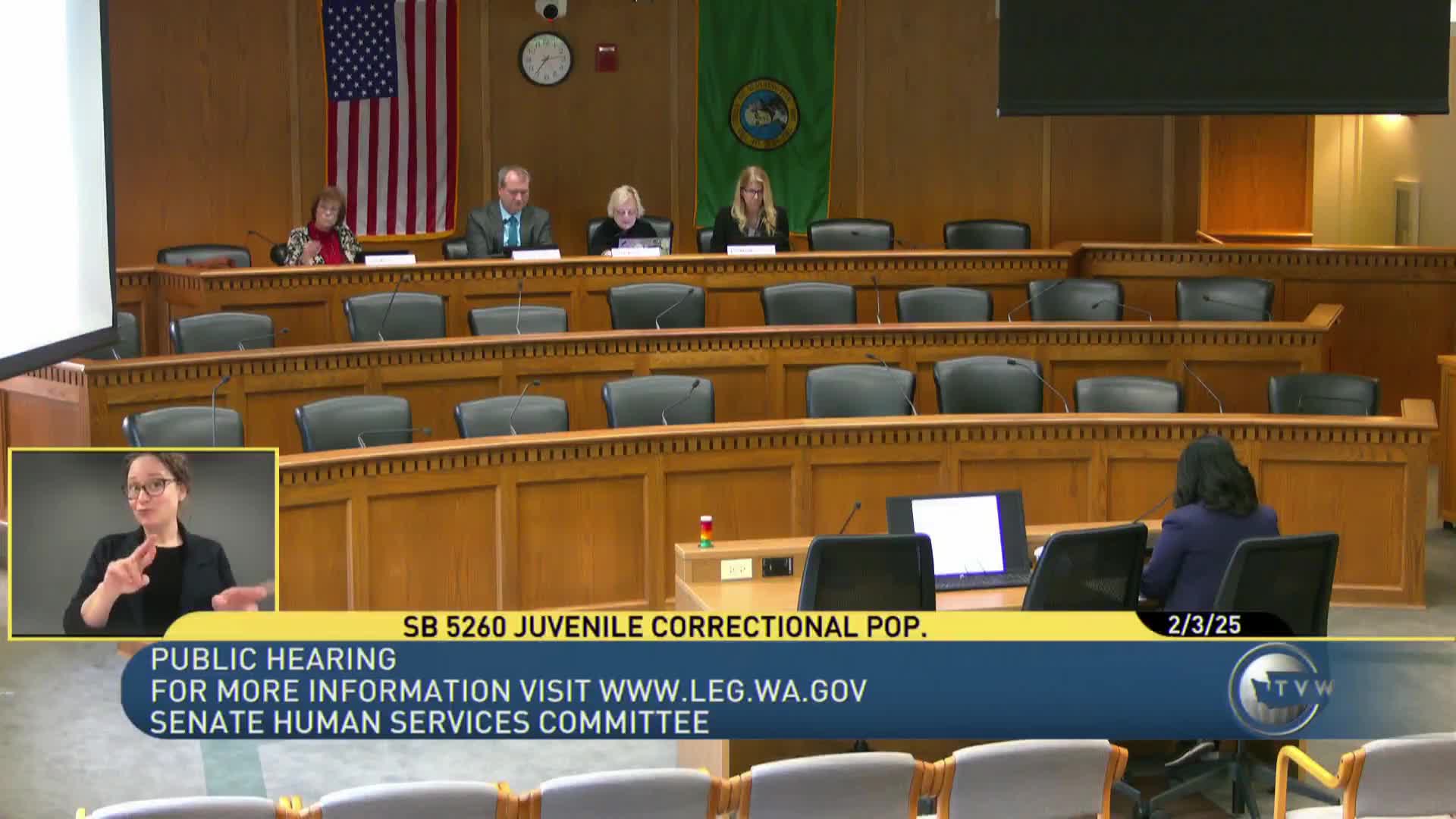
Bill to speed voluntary transfers from juvenile rehabilitation to adult corrections draws calls to keep legal protections
Summary
Senate Bill 5260 would let an 18-or-older youth in DCYF custody request transfer to DOC, require a short reconsideration period, and mandate transfer within 10 days. Supporters say it respects individual choice and eases overcrowding; advocates and DCYF staff said safeguards, clearer information-sharing, and flexibility on timing are needed.
Senate Bill 5260, introduced as the Youth Rehabilitation Pathways Act, would streamline voluntary transfers from juvenile rehabilitation to adult corrections for people age 18 or older who request the move. Supporters said the change respects individuals’ agency and can relieve pressure on overcrowded juvenile facilities; defenders and juvenile advocates urged preserving due-process protections and building clearer information and transition planning into any change.
Kelsey Anne Fung, staff to the committee, outlined the bill’s core provisions. Under the draft presented, a person at least 18 years old could request a transfer from DCYF to DOC; the person would have three days to reconsider, and after that three-day period DCYF would be required to transfer the person to DOC within 10 days. The bill would require DCYF and DOC to develop a transfer-request form and would direct DCYF to inform people entering custody of the option to request a transfer. Fung repeated that DOC’s partial fiscal estimate is indeterminate but likely above $50,000 per year and that DCYF’s fiscal note was still pending.
Sen. Mark Christian, sponsor of the bill, said the measure is intended to honor situations in which an individual believes DOC will better meet their needs, including family proximity or programming options. ‘‘If somebody is wanting to…choose to go to DOC, why are we not honoring that?’’ Christian asked during the hearing.
Defense and youth advocates said the bill should preserve key protections. Sarah Zehr, director of Legal Services (TeamChild), and Sarah Nagy of Columbia Legal Services urged that the current practice — which includes consultation with DCYF’s contract counsel and a review board hearing that probes the young person’s reasoning and protects against coercion — not be eliminated. Nagy noted that current practice gives a youth the opportunity to consult with counsel and receive a set of procedural protections before transfer; she asked that those protections be retained or replaced with clear safeguards so a youth is not pushed out because of worsening conditions or staff pressure.
DCYF presented operational concerns and data. Allison (Lisonbee) Kreutzinger, representing DCYF, reported that in the last year there were 22 self-request transfers; 18 were granted and 4 denied after the review process. DCYF said it is neutral toward the bill’s intent but asked for clarifications: the agency highlighted that a hard 10-day transfer deadline could be disruptive to ongoing programming and medical or behavioral-health transitions and suggested more flexibility so transfers do not interrupt care. DCYF also said DOC staff are sometimes on-site at Green Hill to help classify people for placement, but witnesses and committee members also noted uneven information-sharing and gaps in transition planning.
Other witnesses echoed both the need to respect individual choice and the need to preserve process. Sarah Nagy and Sarah Zehr recommended explicit statutory language that preserved youth access to contract counsel before a self-transfer is finalized, required good-faith information-sharing between DCYF and DOC about likely classification and placement outcomes, and provided for a limited ‘‘transfer back’’ mechanism so a youth who immediately regrets a transfer has a defined pathway to return when appropriate.
Committee members asked whether a youth could change their mind after transfer; sponsor Christian said he would consider an amendment that allows a single return if appropriate, citing the logistical costs of frequent back-and-forth moves. DCYF urged flexibility and planning time for medical and treatment transitions.
The committee did not record a vote during the hearing. Testimony sign-ins on the legislative day indicated many stakeholders organized to comment across related bills on juvenile rehabilitation.