Get Full Government Meeting Transcripts, Videos, & Alerts Forever!
Get email alerts on the Organic Agriculture topic
No spam. Unsubscribe anytime.
Committee hears bill to create organic action plan, microgrants and fee adjustments
Summary
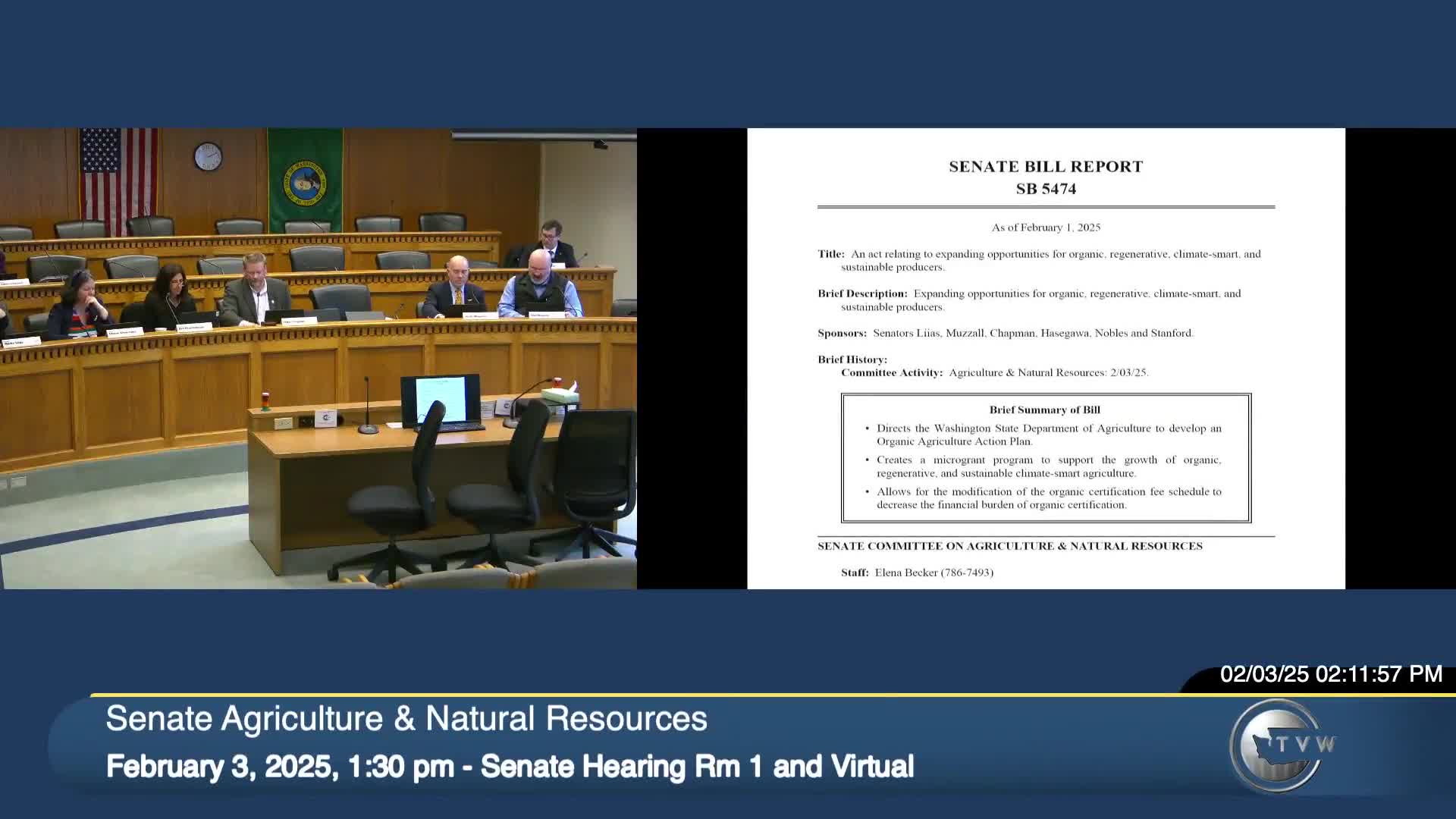
Senate Bill 5474 would require WSDA to produce an organic agriculture action plan, stand up a nonprofit‑run microgrant program with awards up to $25,000, and permit fee adjustments for organic certification if the legislature funds them.
Senate Bill 5474 drew extensive testimony on opportunities and barriers for organic, regenerative and climate‑smart producers. The bill directs the Washington State Department of Agriculture (WSDA) to develop an organic agriculture action plan, authorizes a nonprofit partner to run a low‑barrier microgrant program that can award up to $25,000 per producer, and permits adjustment of WSDA’s organic certification fee schedule if funds are appropriated for that purpose.
Elena Becker, committee staff, outlined the three components: an action plan to analyze barriers and opportunities (including outreach to youth and overburdened communities), a microgrant program prioritized by criteria such as carbon sequestration and leadership from vulnerable populations, and a possible fee adjustment to reduce certification costs if the legislature funds that change. The fiscal note attached to the bill shows estimated operating expenditures of $445,935 in the 2025–2027 biennium.
Multiple witnesses from the organic sector and partnering organizations testified in favor. Melissa Speer, executive director of TILT Alliance and a governing council member of the Coalition for Organic and Regenerative Agriculture (CORA), described Washington’s organic sector: “Washington comes in second in the nation in organic farm gate sales,” and she urged state action to replace shrinking federal supports such as the federal certification cost‑share, which she said has recently been unavailable. Mike Dill of Organically Grown Company emphasized that many farms and processors operate as “split operations” (producing both organic and nonorganic products) and that investments in organic infrastructure would benefit a broad set of producers.
Producers described on‑the‑ground benefits. Maynard Malani, co‑owner of Malani Family Farm and an organic dairy operator, said organic dairy saved his family farm and produces roughly $90 million in organic dairy sales statewide across about 32 farms. Matt Simon, a regenerative producer in Skagit County and chair of CORA’s governing council, urged measures that lower certification and infrastructure barriers for first‑generation and small farmers who are expanding into organic channels. Jeremy Takala, a councilor for the Yakama Nation, asked the committee to consider tribal farms and tribal enterprise structures in program design and noted that tribal operations can be disqualified from nonprofit‑targeted grants because they are structured as tribal business enterprises.
Charles Benbrook, an academic who has published on organic food, recommended the state generate more consumer‑facing data on nutritional and food‑safety benefits to grow demand for organic products; he cautioned that market demand — not technical limits — is the principal constraint on scaling production.
The committee closed the public hearing on SB 5474; staff recorded 1,131 sign‑in responses on the bill (1,112 pro, 18 con, 1 other). No committee vote occurred during the hearing; sponsor and witnesses said they will continue to work with WSDA and other stakeholders on technical details and implementation.