Get Full Government Meeting Transcripts, Videos, & Alerts Forever!
Get email alerts on the Employment Layoffs topic
No spam. Unsubscribe anytime.
Committee hears expansion of WARN-style notices and employer health obligations in layoffs bill
Summary
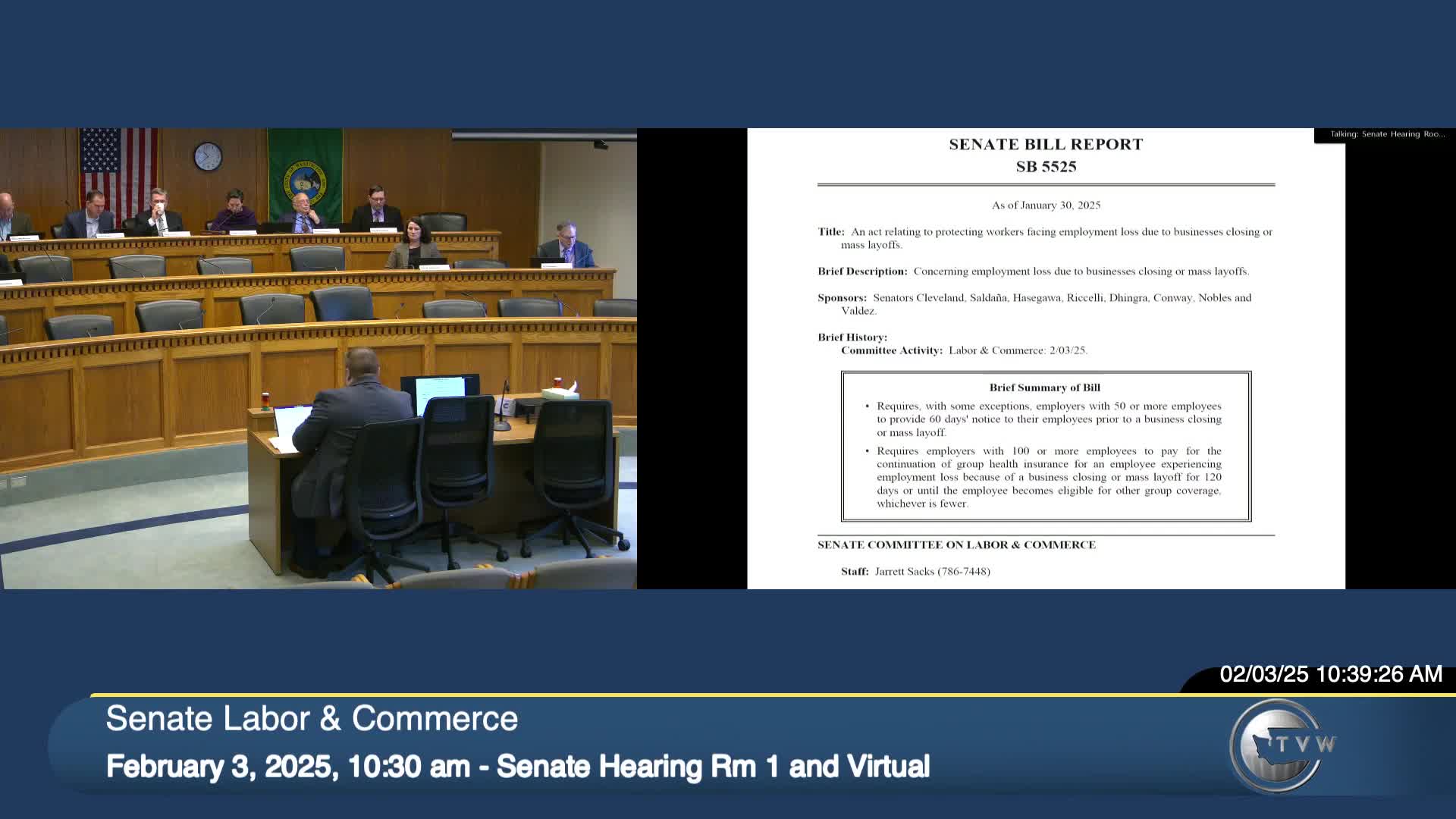
Senate Bill 5525 would lower the state threshold for required notice of business closings or mass layoffs and add penalties and a temporary employer-funded continuation of group health insurance for some layoffs. Proponent testimony emphasized worker planning time; opponents sought clarity about bankruptcy and enforcement.
Senate Bill 5525 would require an employer of 50 or more full‑time employees to provide 60 days’ written notice to the Employment Security Department (ESD) and affected employees before a business closing or mass layoff, mirroring parts of the federal WARN Act but at a lower threshold.
Committee staff explained the proposal is modeled on the federal Worker Adjustment and Retraining Notification (WARN) Act but applies at lower employee thresholds and is state‑level rather than site‑specific. Jarrett Sackstaff, committee staff, summarized the bill and listed exceptions including unforeseeable business circumstances, ongoing capital-raising efforts that would be thwarted by notice, and natural disasters. He said an employer that fails to provide required notice would be liable for up to 60 days of back pay and benefits for each aggrieved employee, reduced by amounts already paid under other laws; failure to notify ESD could trigger civil penalties up to $500 per day.
Sponsor Senator Annette Cleveland told the committee the policy goal is to “bring some stability to workers and families” by giving employees time to seek new employment, apply for benefits and arrange finances. “Advanced notice of job loss allows employees time…to access retraining and support services,” she said.
The bill also requires employers with more than 100 full‑time employees to pay for continuation of existing group health insurance for affected employees for 120 days or until the employee obtains other group coverage. Committee staff noted ESD may investigate complaints and order payment of benefits.
Labor union testimony supported the bill as a worker protection. Brandon Anderson of SPEEA said WARN notices have given his members time to prepare after recent layoffs and urged disclosure of whether displaced work will be outsourced or moved out of state to help affected workers and policymakers.
Committee members queried several implementation issues: how bankruptcy would interact with the notice and payment requirements, how employer payments for continued group health would be enforced in insolvency, whether the state’s provision duplicates COBRA and how the bill compares with other states. Staff told senators that some states have adopted WARN-like notice laws and that the employer-funded continuation-of-coverage provision is uncommon; Connecticut had enacted and later repealed a similar requirement.
No vote was taken during the hearing; staff said a fiscal note had been requested but was not yet available.