Get Full Government Meeting Transcripts, Videos, & Alerts Forever!
Get email alerts on the Historic Landmarks Owner Consent topic
No spam. Unsubscribe anytime.
Bill to require owner consent for historic landmark designations draws split testimony over housing impact
Summary
Senate Bill 5554 would prohibit cities and code cities from designating properties as historic landmarks without the written consent of owners and would prevent landmark designation of properties under 40 years old, with an exception for properties within established historic districts.
Senate Bill 5554 would prohibit cities and code cities from designating a property as a historic landmark if the property is less than 40 years old or if the designation would restrict its use, alteration, or demolition without the written consent of the property owner; designations made without written consent would be void unless consent is obtained.
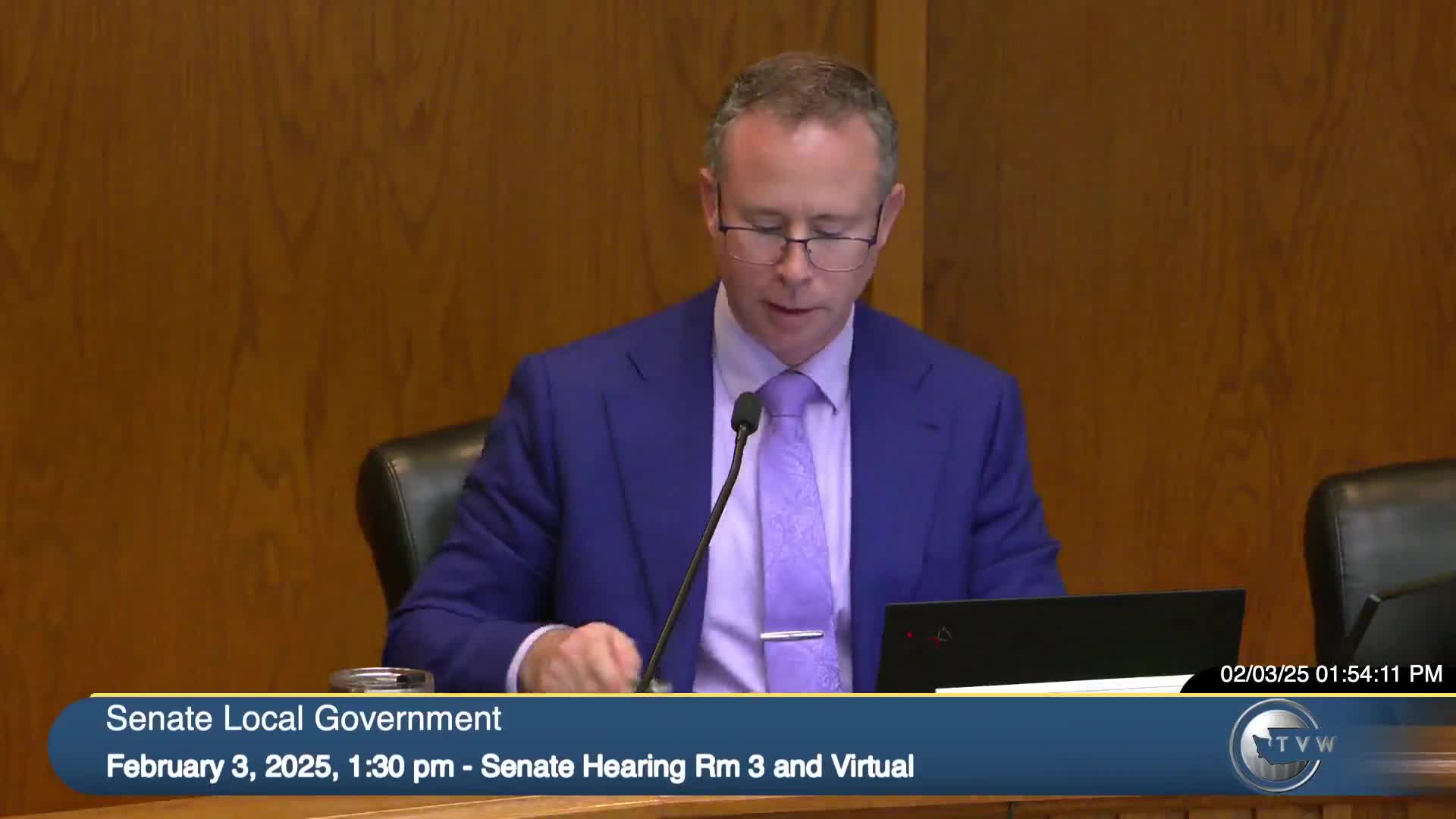
Committee staff Karen Epps briefed the Local Government, Land Use & Tribal Affairs Committee that under the Growth Management Act jurisdictions must consider historic preservation goals, but GMA does not mandate historic preservation. The bill would also require cities to implement the owner-consent requirements no later than one year after the bill’s effective date and would preempt conflicting local regulations after that date; the bill includes a carve-out for properties inside legally established historic districts.
Supporters argued owner-consent protects housing production from what they described as weaponized landmark nominations. Dan Bertollet of Sightline Institute said his group’s research found cases where landmarking without owner consent stalled or killed housing projects, including a cited project that would have added 200 units and another that blocked 63 apartments; he said requiring owner consent would “eliminate this risk and prevent the misuse of historic landmarking to undermine housing.” Several affordable-housing developers and nonprofit witnesses described examples where nomination processes delayed or imperiled permitted housing projects, and one developer said a nomination forced a multiyear legal defense that threatened a 50-unit affordable project.
Opponents, including the Washington Trust for Historic Preservation, Historic Seattle, and Seattle preservation advocates, urged caution. Chris Moore, executive director of the Washington Trust for Historic Preservation, said preservation has long been “local” and that the variation in local ordinance approaches reflects community prerogative; he recommended further work in the interim rather than a state-level preemption. Historic Seattle’s director of preservation services cited nonprofit rehabilitation work that produces and preserves affordable units and noted that in Seattle only about 0.5% of parcels are designated individually or within historic districts.
Colleen McAleer, testifying for Seattle preservation interests, said the bill would waste time addressing a tiny fraction of parcels and could permit later owners to demolish iconic landmarks; she argued landmark status should remain with the building or site regardless of ownership. Preservation witnesses also said landmark boards and city councils often weigh broader public interests, and that local processes provide alternatives such as adaptive reuse.
Committee members asked for examples and data. Staff and proponents offered to share case examples with Association of Washington Cities staff to inform further discussions; the hearing ended with the committee noting additional written testimony would be accepted because technical witnesses were unable to join by remote connection.
No committee vote was taken at the hearing.