Get Full Government Meeting Transcripts, Videos, & Alerts Forever!
Get email alerts on the Port Commissioner Terms topic
No spam. Unsubscribe anytime.
Senate Bill 5370 would let port districts ask voters to extend commissioner terms from four to six years
Summary
Sen. Harris and port officials told the Local Government Committee that allowing port districts to put a ballot measure before voters to lengthen commissioner terms could reduce turnover and help continuity on long-term port projects; the change would take effect only if a majority of district voters approve a ballot proposition.
Senate Bill 5370 would permit port districts now governed by four-year commissioner terms to put a ballot proposition to voters asking to extend those terms to six years.
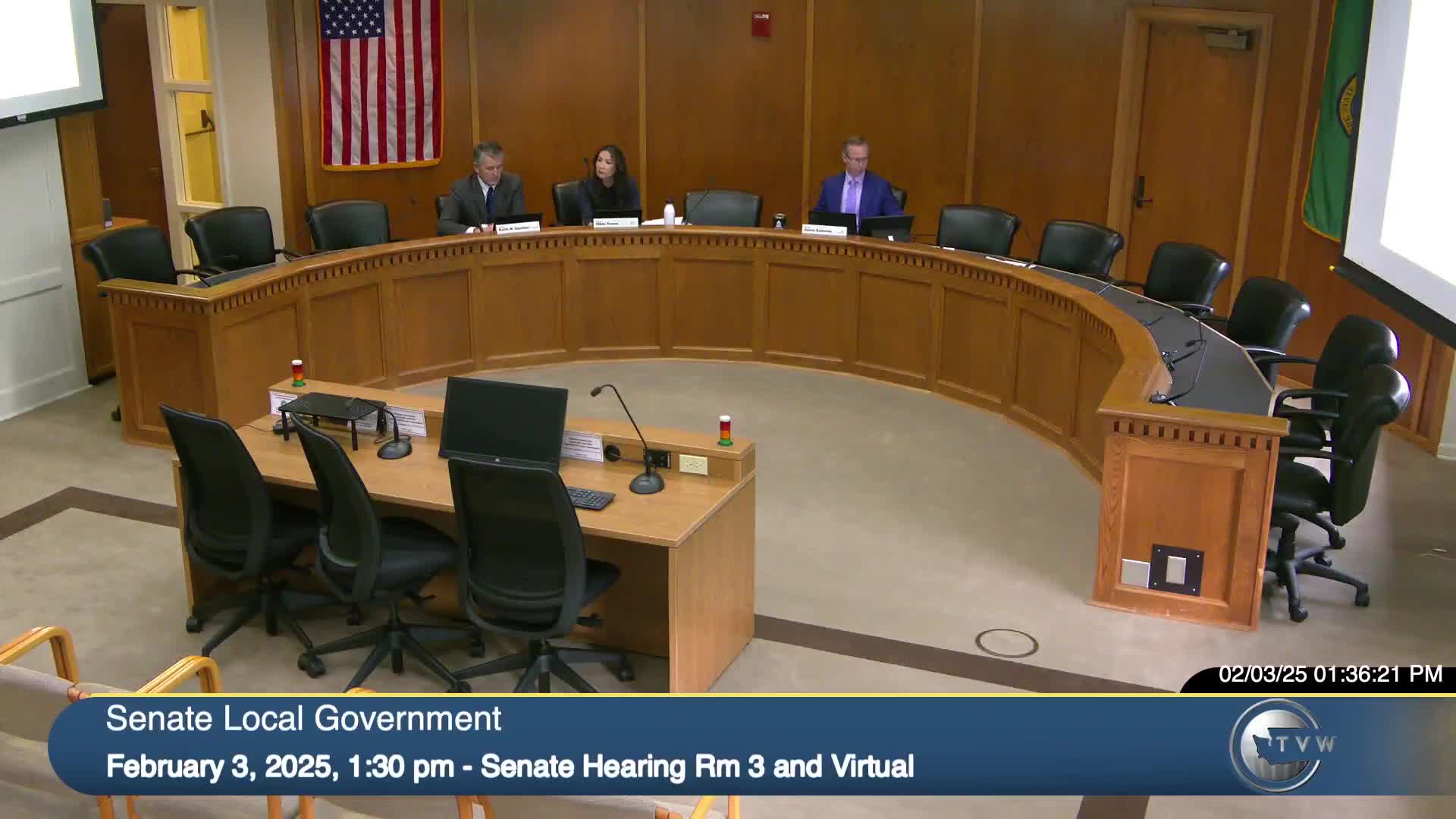
The measure, sponsored in the Senate by Sen. Harris, was introduced Tuesday to the Senate Local Government, Land Use & Tribal Affairs Committee with a staff briefing from Rohan Bhattacharya, committee staff. Bhattacharya summarized the bill’s mechanics: if a petition signed by at least 10% of the district’s voters in the last general election is submitted and validated, the proposition goes on the next general election ballot; if a simple majority approves it, elected commissioners would serve six-year terms.
Sen. Harris said the bill responds to “turnover that takes place in long term projects and how it can affect them.” She told the committee the change is a local option and “it still goes before the voters and we'll see what they think.”
Eric Fitch, executive director of the Washington Public Ports Association, described the bill as addressing continuity problems at smaller ports that currently elect two-thirds of a three-commissioner board at the same time under four-year terms. “We are working on language to ensure turnover at port districts does not disrupt long term capital operations,” Fitch said, and noted the association has an amendment in process.
John Spencer, a commissioner with the Port of Camas-Washougal, gave a local example of the turnover problem: after nine years on his port board, Spencer said he intends to retire at year-end and that “it's quite possible that come next January, we will have only one person on board or port leadership who has more than about a year's worth of experience.” He urged the committee to consider the bill to allow ports to ask voters for six-year terms so projects carry continuity across election cycles.
Rick Hoffman, port manager for the Port of Lopez, said island ports act as “a lifeline to the mainland” and that institutional knowledge on small boards is critical. “Losing the possibility of losing two thirds of our commission at one time would be a very big obstacle to overcome,” Hoffman said, asking the committee for support.
Committee staff said a fiscal note had been requested but not yet received. No formal action or vote on the bill was recorded at the hearing; proponents said any change would be subject to voter approval at the local level.
The committee recorded public testimony from the ports’ association and two port districts; senators on the committee asked procedural questions. The bill’s sponsor and proponents emphasized the change is optional and requires a ballot measure to take effect.
If the bill advances, the next steps would be committee work on the amendment Fitch described, consideration of a fiscal note, and possible scheduling for further committee action or a floor vote.