Get Full Government Meeting Transcripts, Videos, & Alerts Forever!
Get email alerts on the Transportation Planning Studies topic
No spam. Unsubscribe anytime.
Joint Transportation Committee staff summary lists 2024 studies, including P3, delivery fee, and emissions tools
Summary
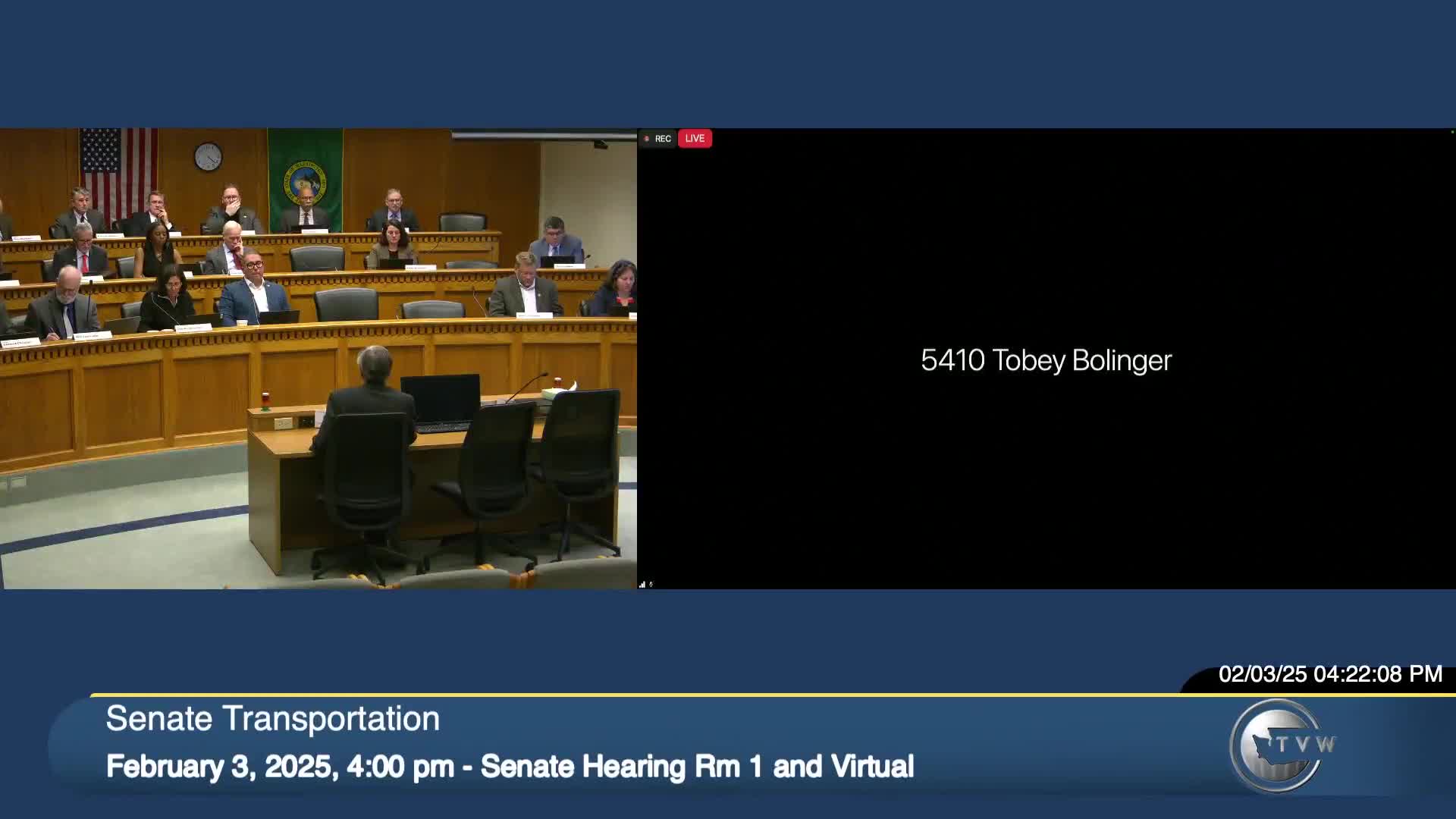
Dave Katterson, coordinator for the Joint Transportation Committee, told the Senate Transportation Committee on Feb. 3 that the JTC completed four studies in 2024 and is pursuing several additional projects through mid‑2026.
Dave Katterson, coordinator for the Joint Transportation Committee (JTC), briefed the Senate Transportation Committee on Feb. 3 about the JTC’s 2024 activities and ongoing studies.
Katterson described four studies completed in 2024. The first produced proposed legislative draft language and an implementation plan for a more workable public‑private partnership (P3) framework and assessed whether P3s could be used for culvert replacements at state ferry terminals. The second examined the feasibility and estimated costs of a statewide household travel survey (household‑level travel diaries) and concluded a statewide effort would be expensive — consultant estimates ranged broadly from about $1.9 million to $8.8 million per biennium, with a midrange of roughly $3.2–$3.4 million per biennium for an adequate sample. The third study, requested by the Association of Washington Cities, analyzed a retail delivery fee and presented a revenue model that showed a 30‑cent per order fee could generate an estimated $45 million to $112 million per year in 2026 depending on exemptions; initial Department of Revenue implementation estimates of start‑up costs were presented. The fourth was a SARA (Statewide Assessment of Reduction Analysis) tool to measure emissions reductions and equity benefits of vehicle fuel conversion projects; Katterson said phase 1 (tool development) was complete and phase 2 (implementation planning with agencies) was in progress and expected to wrap up by June.
Katterson also listed other active projects: reviewing WSDOT project delivery methods to reduce costs and timelines; a trans‑oriented development (TOD) study covering selected cities; local project delivery streamlining; an analysis of what it would take for Washington to adopt berth emission standards for ocean‑going vessels similar to California’s CARB rules; and an independent legislative review tied to potential changes at the lower Snake River dams (with WSU’s freight institute) scheduled through 2026.
He noted the JTC plans a September tour and will update study catalogs and meeting schedules on the JTC website. Committee members asked clarifying questions about SARA phase 2 timing and technical treatment of charging station costs in that tool.