Get Full Government Meeting Transcripts, Videos, & Alerts Forever!
Get email alerts on the Assaults Behavioral Health topic
No spam. Unsubscribe anytime.
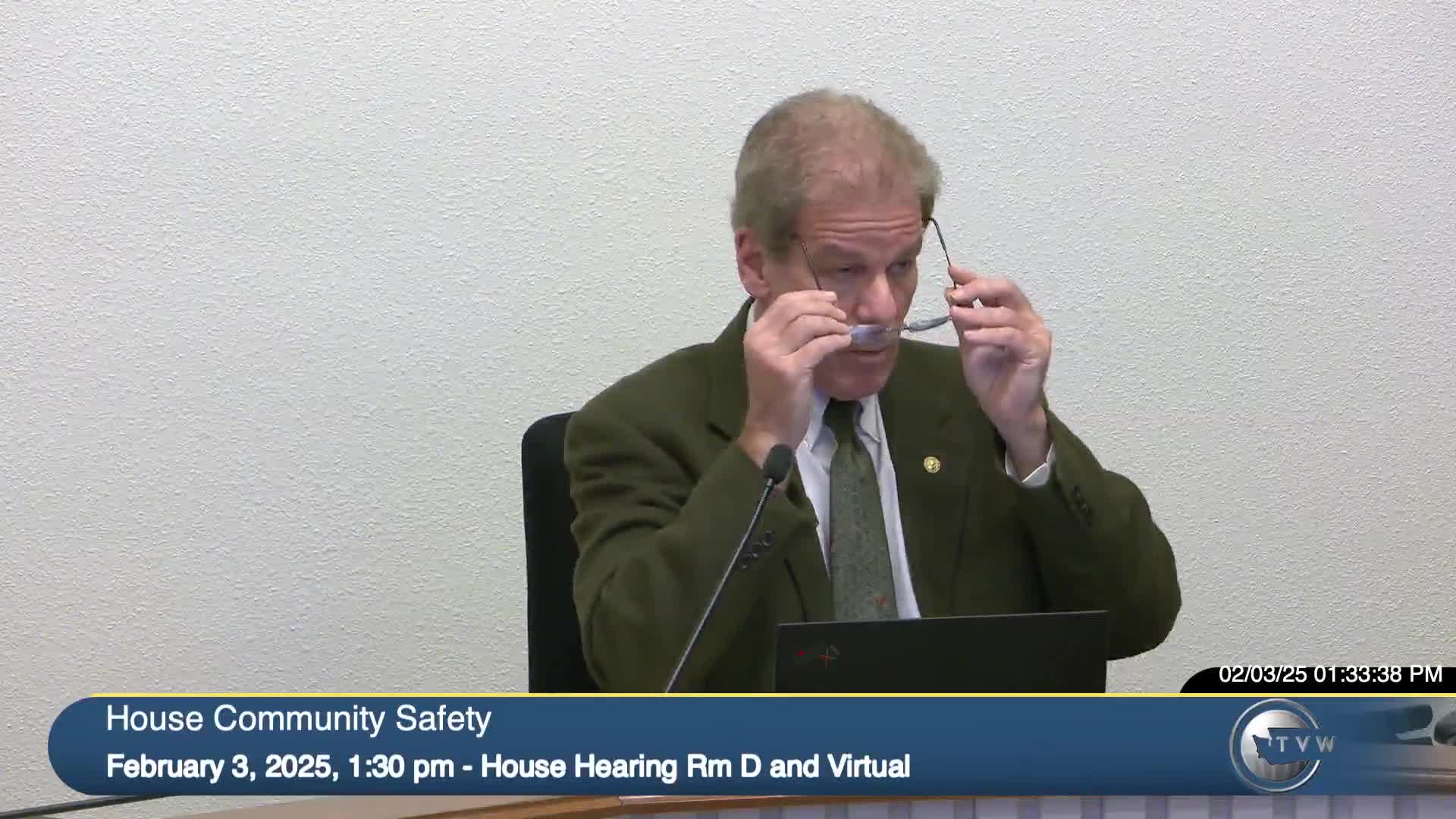
Committee hears bill to except behavioral-health patients from felony upcharge for assaulting health workers
Summary
The Community Safety, Justice & Reentry Committee heard testimony Feb. 3 on House Bill 1220, a measure that would create an exception to the third-degree assault felony enhancement for people who assault health-care workers while detained, under evaluation for detention for behavioral-health disorders, detained for behavioral-health treatment, or receiving or seeking voluntary inpatient behavioral-health treatment.
The Community Safety, Justice & Reentry Committee heard testimony Feb. 3 on House Bill 1220, a measure that would create an exception to the third-degree assault felony enhancement for people who assault nurses, physicians or other health-care providers while they are detained, under evaluation for detention for behavioral-health disorders, detained for behavioral-health treatment, or receiving or seeking voluntary inpatient behavioral-health treatment.
The bill’s prime sponsor, Representative Daria Farovar, said the change is narrow and intended to address what she called a harmful pattern in which people in acute behavioral-health crisis are charged with higher-degree felonies and then diverted into competency restoration systems. "What we're trying to do with this bill is really take a scalpel to our assault 3 laws and take a narrow look at folks who we already know are not doing well," Representative Farovar said. She cited pre-pandemic data showing about 40% of people arrested on an assault-3 charge in a health-care setting later entered competency proceedings.
Supporters said the current felony upcharge does not reduce workplace violence when it is applied to people experiencing psychosis or related crises. Kimberly Mozaff, who described herself as plaintiff counsel in the Trueblood litigation and former Disability Rights Washington staff, testified in support and said her organization's 2020 investigation and subsequent reporting found that the felony upcharge often pushes people out of treatment and into jails and backlog-prone competency systems. "This practice is harming the patients and it's undermining our goals of reducing recidivism and effectively stabilizing very sick people," Mozaff said.
Katie Hurley of the King County Department of Public Defense and Todd Carlisle of Disability Rights Washington also testified in support. Hurley said felony prosecution stalls treatment and often leads to costly, ineffective jail or competency outcomes: "A felony criminal prosecution does not provide the person suffering from mental illness access to needed treatment," she said.
Opponents voiced workplace-safety concerns. Justin Gill, an ARNP and president of the Washington State Nurses Association, said that nurses face the highest rates of workplace violence and that some patients are "fully aware of the decisions that they're making in that moment." Dr. Ryan Kaye, an emergency physician with the Washington chapter of the American College of Emergency Physicians, testified in opposition and described personal incidents of assault in emergency settings. Russell Brown, executive director of the Washington Association of Prosecuting Attorneys, said the statute communicates societal values about harm to caregivers and cautioned against blanket reductions in penalty because deterrence and other sentencing objectives are part of the law’s policy.
Witnesses from labor and advocacy groups described their internal discussions about the bill. Lindsey Grama, speaking for SEIU Healthcare 1199NW, said health-care workers ultimately supported the narrow exception after learning that felony charges would still be available when appropriate and that the bill would not prevent officers or employers from calling police or seeking criminal charges.
Committee members asked how the bill would apply in different fact patterns. Representative Griffey, who said he has been assaulted in course of medical duties, asked how the bill would affect charging and whether charging recommendations should be modified. Farovar and witnesses clarified the measure targets conduct by people already in the pipeline for involuntary or competency-related evaluation (the transcript references 1077 and ITA proceedings) and would not cover an ordinary assault in an ER by someone not in those proceedings.
The public hearing on HB 1220 concluded after testimony from advocates, health-care representatives, prosecutors, defense counsel and people with lived experience; the committee did not take immediate action at the hearing.
Ending: The committee held a public hearing but took no formal vote on HB 1220. The bill drew testimony across a spectrum — legal advocates and defense counsel focused on reducing unnecessary felony processing for people in crisis, while nurses and emergency physicians emphasized workplace safety and the need for protective measures and staffing improvements. Further refinements and technical questions were left to staff and sponsor discussions going forward.