Get Full Government Meeting Transcripts, Videos, & Alerts Forever!
Get email alerts on the Veterans Parking topic
No spam. Unsubscribe anytime.
Committee hears bill to allow certain veterans who use service animals to access special parking
Summary
Senate Bill 5410 would authorize veterans with a 70% service‑connected disability rating who use a service animal to apply for special parking privileges; veterans and nonprofit trainers testified in favor, describing safety risks for service animals in standard parking spaces and the program’s potential benefits.
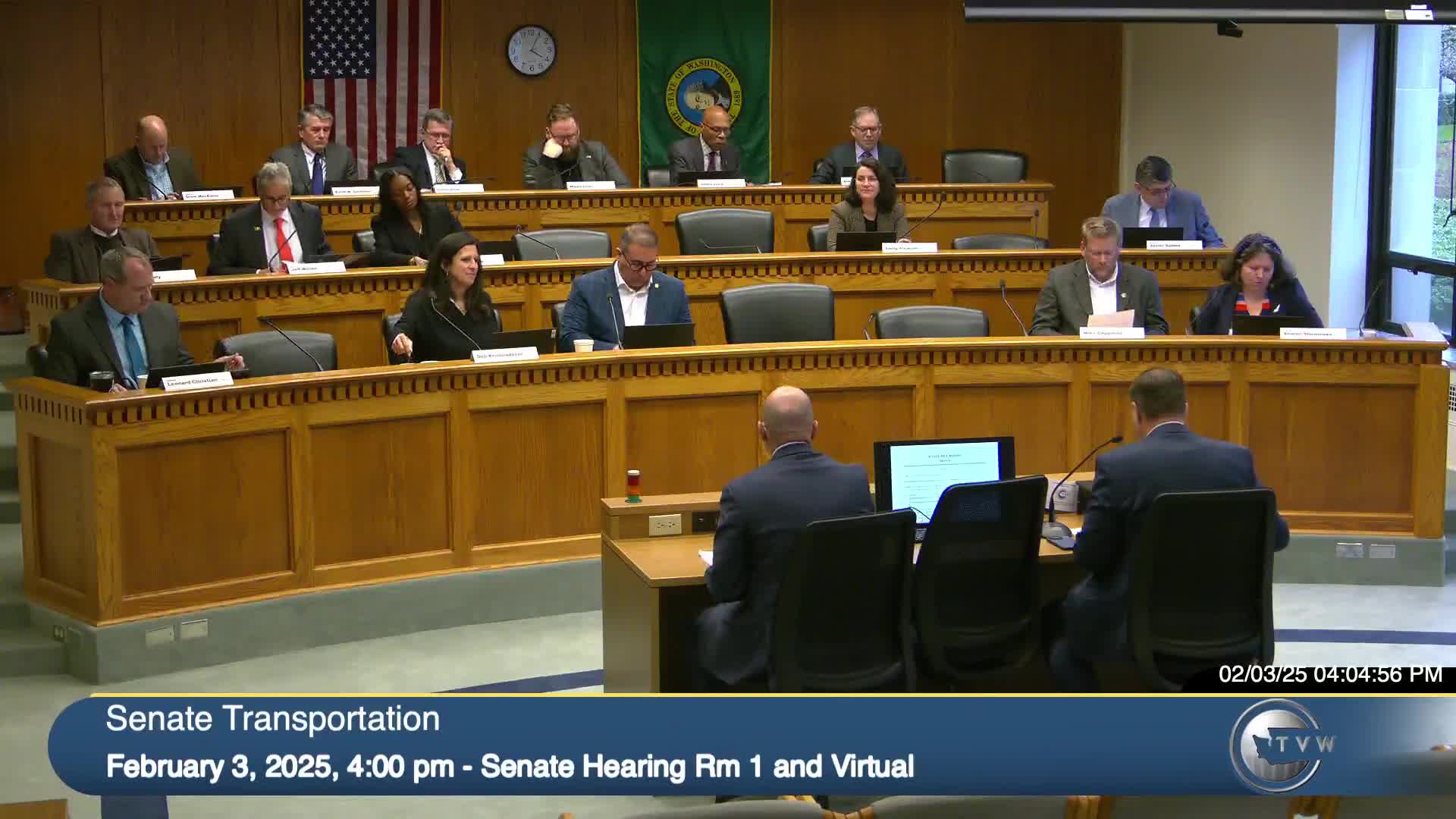
Senate Bill 5410, presented to the Senate Transportation Committee on Feb. 3, would permit veterans with a 70% service‑connected disability rating and who use a service animal to apply for special parking privileges through the Department of Licensing.
Brandon Popovac, committee staff, described the bill’s mechanics: a person who meets certain disability criteria may apply for special parking privileges and receive special license plates or parking placards at no cost, and current statute requires renewal at least every five years. Popovac said the bill would add veterans who have a 70% disability rating from the U.S. Armed Forces or the U.S. Department of Veterans Affairs and who use a service animal. He said the fiscal note lists more than $100,000 in one‑time costs and minimal ongoing costs for the Department of Licensing to process additional applications.
Sponsor Sen. John Braun said the intent is narrow: “It simply allows folks who have a 70% — at least 70% — and service animals that actually help them with that disability.” He told the committee that the change could be fixed to read “at least 70%” if the language requires clarification.
Public testimony in support followed. Dan Regester of K9 Cavalry, a Washington nonprofit that trains service dogs, told the committee that many service animals face safety hazards in standard 96‑inch parking spaces and described the cost of training as high: “Our service dogs sometimes can take $50,000 or more just to train,” he said, arguing that wider parking spaces (120 inches versus 96 inches) reduce injury risk. Alan Acosta of the Veterans Legislative Coalition summarized prevalence figures cited to the committee — including an estimate that more than 100,000 Washington veterans have a service‑rated disability above 70% — and said the bill “will go a long way in supporting our disabled veterans and the use of service animals.”
Several veterans gave first‑hand accounts. Toby Bollinger and Scott Bigger described near‑misses and injuries to older service dogs caused by limited space between vehicles and other parking‑lot hazards.
The public hearing for SB 5410 closed after multiple supporters spoke; no formal action or vote was recorded during the Feb. 3 session.