Get Full Government Meeting Transcripts, Videos, & Alerts Forever!
Get email alerts on the Resale Certificates Cics topic
No spam. Unsubscribe anytime.
Committee hears changes to condo resale certificates; hearing suspended amid internet outage
Summary
House Bill 1500 would add disclosure requirements and limit fees charged for resale certificates in common interest communities; a proposed substitute adds agent liability and an owner enforcement right. The hearing was paused when the committee lost internet access and will be continued.
The House Committee on Housing on Feb. 3 opened a hearing on House Bill 1500, which would revise statutory resale-certificate requirements for units in common interest communities, including condominiums and homeowner associations, and make related changes as Washington transitions to a single Uniform Common Interest Ownership Act.
Audrey Vaisik, staff to the committee, told members that currently four statutes govern residential common interest communities but that effective Jan. 1, 2028 the older statutes will be repealed and the Washington Uniform Common Interest Ownership Act (staff acronym: WICIWA) will apply to all common interest communities. Vaisik summarized key proposed changes in HB 1500: additional records to be included in resale certificates; limits on what a reasonable preparation charge may include; separate billing for copying required documents; requirement that certain documents be provided electronically at no cost; protection for purchasers from liability for undisclosed alterations the association should have known about; and revisions to contract-cancellation timing when certificates are not provided on time.
Vaisik described current statutory limits on fees in the resale-certificate process: associations may charge up to $2.75 to prepare a resale certificate and up to $100 to update a resale certificate within six months of the original request. She also said a purchaser may cancel a purchase contract until five days after the resale certificate is provided or until conveyance, whichever occurs first. Vaisik said a proposed substitute retains these provisions and adds language making an authorized agent who charges a fee for a certificate liable for fees, timeliness, accuracy and completeness; the substitute also authorizes a unit owner to bring an action to enforce certificate requirements.
Representative Julie Reid, sponsor of the proposed substitute, said the bill is aimed at parity and transparency for condo buyers and to curb excessive fees charged by management companies. "This bill is really just about some basic fairness and transparency," Reid said, noting that many resale-certificate items are available electronically and that the bill would restrict fees charged for documents that are already part of the certificate.
Bill Clark of Washington Realtors testified in support and emphasized the importance of timing for buyers. "For the buyer, that information is pretty critical in terms of what, in fact, they are buying into and how that relates to the timing of the transaction," Clark said. He said the bill's timing clarifications would help consumers.
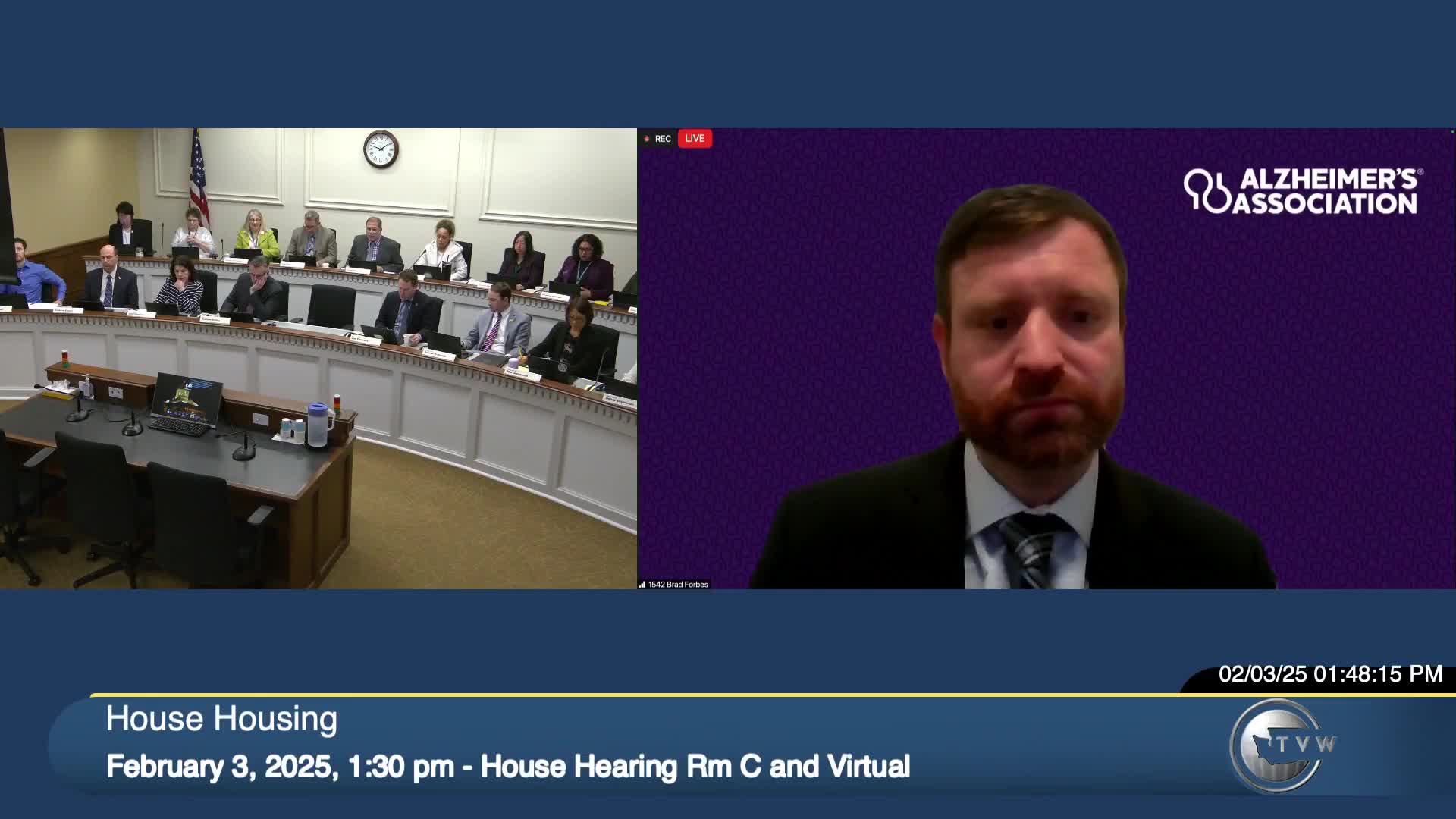
The hearing was interrupted by a campus-wide internet outage that disabled remote testimony and streaming on TVW. The committee suspended the HB 1500 hearing while staff worked to restore connectivity; no final action or vote occurred. The committee later suspended action on the bill pending reconvening and allowed for written testimony from those who could not appear when the hearing resumes.
Committee staff and the sponsor indicated openness to technical fixes and stakeholder-driven amendments, including work on draft-document liabilities and exceptions for unit owners who store records only in non-electronic formats.
No vote was taken. The hearing will be resumed at a later date when technology allows.