Get Full Government Meeting Transcripts, Videos, & Alerts Forever!
Get email alerts on the Cte Dual Credit topic
No spam. Unsubscribe anytime.
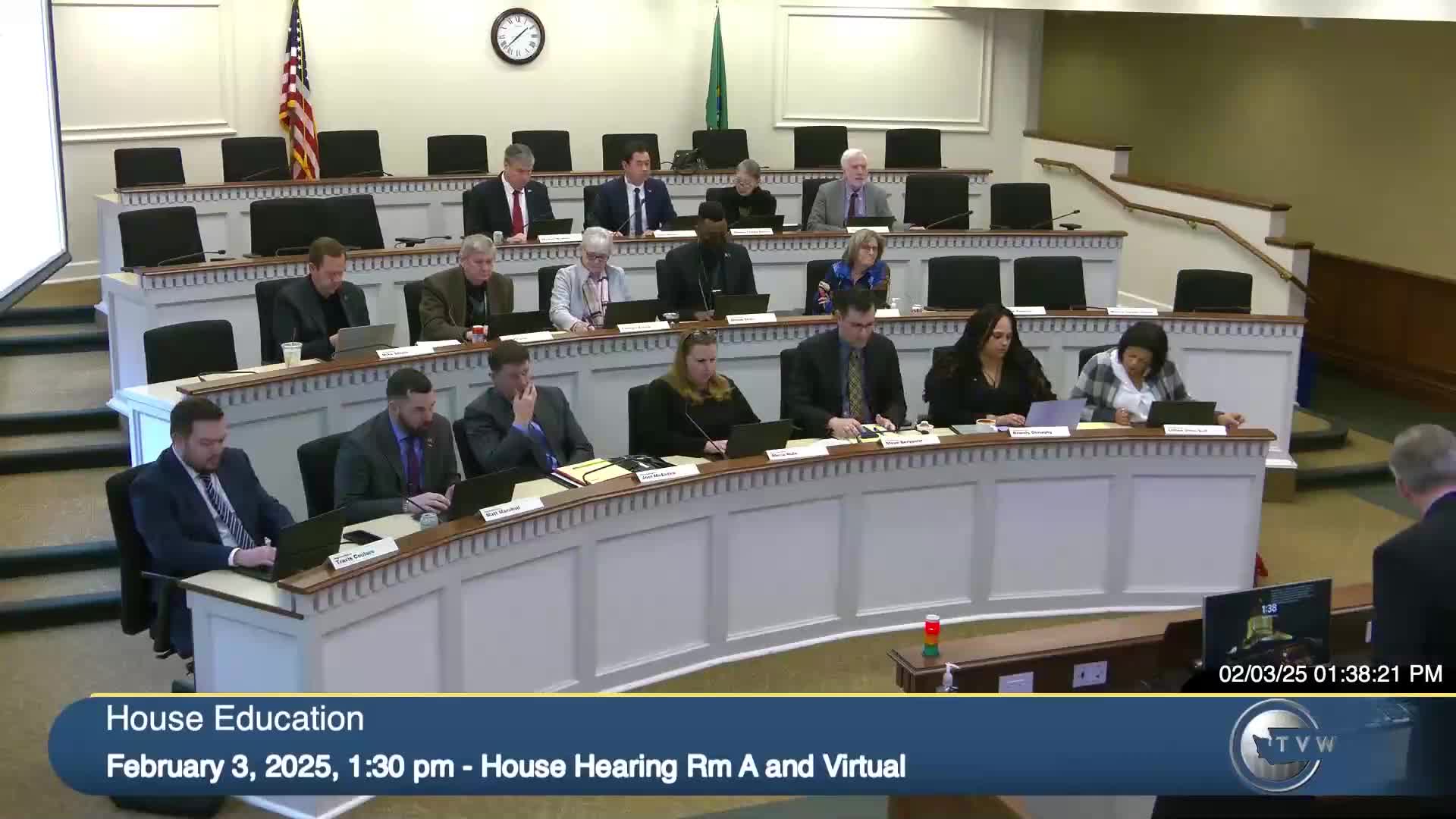
Lawmakers consider bill to streamline Career and Technical Education dual-credit transfer and data systems
Summary
House Bill 1273 would direct Educational Service Districts, SBCTC, OSPI and local partners to streamline CTE dual-credit courses, statewide articulation agreements, and student-record systems so credits earned in high school transfer to postsecondary programs.
House Bill 1273 would direct a statewide effort to improve Career and Technical Education (CTE) dual-credit access, articulation and tracking so students earning college-equivalent CTE credits in high school can apply them toward postsecondary credentials.
Megan Wardacki, counsel to the committee, summarized the bill’s four parts, telling members HB 1273 requires Educational Service Districts (ESDs) to coordinate regional efforts with the Office of Superintendent of Public Instruction (OSPI), the State Board for Community and Technical Colleges (SBCTC), community and technical colleges, skill centers and local districts. The statute would encourage, and SBCTC would publish, statewide articulation agreements for the most common CTE dual-credit courses and produce a multi-year workplan. The bill would also direct SBCTC to plan improvements to statewide tracking and transcription systems and require reports to the Legislature on implementation.
Representative Dave Paul, the bill’s sponsor, said the majority of dual-credit participation statewide is through CTE programs but that many of those credits do not transfer meaningfully to students’ postsecondary programs. "Many of those credits are just not transferring," Paul said. He described the bill as a way to align high school CTE offerings with college and apprenticeship pathways so students can move smoothly into in-demand careers.
Students, regional partners, and system leaders testified in support. Sienna Girard, a former Running Start student, recounted earning an associate degree while in high school and encountering an outdated list of eligible CTE options at her college. "Having an updated list of available programs for CTE credit... is essential," she said. State and regional education leaders described pilot work and existing partnerships: Jenny Beltre of Career Connect Northwest outlined regional successes and a community-of-practice; William Belden of the SBCTC described plans to continue pilot efforts and develop technology supports; Vicki Hurdina (ESD 112) detailed a rural student who earned articulated credits without clear notice or transcription, noting only about 3% of CTE dual-credit courses in high school were transcribed into college-bearing credit in her region.
Witnesses asked the committee to preserve resources for administrative staff to support articulation, create centralized technical tools, and maintain pilot sites while scaling best practices. Several speakers emphasized equity: CTE dual credit attracts a more socioeconomically and racially diverse cohort than some other dual-credit pathways and can lower college costs if credits transfer.
Committee members did not take final action; the hearing closed with the bill remaining under consideration.