Get Full Government Meeting Transcripts, Videos, & Alerts Forever!
Get email alerts on the Property Tax topic
No spam. Unsubscribe anytime.
Senate narrows homeowner property-tax cut after daylong debate; key amendments split and two fail
Summary
The Wyoming Senate considered Senate File 69, a homeowner property-tax exemption, through multiple amendments and hours of debate. Lawmakers rejected removing a sunset, adjusted the size and scope of the exemption and approved a 25% reduction amendment. Several amendment roll-call tallies were recorded; the bill was ordered to third reading.
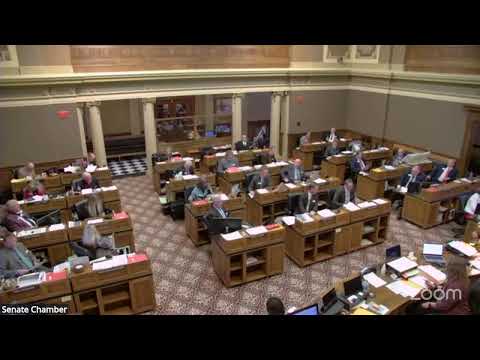
The Wyoming Senate debated Senate File 69, a homeowner property-tax exemption proposal, through multiple amendments on Jan. 31, 2025, ultimately adopting a scaled-back change and returning the measure for third reading.
Senate File 69 would provide residential property tax relief by exempting a share of assessed value; the body spent more than an hour on competing amendment packages that would change the level, duration and county-specific effects of the exemption. The Senate voted on four recorded second-reading amendments: two failed and two were adopted, and senators repeatedly raised concerns about interaction with a pending ballot initiative and local budgets.
The core dispute centered on whether to remove a sunset provision that would make the bill’s reduction permanent. Senator Scott, the sponsor of the initial amendment to remove the sunset, argued removal was necessary to signal a long-term commitment: "With the sunset date in there, what we're communicating to the taxpayers is that this is just a temporary one-time tax cut," he said on the Senate floor, urging colleagues to adopt the amendment. The motion to remove the sunset failed on a roll call: 9 ayes, 21 no, 1 excused.
Senators opposed to removing the sunset said the change could preclude later legislative adjustments and complicate relations with a likely voter-initiated measure. Senator Hicks, arguing against removing the sunset, said the Senate should "come back and say, in context of all this other stuff, where are we at? We need to be able to make informed decisions on all of these other things we've already done." Several senators urged cautious, phased changes so counties and special districts could adapt.
After the failed sunset motion, senators considered county-targeted and funding-balance amendments. Senator McEwen offered a committee-of-the-whole amendment (second-reading amendment 2) that prohibited an individual from taking both the relief in Senate File 67 and Senate File 69; that amendment passed by voice vote. Senator Steinmetz proposed an amendment intended to protect smaller counties by setting an assessed-valuation cutoff; that amendment (second-reading amendment 3) failed on roll call, 10 ayes, 20 no, 1 excused.
Senator Bridal then offered a compromise that reduced the exemption to 25% (second-reading amendment 4). Supporters framed 25% as a balancing measure that would grant relief while preserving local services. Senator Bridal said a lower rate would help avoid forcing deeper cuts to hospitals, fire and police services: "We can't afford to lose another hospital," she warned. After debate, the Senate adopted the 25% amendment, 19 ayes, 12 no.
Senator Steinmetz summarized cost estimates tied to one amendment, saying, "that would give us about $70,000,000 we're giving back and over 1 year. So for the biennium, it would be a 100,000,000 out of the general fund and 50,000,000 out of the LSRA." Several senators referenced competing policy actions already enacted this session or passed previously, including veteran exemptions and caps, and noted the presence of an already-passed constitutional amendment and a separate initiative likely to appear on a future ballot.
Following the amendment votes the Senate returned the bill to second-reading status and ordered it read a third time without objection. Record votes on key amendments (sunset removal; county-targeting; and the final 25% amendment) are in the actions section below. The bill remains subject to further floor action on third reading.
Why it matters: Property-tax changes affect school funding, municipalities, hospital districts and other local services, and the bill prompted sustained debate over immediate relief for homeowners versus the fiscal impacts to local governments and the state budget.
What’s next: The Senate ordered the bill to a third reading; further floor votes are expected when the Senate advances third-reading items.