Get Full Government Meeting Transcripts, Videos, & Alerts Forever!
Get email alerts on the Historic Preservation Tdr topic
No spam. Unsubscribe anytime.
Commission adopts TDR program to help preserve downtown historic buildings
Summary
Commission approved a transfer-of-development-rights program in the comprehensive plan and zoning code to let owners of designated historic properties sell unused density or buildable square footage to certain downtown receiving sites; both ordinances passed unanimously.
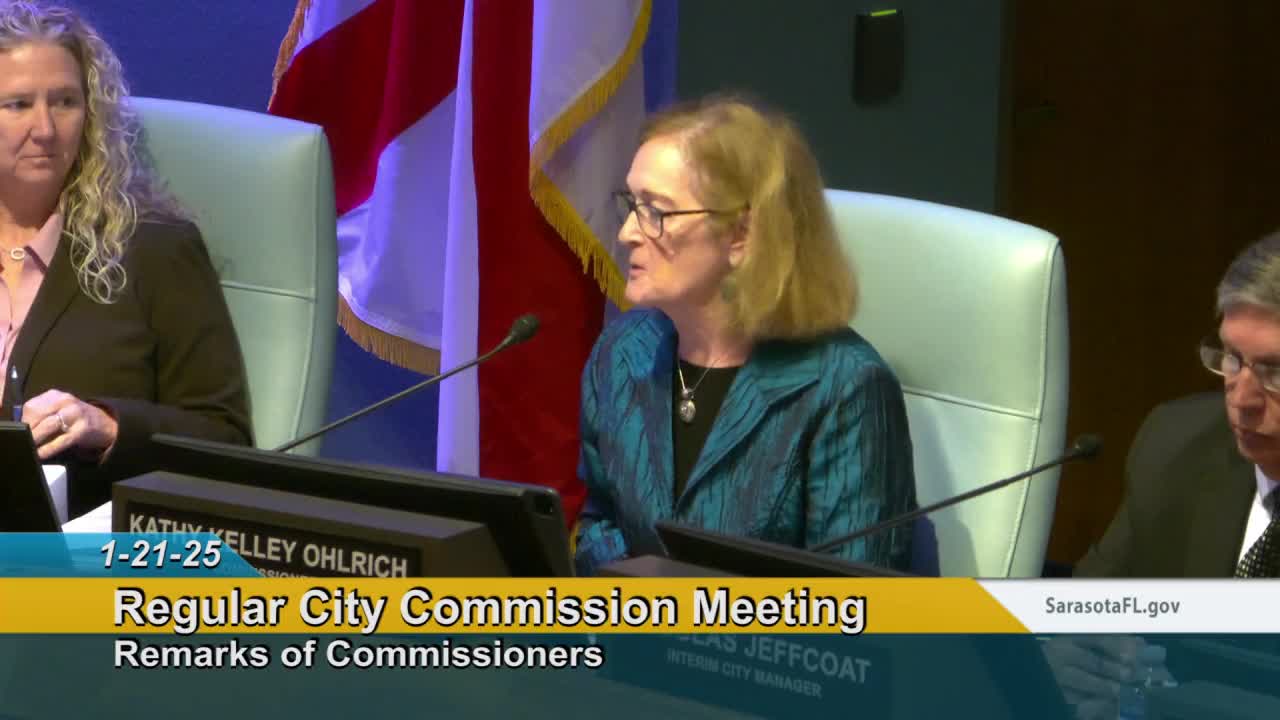
The Sarasota City Commission on Jan. 21 unanimously adopted a two-part package to create a historic preservation transfer-of-development-rights (TDR) program aimed at preserving key downtown buildings while allowing development capacity to move to designated receiving areas.
Planning director Steve Cover and senior staff said the program is voluntary and limited to a downtown area of about 1,221 acres. Under the adopted plan and zoning changes, owners of "designated historic buildings" — defined to include locally designated properties, contributing structures in local or national districts and certain eligible non-contributing downtown buildings — may sell unused density (dwelling units) and/or unused buildable square footage to developers in receiving zones.
Chief planner Brianna Dodds described the mechanics: a designated historic building would get a TDR zoning confirmation letter that quantifies the transferable units or square footage. Those rights would be listed in a public TDR registry. A future receiving-site application would include a sending/receiving agreement, a preservation restrictive covenant and a maintenance plan. When approved, the transfer is severed from the sending site and recorded in the county records. "Additional height for a receiving site is available only when buildable square footage is transferred," Dodds said; receiving sites may gain up to two extra stories under the adopted text.
The ordinance retains the downtown bayfront area as a density-receiving zone but bars additional height there. The commission declined a planning-board recommendation to allow receiving-site height increases of up to four stories in the downtown core; staff had recommended a two-story cap. The zoning amendment ties the density bonus to existing comprehensive-plan language and makes buildable-square-foot transfers a one-to-one swap.
Erin DeFazio, program director of the Sarasota Alliance for Historic Preservation, praised the program as a community-driven tool that will incentivize preservation. She asked staff to adopt a preservation covenant form modeled on Miami—s template rather than the Saint Petersburg example used in the backup materials, saying Miami—s form better matches Florida law and includes demolition prohibitions, maintenance requirements and a requirement to follow the Secretary of the Interior—s standards.
Brianna Dodds said covenant language will be developed as part of the application process and recorded with the county; staff and Alliance representatives will continue to refine the covenant form before individual transfers are recorded.
Both ordinances passed on a unanimous vote. The comprehensive-plan amendment (Ordinance 25-5557) was adopted and transmitted as required; the zoning text amendment (Ordinance 25-5556) establishing the TDR overlay district was also adopted with the two-story height limit for transfers.