Get Full Government Meeting Transcripts, Videos, & Alerts Forever!
Get email alerts on the Local Replacement Formula topic
No spam. Unsubscribe anytime.
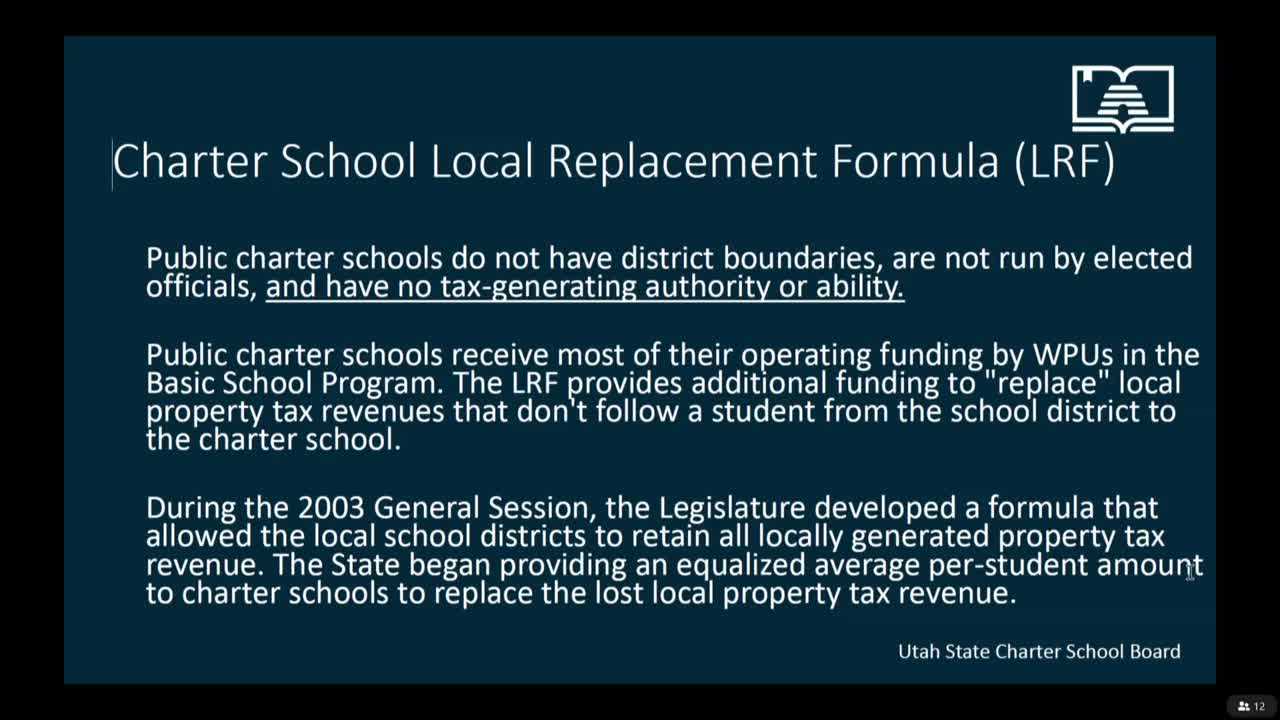
Staff explains charter local replacement formula as funding rises for 2026
Summary
Analysts detailed how Utah's charter school local replacement formula works, the recent formula changes, and why the per-student replacement rate rose to about $3,628 for fiscal year 2026—driven by property tax collections and a two-year data lag.
State education financial analysts provided the committee a technical briefing on the charter school local replacement formula, the state mechanism that replaces local property tax revenue for charter students.
Ben Leshman, a financial analyst, and others traced the formula's evolution from a transfer-based approach to the current state-funded model that equalizes property-tax replacement statewide. "The formula provides three averages: district property tax per student, a statewide debt-service average, and then a total average per charter school student," Leshman said.
Nut graf: The formula converts district-level property-tax receipts into a per-student replacement rate applied to charter enrollment. Leshman said the current calculated replacement rate before recent adjustments was about $3,579; a legislative $4 million appropriation to reduce a two-year data lag raised the 2026 rate to $3,628 per charter student. Total state cost using that rate was presented as about $30.29 million, with districts required to pay 25% of step 1 (district per-pupil local revenue) into a restricted fund that offsets the total.
Leshman explained the five-step statutory calculation: (1) compute district per-pupil local revenue from voted boards and capital levies plus equalization funds, (2) compute the charter students' weighted average of those district amounts, (3) add a statewide average debt-service amount, (4) create the local replacement rate, and (5) multiply by charter enrollment to get total cost. He noted a two-year data lag driven by property-tax reporting and that the formula excludes district expenditures for certain community facilities, such as recreation centers.
Committee members asked about equity differences between charters and districts. Representative Miller and others asked whether equalizing revenue to a statewide average benefits charters at the expense of some low-tax districts. Leshman said full equalization would be costly and that policy judgments remain about acceptable equity levels. Representative Miller also asked if charter enrollment growth triggers additional WPUs during the year; Leshman said school-by-school projections and October verification are used, and funding is adjusted if enrollment differs from projections.
Ending: Leshman and staff said the formula is complex and produces varying effects by district; legislators and stakeholders discussed whether further equalization or changing the statutory 25% district share should be pursued in future policy work.