Get Full Government Meeting Transcripts, Videos, & Alerts Forever!
Get email alerts on the Healthcare Cancer Research topic
No spam. Unsubscribe anytime.
University of Utah requests $65 million bond for Huntsman Cancer Institute Vineyard campus
Summary
University of Utah leaders asked the Transportation and Infrastructure Appropriations Subcommittee to authorize bonding of $65 million to help complete phase 1 of a new Huntsman Cancer Institute campus in Vineyard, citing patient travel reduction and a $400 million first-phase price tag.
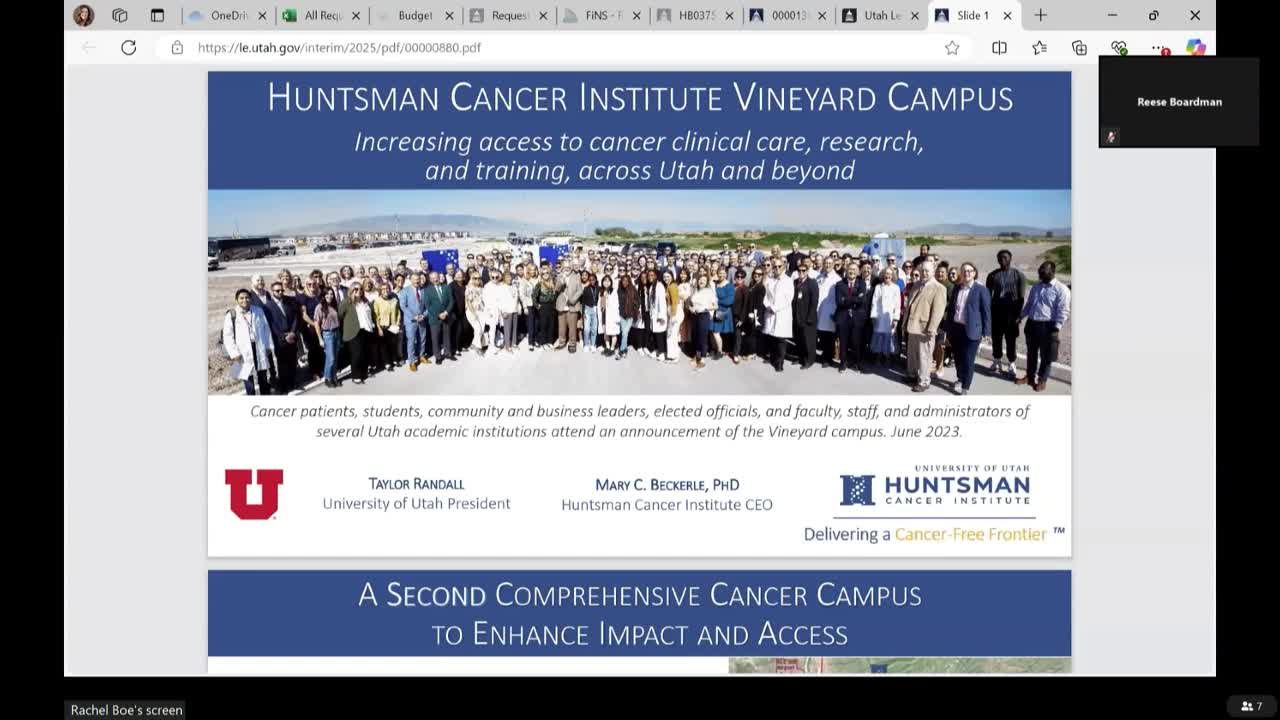
Taylor Randall, president of the University of Utah, told the Transportation and Infrastructure Appropriations Subcommittee on Feb. 3 that the university is requesting authorization to issue $65,000,000 in bonds to expand the Huntsman Cancer Institute into Utah County with a new Vineyard campus. "We are coming to, request bonding of $65,000,000 to expand the Huntsman Cancer Institute into Utah County to what we are calling our Vineyard Campus," Randall said.
Mary Beckerle, chief executive officer of the Huntsman Cancer Institute, detailed planning and fundraising progress. She said the project has completed programming and schematic design, selected a contractor and begun site work for utilities and roads. "We are building a second comprehensive cancer campus in Utah County to meet the growing needs of our population, our existing patients, as well as anticipating the rapid growth in our state and region," Beckerle said, and she invited committee members to a celebratory groundbreaking on April 8.
Beckerle told the committee the first phase of the Vineyard campus covers a 20-acre site and combines a research facility and a clinical care facility. She said the clinical program was designed after mapping more than 40,000 patient visits from Utah County and adjacent southern counties; the Vineyard clinical program is intended to eliminate about 80% of the trips those patients now make to Salt Lake City for care. The phase‑1 cost is $400,000,000.
Funding described in the presentation included a prior state appropriation of $75,000,000 for a research building, $100,000,000 in lead gifts, $35,000,000 in support for land and a committed minimum of $125,000,000 from the Huntsman Cancer Foundation. The presenters said the requested $65,000,000 bonding authorization would cover a remaining balance that will be met with additional philanthropy or debt as required.
Committee members asked about the repayment source for bonding and the role of donations. Representative Kristofferson asked whether operations revenues would repay any bonds; Beckerle replied repayment would come from operations revenues. Members also asked what portion of the project has come from donations; presenters answered that philanthropy provides a substantial share, including a $75,000,000 matching gift from the Huntsman family and other major donors.
No formal committee action on the bond authorization was recorded in the transcript; the item was presented as a funding request for the committee's consideration.