Get Full Government Meeting Transcripts, Videos, & Alerts Forever!
Get email alerts on the Ethics topic
No spam. Unsubscribe anytime.
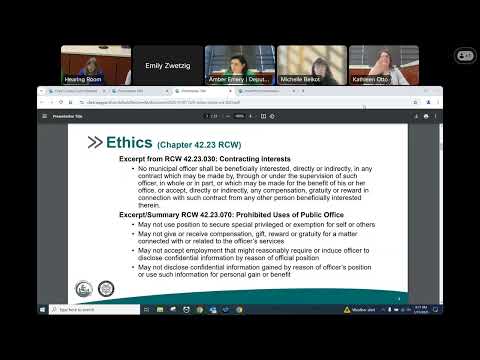
Clark County briefing stresses conflict-of-interest rules, gifts limits and independent ethics commission
Summary
County legal staff reviewed Washington ethics law (RCW 42.23), the county charter’s friends-and-family rules, the Ethics Review Commission process and practical steps officials should take to avoid conflicts of interest and disclosure problems.
Clark County legal staff told council members that state ethics law (RCW chapter 42.23) and the county charter prohibit officials from entering into county business that creates a private financial benefit and emphasize strict limits on nepotism and gifts. "Don't do business with the county," the presenter said, adding that council members should avoid transactions that could be construed as assisting people with whom they have financial relationships.
The training explained why appearance and process matter. The presenter said small office gifts shared by everyone are generally acceptable, but larger, targeted gifts or hospitality from people who have business before the county create risk and should be declined or cleared with staff. "It is better to mention it to us than to see it on the front page of The Columbian," the presenter said.
County and state rules: why it matters
The presenter pointed to RCW chapter 42.23 as the baseline for state ethics restrictions and noted the county charter includes a friends-and-family nonemployment provision that can be stricter than state law. The county charter also established an Ethics Review Commission in an amendment; the presenter said the commission has operated since 2022 and is a three-member panel that receives, investigates and can hold hearings on complaints. The presenter said there have been roughly a dozen complaints since the commission was created and only one proceeded to a public hearing after investigation.
Practical guidance offered included asking staff for advice before hiring, contracting, or accepting gifts, and keeping county business on county systems when possible. The presenter warned that some statutory violations carry civil fines (up to $500 was mentioned) and can be grounds for removal from office; she urged officials to consult county legal staff or HR before taking actions that could create a perception of impropriety.
How complaints are handled
The presenter described the Ethics Review Commission as independent of council and county management, receiving assistance from the county manager’s office and HR but operating separately. When complaints create conflicts for in-house attorneys, the commission typically obtains outside counsel, and the county has used special deputization to bring an independent attorney on as needed.
Ending
Council members asked for clarification on gift limits (one council member referenced an online training that said a $20 limit applied twice in 12 months). The presenter acknowledged differing recollections about dollar thresholds for gifts and advised that, when in doubt, officials should avoid accepting gifts tied to county business and consult legal staff or HR for case-specific guidance.