Get Full Government Meeting Transcripts, Videos, & Alerts Forever!
Get email alerts on the Transit Funding topic
No spam. Unsubscribe anytime.
Clark County councilors press C TRAN on who would pay $20M-a-year light-rail operating costs
Summary
Clark County Council held a work session on C TRAN operations and potential costs tied to the Interstate Bridge replacement (IBR) project, where transit staff laid out an estimated $21.8 million annual increase in operations-and-maintenance costs and described funding options that could be used to cover Washington’s share.
Clark County Council held a work session on C TRAN operations and potential costs tied to the Interstate Bridge replacement (IBR) project, where transit staff laid out an estimated $21.8 million annual increase in operations-and-maintenance (O&M) costs associated with the project and described local funding options that could be tapped to cover Washington’s share.
C TRAN Deputy Chief Executive Officer Scott Peterson said the IBR locally preferred alternative adopted in 2022 initially prohibited C TRAN from paying light-rail O&M costs, with one exception for station security. Peterson told the council the C TRAN board amended that language in November and the board will reconsider the change at its March meeting.
The modification matters because C TRAN has remaining voter-approved sales-tax authority — up to 0.9 percent under state law — and staff said the agency has 0.2 percentage points of that authority available. "For every one-tenth [of a percent] we're getting about $9,000,000," Peterson said, and using a full one-tenth could cover a substantial portion of the Washington-side O&M estimate.
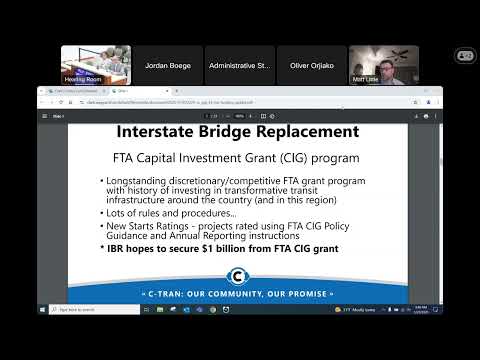
Why it matters: the FTA Capital Investment Grant (CIG) process, a key federal discretionary program that could contribute to capital costs, evaluates both project justification and local financial commitment. TriMet and C TRAN officials said FTA will review whether local agencies can sustain the additional service without compromising existing service — a factor that affects the project’s competitive rating.
TriMet planner Jeb Dorn told councilors the current modeled annual O&M total for the project is about $21,800,000 in opening-year (fiscal 2033) dollars: roughly $20,200,000 attributed to TriMet light rail and about $1,500,000 attributed to increased C TRAN express-bus service. "It's $21,000,000 in total. $20,000,000 of that is for the light rail and $1.5 is for the express bus service increases," Dorn said.
Those numbers are subject to change: staff emphasized updated ridership modeling and a revised capital-cost estimate are expected later this year. Peterson and TriMet staff said much of the transit modeling originally used a 2019 base; the program is updating that modeling and expects to submit materials for an initial FTA rating potentially as early as late 2025 or in early 2026.
How costs were split: staff described a geographic split used to apportion O&M between Oregon and Washington. For the 1.9-mile light-rail extension, TriMet staff said about 55 percent of the extension’s footprint is in Oregon and 45 percent is in Washington; for the express-bus mileage modeled, about 62 percent falls in Oregon and 38 percent in Washington. After applying estimated fare recovery, staff said the post-fare-recovery amount under discussion is about $16.4 million, which is then allocated using those geographic splits.
Capital and fleet assumptions: staff said the program’s current capital estimate for the light-rail component is roughly $1.8 billion to $1.9 billion. The draft EIS service plan that informed the O&M estimate assumes about 19 light-rail vehicles would be required to support the defined level of service; TriMet and C TRAN staff said vehicle procurement is a capital cost separate from the annual O&M figures.
Fare-recovery and ridership caveats: TriMet staff said the model used to estimate fare recovery for the extension assumed about 25 percent fare recovery for the light-rail portion; staff noted C TRAN’s current systemwide fare-recovery rate is substantially lower than that (staff said it is currently well below pre-pandemic levels and cited a figure in recent years closer to 3 percent, but said pre-pandemic recovery was around 14–15 percent). Peterson and Dorn both said updated ridership and financial modeling will be submitted to FTA this year and will change many of the current assumptions.
Local funding options discussed: C TRAN staff reviewed three legal routes available under Washington law: - Use the agency’s remaining two-tenths (0.2%) of voter-approved general transit sales-tax authority (C TRAN currently levies 0.7% and may go to 0.9%). Staff estimated roughly $9 million per one-tenth of sales tax revenue based on current receipts, so 0.2% could yield in the ballpark of $18–20 million annually. - Pursue a separate high-capacity-transit sales tax under RCW 81.104 (a different, voter-approved up-to-0.9% tax specific to fixed-guideway/high-capacity projects), which can be applied regionally or to a smaller subdistrict. - Seek other state or legislative funding, though staff said the current state budget situation makes that challenging.
Council reaction and next steps: multiple councilors said they were surprised by the size of the annual O&M estimate and urged caution. Councilors asked C TRAN and TriMet to provide additional detail before C TRAN’s March reconsideration, including: per-mile or per-station breakdowns of the O&M estimate; updated ridership forecasts; current TriMet and C TRAN fare-recovery figures; the number and role of security staff and how security responsibilities would be divided; and a full list of Washington-side funding options and what each option would enable or foreclose.
Frank Green, assistant program administrator for the IBR program, described the physical design: "Light rail would be on its own dedicated guideway," and the proposed bridge and corridor work would also provide bus-on-shoulder capacity through the main corridor investments, he said.
C TRAN staff asked the council to send written questions and said the IBR program would coordinate with TriMet to return with answers. The C TRAN board’s vote to reconsider its November language is scheduled for March; councilors said they expect more briefings and asked staff to bring TriMet to future sessions for detailed answers.
No final policy decision was made at the council session. The C TRAN board’s November amendment remains in place until the board’s March reconsideration.