Get Full Government Meeting Transcripts, Videos, & Alerts Forever!
Get email alerts on the Homelessness topic
No spam. Unsubscribe anytime.
Clark County staff outline Community Action and Homeless Crisis RFAs, set April 25 scoring deadline
Summary
Clark County Community Services staff presented the county’s Request for Application processes for the Community Action Program (CAP) and the Homeless Crisis Response System (HCRS), including funding amounts, Bonfire submission and scoring procedures, applicant presentation dates and a required score submission deadline of April 25, 2025.
Clark County Community Services staff presented the county’s Request for Application (RFA) processes for the Community Action Program (CAP) and the Homeless Crisis Response System (HCRS) during a Community Action Advisory Board meeting, outlining available funds, scoring procedures and a schedule that includes applicant presentations on March 5 and April 2 and a scoring deadline of April 25, 2025.
The CAP funding pool cited by staff is approximately $284,000 per fiscal year, allocated across physical health (including dental and food assistance), income and asset‑building services, and transportation assistance. Staff explained the HCRS RFA offers roughly $4,000,000 for the fiscal year and funds program types such as rapid rehousing, permanent supportive housing (PSH), street outreach, homelessness prevention (EPRAP), temporary housing and core supports.
Why it matters: awards from these RFAs will direct county and state grant dollars to nonprofits and providers that deliver food, dental and transportation supports, eviction prevention and housing services for people who are low income or experiencing homelessness. The county’s allocations and the CAB’s funding recommendations will determine which local programs receive multi‑year contracts that are slated to begin July 1, 2025.
County staff walked CAB members through application logistics, scoring rules and the procurement portal (Bonfire). They stressed that CAP and HCRS are separate RFAs and have distinct questionnaires and scoring rubrics: some questions are subjective and scored by CAB members, while objective questions (predetermined criteria) will be scored by Community Services staff. Staff also reviewed compliance items such as HMIS reporting requirements for programs that provide direct client supports.
Kayla Williams, program coordinator for the Homeless Crisis Response System, told the board the HCRS budget estimate has already been reduced from an earlier projection: “I originally had about 20% more in funds, but the state has alerted us that we need to prepare for cuts,” she said, describing state funding uncertainty that forced a revision to the guidance documents.
Staff provided the following notable details and deadlines that CAB members will use to complete reviews:
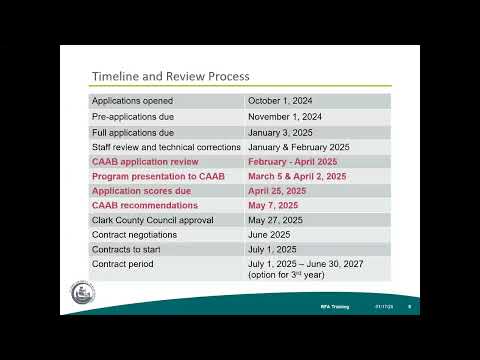
- Timeline and next steps: Full applications were due Jan. 3, 2025; staff are completing technical corrections. CAB reviewers will receive their assigned applications (in Bonfire) in February; applicant presentations are scheduled March 5 and April 2 (each applicant will have five minutes to present and five minutes for CAB questions); scores are due April 25, 2025; the CAB will make funding recommendations at its May 7 meeting; the Clark County Council will review proposed contracts May 27; awarded contracts would start July 1, 2025 and run through June 30, 2027 with an option for a third year.
- Funding highlights and limits described by staff: CAP ~ $284,000/year with a $40,000 minimum award threshold per contract to limit administrative overhead; CAP category breakdown cited in the presentation included $113,500 for physical health, $99,500 for income/asset building, and $71,000 for transportation (staff said funds may be reallocated among categories if an entire category goes unfunded). HCRS totals were described as roughly $4,000,000 for the fiscal year; staff identified $540,000 for rapid rehousing and a PSH figure presented in the slides (figure in transcript appeared garbled and should be treated as approximate in published materials). Staff emphasized that shelters already funded by the county are not always run through the competitive RFA process, but some shelters were asked to complete the HCRS application in this cycle to validate operations.
- Application volume and reviewer assignments: Staff reported 36 total applications across both RFAs. CAB members were divided into scoring groups; staff said most reviewers will score about 12 applications each and that CAB scores are averaged. Staff recommended reviewers read assigned applications before presentations, hold off final scoring until after presentations and use the guidance documents and Bonfire materials provided.
- Scoring rules and equity guidance: Staff reviewed the scoring guides (available on the County website and in Bonfire) and walked CAB members through scoring ‘through an equity lens’ and sources of scoring bias (affinity bias, halo/horns, contrast, central tendency, leniency/strictness, recency, and “worship of the written word”). Staff reiterated that subjective questions are scored by CAB members while deterministic/objective questions are scored by county staff.
CAB members raised process concerns and asked for improvements. YWCA-affiliated CAB member Britney asked that the board hold a post‑process review because she felt the five‑minute presentation format “is a little bit more performative than actually allowing time to get information and to ask substantial questions,” and requested time on a future agenda to review whether the presentation format is working.
Staff said the guidance documents and Bonfire portal will be the primary resources for scoring and that staff will send the presentation slides, guidance documents and a detailed spreadsheet indicating which applications each CAB member must score. Staff also offered to provide printed copies or one‑on‑one technical assistance for reviewers who lack Excel access.
Ending: County staff asked CAB members to start reviewing assigned files as soon as they receive them, to prepare questions for applicant presentations and to contact Community Services staff with any technical problems. Staff said they would send a follow‑up email with the slides, links to guidance documents and the Bonfire project invitations; the CAB’s next meetings associated with the RFAs are Feb. 5 (equity training), March 5 (presentations) and May 7 (funding recommendations).