Get Full Government Meeting Transcripts, Videos, & Alerts Forever!
Get email alerts on the Demolition Policy topic
No spam. Unsubscribe anytime.
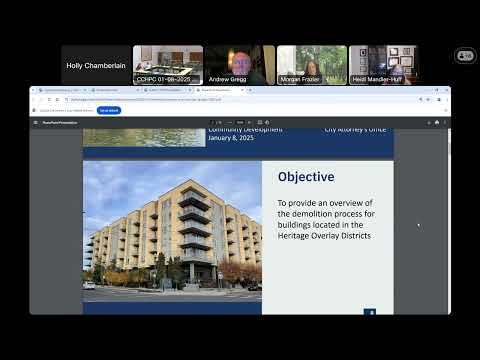
City of Vancouver staff brief Clark County Historic Preservation Commission on demolition rules for heritage overlay districts
Summary
City of Vancouver development review manager Jason Nordst told the Clark County Historic Preservation Commission on Jan. 8 that buildings in heritage overlay districts face two distinct demolition processes: an "unfit building" determination under the city building code and a demolition request reviewed under the heritage overlay rules.
City of Vancouver development review manager Jason Nordst told the Clark County Historic Preservation Commission on Jan. 8 that buildings in heritage overlay districts face two distinct demolition processes: an "unfit building" determination under the city building code and a demolition request reviewed under the heritage overlay rules.
The presentation explained that an unfit building determination follows Vancouver Municipal Code (VMC) 17.32 and is limited to life-safety conditions such as structural damage from fire, earthquake or flood. "If the building cannot be reasonably repaired, then the building official may order its demolition," Nordst said. Demolition requests for buildings that are not deemed unfit follow VMC 25.10050 and require an applicant to show that preservation is not feasible because of economic hardship.
Why it matters: the two tracks have different reviewers, different evidentiary burdens and different appeal routes. Registered buildings on the historic register are reviewed by the Historic Preservation Commission (HPC); buildings deemed "eligible" are decided by the planning official with HPC consultation; unfit determinations are made by the building official and do not require HPC approval.
Nordst outlined the unfit standards in VMC 17.32, noting the code lists 19 possible conditions and that only one need be met for a building official to proceed. Among the code’s substantive indicators are whether 40% or more of a building is damaged, whether repair costs would exceed value, or whether the building is a fire hazard. He also summarized the four criteria the HPC (or planning official) must apply when considering a demolition request under the heritage overlay, including whether denial would deprive the owner of reasonable economic use of the property.
Commissioners pressed staff on how economic analyses are handled. Nordst said applicants typically submit an economic hardship report that must include, among other things, recent assessed value and tax information and analysis of reasonable alternatives to demolition. He said the city had required multiple economic reports in the recent Academy smokestack case and that the city uses a third-party structural plans examiner to peer-review structural findings. "We did have them provide us with, I think, three separate economic analyses that were able to support their claim," Nordst said.
Several commissioners raised concerns about "demolition by neglect" and whether the code could be changed to prevent owners from allowing historic properties to deteriorate until they qualify as unfit; staff said the unfit chapter (VMC 17.32) does not explicitly address demolition by neglect. On appeals, Nordst said decisions for registered buildings may be appealed to city council (only the party of record may appeal), eligible-building decisions to the hearings examiner, and unfit determinations to city council. Commissioners asked whether the HPC could appear at appeals; staff said the record of the HPC decision would be available to the appellate body and promised to confirm whether commissioners may present oral argument in an appeal.
Commissioners also asked whether grants or outside funding would be considered in the unfit or economic analyses. Nordst said the city can and does consider evidence of outside funding and encouraged applicants to pursue grants but acknowledged there is no code provision that requires an owner to seek outside funds. He noted many determinations are highly fact-specific and that what is "reasonable" to repair in one case may differ from another.
The presentation included examples: the Academy boiler and laundry smokestack (which went through an unfit determination and then a demolition request) and the Vancouver Funeral Home property (outside the heritage overlay and demolished after photo documentation because it was over 50 years old). Nordst closed by inviting follow-up questions and flagged that the city attorney’s office (represented at the meeting) could answer legal-process questions.
Looking ahead: commissioners asked staff to confirm whether the HPC may present at appeal hearings and requested more clarity on how the building official considers historic-preservation context when making unfit determinations.