Get Full Government Meeting Transcripts, Videos, & Alerts Forever!
Get email alerts on the State Highway System Management Plan topic
No spam. Unsubscribe anytime.
Caltrans presents draft 2025 State Highway System Management Plan, flags rising damage costs and new climate focus
Summary
Caltrans unveiled its draft 10‑year State Highway System Management Plan for 2026–2035, outlining a roughly $60 billion investment plan, increased reserved funding for damage response, and a widening set of climate‑adaptation priorities including inland resiliency and wildfire evacuation planning.
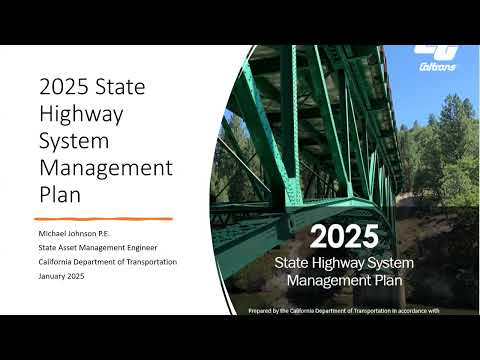
Caltrans on Thursday presented the draft 2025 State Highway System Management Plan, a 10‑year asset‑management document that the agency says will inform the four‑year SHOP program and the June report to the governor and Legislature.
The plan “lays out investments for the next 10 years on the order of $60,000,000,000 for the State Highway System,” Caltrans State Asset Management Engineer Mike Johnson told the Transportation Commission. He said the plan covers July 1, 2025, through June 30, 2035, and is intended to be granular enough to generate district‑level performance plans and project portfolios.
Why it matters: The management plan sets targets used to prioritize repairs, operations and climate adaptation across more than 50,000 lane miles of highway and roughly 13,000 bridges. Commissioners and regional officials pressed Caltrans about wildfire evacuation planning and how the plan will translate to projects that protect communities at imminent risk.
What Caltrans told commissioners - The plan is an integrated asset‑management document that translates statewide goals into district performance plans and, ultimately, SHOP programming. In odd‑numbered years Caltrans submits a draft to the commission for review; the final plan must go to the governor and Legislature by June 1, the department said. - Caltrans staff described a layered approach: an unconstrained needs assessment (what it would cost to reach desired targets), then a constrained investment plan based on realistic fund estimates. Johnson said current funding covers roughly 60% of identified needs. - The department expects the plan to reduce some sea‑level‑rise costs because it incorporated updated models. At the same time, Johnson said, new precipitation and drainage models and higher observed damage from extreme events have raised costs in other areas. - Because recent years have produced large emergency expenditures, Caltrans proposes nearly doubling the plan’s “damage reservation” (the set‑aside for emergency repairs). Johnson warned that increasing that reservation reduces the funding available for planned projects. - The plan expands inland climate and resiliency objectives — including funding for adaptations related to wildfire, precipitation and inland erosion — and will for the first time include quantified bike‑and‑pedestrian targets required by Senate Bill 960.
Public and regional input - Regional officials urged Caltrans to prioritize evacuation capacity and infrastructure hardening in wildfire‑prone areas. Mike Woodman, executive director of the Nevada County Transportation Commission, and Sean Teegan of the Shasta Regional Transportation Agency called for clearer prioritization of projects that improve evacuation routes and reduce wildfire risk. Woodman noted the human and economic impacts of recent fires and urged the state to treat evacuation efficiency and hardening as priorities. - But Caltrans officials and commissioners emphasized tradeoffs: Johnson and others said the state’s SHOP resources were not designed to fully fund a new, large‑scale climate‑adaptation program and that many adaptation needs will compete with traditional “fix‑it‑first” obligations.
Commissioner questions and department response - Commissioners asked whether project prioritization has shifted in response to recent wildfires and whether project scoring would change to emphasize safety and evacuation capacity. Johnson said Caltrans has been working with UC Davis on evacuation‑scenario analysis and has increased climate investments, but also stressed the department must balance 30 objectives simultaneously and will prioritize operational, lower‑cost measures (for example, signal changes, contraflow operations and shoulder use) where they can provide meaningful benefits at lower cost. - Commissioners also asked how the plan informs the governor and Legislature. Johnson and Executive Director Tanisha Taylor said the plan and its briefings are a key vehicle for communicating statewide needs and can underpin legislative or budget requests to increase funding for adaptation.
Uncertainties and next steps - Caltrans staff said many risks remain unpredictable: construction cost inflation, frequency of extreme events and the pace of permit and partner‑agency approvals. The department will release the formal draft to the commission before Feb. 15 and open it for public comment; Caltrans expects to return to the commission with a final plan after the March meeting.
Ending note: Johnson said the plan will feed the 2026 SHOP programming cycle and an annual June “report card” to the commission that will track progress against SB‑1 commitments and other targets. “We are literally doing a grassroots ground‑up performance gap analysis for all 30 of those objectives from scratch every two years,” he told commissioners.