Get Full Government Meeting Transcripts, Videos, & Alerts Forever!
Get email alerts on the Police Accountability topic
No spam. Unsubscribe anytime.
Montgomery County reviews Police Accountability Board operations and complaint data tracking
Summary
County council members and Police Accountability Board officials discussed gaps in complaint data, possible case management systems, and access to investigative materials during a Feb. 3 public safety work session, and flagged staffing and budget needs to support the board’s mandate.
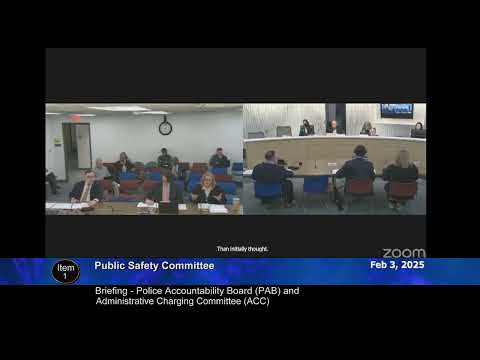
Montgomery County officials on Monday, Feb. 3, 2025, reviewed the Police Accountability Board’s operations and the county’s tracking of complaints against law enforcement, focusing on data gaps, case-management options and whether the board can access investigative materials such as body-worn camera footage.
The Police Accountability Board is charged with reviewing outcomes of community complaints about police misconduct and recommending policy changes, and the Administrative Charging Committee (ACC) adjudicates those complaints. “The Board's duty is to review the outcomes of community complaints of police misconduct, such as racially biased policing and excessive use of force, and to recommend sound policies to improve police accountability,” said Bishop Paul Walker, chairman of the Police Accountability Board.
Why it matters: Council members pressed officials for clarity because the county’s ability to analyze trends depends on consistent, complete complaint data and an effective tracking system. Without reliable demographic fields and a robust case-management system, staff said, the county cannot easily produce the year-over-year analysis the community and council want.
Forrest Gillman Riley, administrative director for the Police Accountability Board and Administrative Charging Committee, summarized the board’s recent work and data. He said the ACC received 120 complaints from December 2023 through November 2024 and issued 43 written opinions during that period. “Out of the 43 written opinions, the ACC issued 24 administrative charges in 12 of the complaints,” Gillman Riley said, adding that adjudicated complaints resulted in charges in roughly 28% of complaints and involved about 22% of named officers. The ACC’s most common discipline recommendation was a letter of reprimand; it recommended termination in one case.
Officials and council staff highlighted two principal resource questions: whether to build an in-house case-management solution through the county’s Technology Enterprise Business Solutions (TEBS) agency, or to procure an off-the-shelf product. Council staff noted an example from Caroline County, where several agencies purchased the same complaint case-management system (using grant funding) and created a single portal for complainants. “That allows complainants to file their complaints online through a single portal,” Susan Farag, council staff, said. County staff told the committee TEBS support is available for broadcasting and operational assistance but that the PAB’s needs may require either a relational internal system or commercial software such as IA Pro.
Council members and board representatives discussed persistent data discrepancies between the PAB and at least three law-enforcement agencies (the Montgomery County Police Department, the City of Rockville and Gaithersburg). Farag said the discrepancies “do not mean that there are any mistakes or irregularities,” but they could not be reconciled in time for budget deliberations and therefore the council asked the board to report back before the next budget cycle.
A particular concern is missing demographic fields: staff said about 18% of complainants did not report gender and 52% did not report race or ethnicity during the period reviewed, which complicates racial-equity analysis. “That data gap makes it really difficult to do any type of racial equity analysis,” Farag said, and officials discussed user-interface fixes (checkboxes, clearer online prominence, and plain-language forms) intended to raise completion rates.
Council members also pressed whether the Police Accountability Board can review investigatory materials (for example, body-worn camera footage and internal investigation files) beyond the original civilian complaint and the ACC’s written opinion. Farag and staff described legal and procedural constraints: board members currently receive the original complaint and the ACC’s written decision but not the investigative files. “At the beginning of each new quarter, the members of the Police Accountability Board are given access to the original complaint and the written decision from the ACC. They are not given access to the investigative files,” Farag said, adding that the county attorney’s office had advised that the board’s current statutory design appears to prevent routine access to investigative files.
Board members said they are actively discussing how to obtain additional materials and the legal implications of becoming custodians of records subject to Maryland Public Information Act (MPIA) requests. “We are currently discussing how we could obtain these type of pieces of information like BWCs…if it is in the purview of the PAB, if it is, how?” a Police Accountability Board member said, noting concerns about redaction responsibilities and public-records handling.
Staff and council members proposed procedural options to reduce burdens associated with MPIA requests, such as referring requesters to the original custodian (the law-enforcement agency) for processing or adopting bylaws that clarify handling of records transferred to the board. Council members also asked staff to survey other Maryland jurisdictions for reporting practices and for example approaches to deadlines (calendar year vs. fiscal year) and for the level of detail other jurisdictions publish about adjudicated complaints.
Budget and staffing: Farag reported the approved FY25 PAB operating budget is about $788,000, which funds two full-time staff, board member compensation, two independent counsel positions (the council added $200,000 to fund two independent counsel roles) and compensation for trial board members. Staff emphasized that PAB and ACC currently have minimal administrative staff (one administrative director and one senior executive administrative aide) and that other jurisdictions sometimes dedicate separate staffs to each entity.
Next steps: Council members asked the PAB and staff to return with clearer recommendations about technology procurement (internal TEBS build versus off-the-shelf), a plan to reconcile agency data counts, and legal guidance about what investigatory materials the board can receive. Staff said they would consult the county attorney and special counsel for the ACC and report back during upcoming budget deliberations.
The work session closed after the council thanked the board and staff for their work and asked for follow-up items and clarifications to be provided to the committee.