Get Full Government Meeting Transcripts, Videos, & Alerts Forever!
Get email alerts on the Downtown Entertainment District topic
No spam. Unsubscribe anytime.
Champaign council reviews Year‑2 plan for Downtown Entertainment District after pilot year
Summary
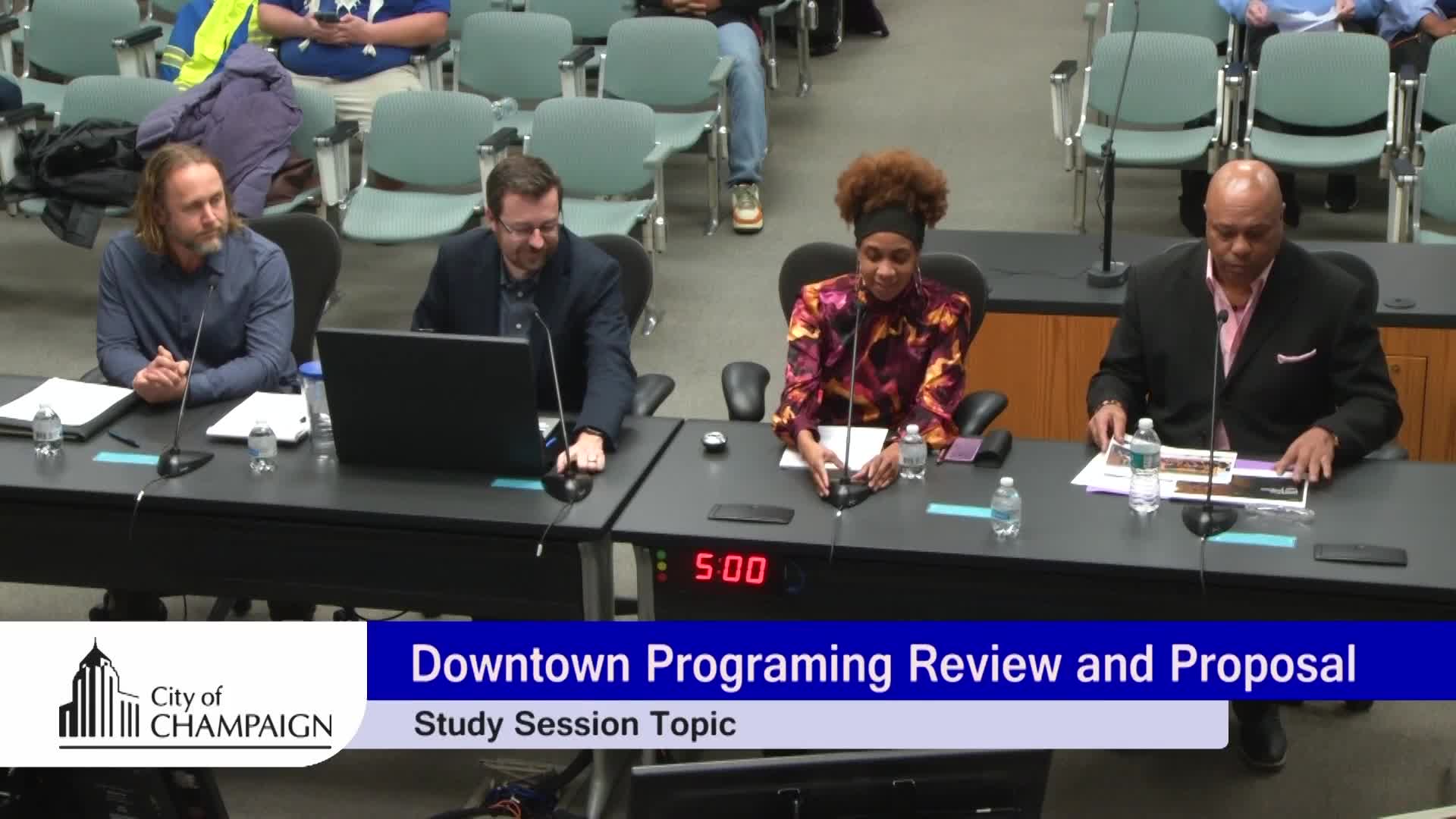
City of Champaign staff told the City Council on Jan. 10 that the first year of the Downtown Entertainment District pilot attracted thousands of visitors and prompted a multi‑part proposal for 2025 that would scale some Market Street activities, formalize a social district and add staff and maintenance resources.
City of Champaign staff told the City Council on Jan. 10 that the first year of the Downtown Entertainment District pilot attracted thousands of visitors and prompted a multi‑part proposal for 2025 that would scale some Market Street activities, formalize a social district and add staff and maintenance resources.
"The mission of the Downtown Entertainment District centered on an initiative to bring new energy and excitement to Downtown Champaign, rebuilding our local music scene and creating a new public space for the community to gather," said Rachel Joy (staff member) during the presentation.
The nut graf: Staff described a program that ran from May through September 2024 with a mix of street festivals, a Market Street concert series (the “Beat”), Friday Night Live extensions, live entertainment grants and special event sponsorships. Tracy (staff member) said attendance totaled roughly 23,000 people across the season and the Market Street events reached peak single‑night attendance of about 1,700.
City staff laid out eight program areas for 2025 including a farmers‑market music program, weekday lunchtime concerts on the new plaza stage, a continuation and modest change to Friday Night Live, a formal social (festival) district with standardized hours, a twice‑monthly Market Street concert series, tightened special‑event sponsorship rules, year‑round live entertainment grants and a proposed Center City Care Team for cleanliness, outreach and engagement.
Derek Braun, described by staff as the temporary project specialist who managed the pilot, summarized several of the proposals and emphasized partnerships: "It's been an honor and a privilege to serve the people of, and the businesses of the City of Champaign," he said, and outlined plans to partner with organizations such as 40 North and the Springer Cultural Center to program the plaza stage and expand daytime offerings.
Key program changes staff proposed: - Market Street ("the Beat"): move the stage to North Market facing south, reduce Market Street concerts to twice per month (first and last Saturdays) and shorten hours from a 1 a.m. end time in 2024 to 8–11 p.m. in 2025. Staff said the changes respond to resident noise complaints, business feedback about staffing and crowd flow concerns on very busy nights. - Social district: standardize a festival/social district Thursday–Saturday 11 a.m.–11 p.m. to reduce confusion about where and when open‑container permissions apply and to allow voluntary business participation across downtown. - Grants and special events: continue the live entertainment grant program and the special event sponsorship fund but require earlier applications and more curation to avoid multiple competing grant events on the same night. - New staffing and maintenance: extend the temporary project specialist through the calendar year, propose a new full‑time events coordinator in Planning & Development, and create a Center City Care Team (Cleanliness, Assistance, Resources, Engagement) to handle power washing, litter, outreach and other downtown maintenance needs.
Staff said infrastructure changes made during the pilot included festival lighting, six security cameras, bollards, public Wi‑Fi, and temporary power stations. They reported a staffing model in 2024 that included a single project specialist, private security through a firm, safety monitors, neighborhood ambassadors and volunteer groups; staff told council they reached peak nights requiring roughly 30 staff on Market Street.
The proposal includes a budget amendment request to cover the gap between the current fiscal year and summer 2025 programming, and staff said larger budget decisions (new permanent positions, long‑term funding sources such as a TIF, SSA or BID) would be routed through the regular budget process this spring and summer.
Council members and public commenters raised several recurring concerns: - Inclusion and equity: community speakers and First Followers representatives said the Market Street Beat provided a rare, cross‑demographic space for young Black residents and returning citizens and urged the city not to remove safe, late‑night options that drew those communities downtown. - Business impacts: several downtown business owners told the council that large street events concentrated foot traffic in limited locations and could depress sales at some establishments; they asked for clearer marketing and year‑round grant support so smaller businesses could benefit. - Public safety and staffing: council members, staff and the police representative discussed the operational strain of extended late‑night events and the need to align programming with realistic staffing levels; staff emphasized the pilot exposed wear‑and‑tear on personnel and public works resources. - Homeless outreach and care team scope: public commenters and council members flagged the need for the proposed care/ambassador team to include trained outreach capacity—meaning not only cleaning and maintenance but also linkages to shelters and social services.
Public feedback also included calls both to preserve the large‑scale Market Street experience and to ensure that any multi‑venue model does not simply disperse parties across the city and recreate the public‑safety problems the pilot aimed to reduce.
No formal policy vote on the Year‑2 plan occurred; staff said the presentation was intended to obtain direction before returning with a budget amendment and more detailed program language. Staff requested council authorization to develop job descriptions, RFP language and a seasonal operations plan so programming could begin in May 2025 when the new plaza opens.
Ending: Council members asked staff to return for additional study‑session discussion and to prioritize several elements—staffing for program coordination, the role of First Followers and similar community partners, and a clearer funding path—before any final budget amendments. Staff said they plan to bring a budget amendment and refined proposals back to council as the fiscal process advances.