
Lynn Public Schools outlines post‑MCAS competency pathways; committee advances proposed IKF changes
Get AI-powered insights, summaries, and transcripts
Subscribe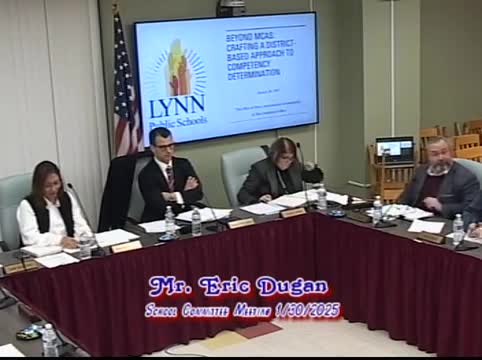
Summary
District leaders presented proposed competency determination pathways for cohorts affected by the removal of MCAS as a graduation requirement. The policy would provide course‑based, universal pathway options and a retroactive review process for students from 2003–2024; the subcommittee moved the proposed policy to the full committee.
Lynn Public Schools compliance and academic leaders presented a multi‑year proposal to define local competency determination and graduation requirements after the statewide ballot change that removed MCAS as a diploma requirement.
Charlie Gallo, Lynn Public Schools compliance officer, and Deputy Superintendent Marissa Ligotis outlined a phased approach that varies by graduating cohort: a transcript review pathway for cohorts who left school before the change; course‑based passing grade options for current cohorts; and a longer‑term model for students who enter 9th grade in 2025 (class of 2029 and beyond) that would require a 2.0 unweighted grade‑point average in core courses plus one universal pathway demonstrating college or career readiness.
Key elements presented to the policy subcommittee include: - Retroactive review (cohorts 2003–2024): eligibility via transcript review for students who left under the former MCAS graduation rules; two annual submission windows were proposed (June–July and November–December). - Class of 2025 and 2026–2028 proposals: passing course grades in specified 10th‑grade core courses (ELA, math, science/technology/engineering) and access to course recovery to meet requirements. - Class of 2029 and beyond: attainment of a 2.0 unweighted GPA in core courses plus at least one universal pathway (the district listed up to 12 real‑world pathways such as AP/dual enrollment, CTE credentials, industry certifications, CLEP, portfolios, district end‑of‑course exams, or other superintendent‑designated pathways).
The proposal explicitly states that English learners and students with disabilities would be expected to meet competency requirements through the universal pathways with applicable accommodations or individualized pathways (for students with complex cognitive disabilities) through portfolios or transition plans. Presenters said the policy language was developed with input from special education counsel and the curriculum office.
Committee members asked about accommodations, outreach to formerly enrolled students, and comparability to other nearby districts. Kathy Aiello, interim executive director for data, assessment and accountability, told the committee that 180 district students currently remain without the prior MCAS competency (i.e., would have been affected under the old MCAS requirement) and that many of those students would meet diploma requirements under the proposed course‑based or pathway options.
Panelists said that DESE continues to require MCAS participation for accountability purposes and that districts must identify competency measures that align to the knowledge and skills MCAS tested. Gallo urged the committee to adopt a policy to provide clarity and multiple avenues for students to demonstrate competency rather than rely on a single test.
The policy subcommittee voted to forward the proposed IKF competency determination and graduation requirement amendments to the full school committee for committee‑of‑the‑whole review. The subcommittee also advanced a separate, updated athletic eligibility/high‑school transfer policy (JJICA) to the full committee with no substantive change beyond clarifying language for lottery‑based admission schools.
Full committee review and final adoption remains pending; presenters said the district will provide the detailed amended IKF language and supporting data to the full committee and post materials for stakeholder review prior to any adoption vote.