Get Full Government Meeting Transcripts, Videos, & Alerts Forever!
Get email alerts on the State Legislation topic
No spam. Unsubscribe anytime.
House Appropriations Committee reports dozens of bills across health, education and commerce; two measures tabled
Summary
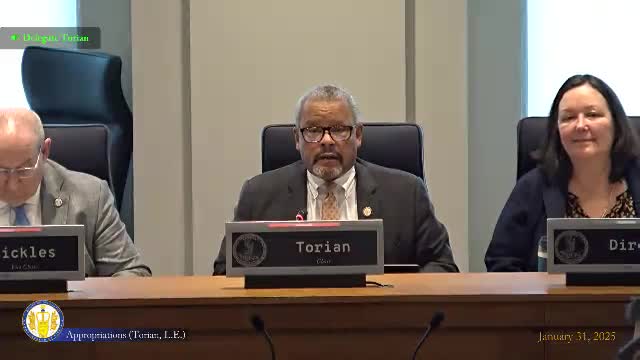
The House Appropriations Committee met to consider a large docket of bills across multiple policy areas. Most measures were reported out of committee with recorded voice votes; two bills were tabled after contested roll calls and one item experienced a temporary vote recording issue.
The House Approations Committee met in session to consider a broad docket of bills covering education, health and human resources, commerce, general government, higher education and transportation. Committee members reported the large majority of bills out of committee by recorded voice votes; two bills were tabled after roll-call votes.
Most actions were procedural reports of House bills to the next stage of the legislative process. Examples include bills directing state agencies to study or implement programs (for example, bills directing the Department of Medical Assistance Services to examine presumptive Medicaid eligibility for pregnant individuals and to study optional benefits for sickle cell disease), bills creating advisory bodies (including a Virginia Forensic Nursing Advisory Council and a Women’s Health Commission), and bills adjusting licensure or coverage requirements for health services and providers (including bills related to nursing home sanctions, psychiatric emergency departments, and reimbursement parity for certified midwives).
Why it matters: the committee’s actions advance or pause a range of policy proposals that affect health-care delivery, school credentialing and workforce supports, energy and infrastructure programs, and other state functions. Several bills affecting Medicaid coverage, maternal health, nursing home oversight and energy programs were among those reported favorably, which moves them forward in the legislative process.
Major procedural outcomes
- Multiple health and human services bills were reported unanimously or by strong majorities, including HB 1641 (Medicaid coverage for pediatric acute-onset neuropsychiatric disorders associated with strep infections), HB 1701-series items on food access and workgroups, HB 1900 (Medicaid coverage for rapid whole genome sequencing, emergency clause), HB 1923 (reimbursement parity for some midwife services), HB 2102 (presumptive eligibility for pregnant individuals directed to DMAS), and HB 2757 (study of optional benefits for sickle cell disease). Many of these reported with 21 to 0 voice tallies where recorded.
- Education-related measures reported included bills directing Board of Education actions on language assessments and teacher endorsements (substitutes for bills described in the docket) and an attendance-recording amendment which the committee reported with a motion that eliminated a fiscal impact.
- Commerce and natural-resources items reported included bills creating a grant program for first-time homebuyers, extending a housing tax credit sunset, establishing an electric vehicle rural infrastructure program, and creating or reorganizing energy programs and boards (including a reconstituted Virginia Clean Energy Innovation Board). Vote tallies for these ranged from unanimous 21–0 reports to closer 12–9 and 15–6 tallies on contested items.
- Two bills were tabled: HB 2300 (a residential well water testing and treatment program and fund at the health department) was initially moved to the table and after a recording issue was finally tabled by a roll call (final recorded tally 12–9). HB 2616 (a redistribution of a portion of funding from the $4.25 for Life fund affecting regional EMS councils) was tabled by recorded roll call (12–9).
- A number of bills passed out of committee by split votes (examples in the docket included multiple commerce, technology and labor-related bills) and several high-profile measures were reported with recorded but unanimous tallies.
Procedural notes and vote recording
The transcript indicates at least one vote experienced a recording or roll-call issue (the tabling attempt for HB 2300/HB 2,300). Committee staff attempted to re-run the roll and the final recorded outcome for that bill in the transcript is 12–9 in favor of tabling. For another bill (HB 1,900), the transcript captured both a 20–0 read and then a 21–0 read; the final read recorded in the transcript is 21–0. Where the transcript lists multiple tallies for the same measure, this article reports the final recorded tally listed in the committee proceeding.
What’s next
Bills reported favorably (approved/reported out of committee) will proceed in the legislative process to floor or further committee consideration as applicable. Tabled bills remain in committee and would require a future motion to take them from the table. Committee members were asked to meet immediately in the library upon adjournment to continue business.
(See the accompanying “Actions” array for the full, itemized list of motions and recorded tallies from the committee docket.)