Get Full Government Meeting Transcripts, Videos, & Alerts Forever!
Get email alerts on the Criminal Justice Docket Roundup topic
No spam. Unsubscribe anytime.
Subcommittee advances mix of criminal-justice bills; several high-profile measures sent to study
Summary
The House subcommittee on courts of justice reported several criminal-code measures to the full House— including new state mail-theft language and a new offense for street takeovers—while tabling or asking for study on larger, more technical bills that could change sentencing or legal standards.
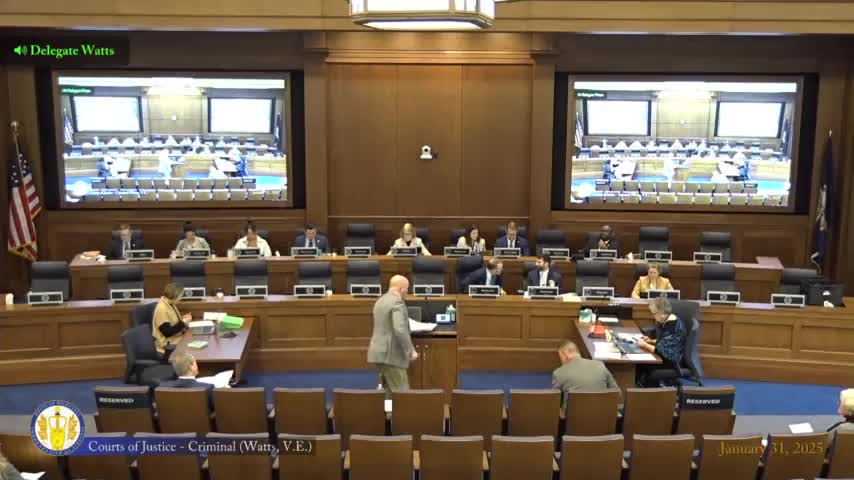
The House subcommittee on courts of justice met to consider a broad package of public-safety and criminal-code changes, voting to report multiple bills to the full House, amending others and tabling several matters for further study.
The subcommittee reported bills including new state-level mail-theft language, a measure to criminalize street takeovers and exhibition driving, and an amendment extending judges’ discretion to issue longer protective orders for repeat offenders. Lawmakers tabled large or technically complex proposals for additional review, including a plan to consolidate the state’s ‘‘violent felony’’ list and a rewrite of unlawful-image statutes that would expand penalties and add protections for AI-generated content.
Why it matters: The panel moved proposals that prosecutors and local law enforcement said they need to address growing problems—package and check theft, staged street-driving events that have caused injuries and deaths, and repeat domestic abusers—while pausing bills that could change sentencing or criminal-law mens rea across many code sections until experts or study groups weigh in.
Most important votes and outcomes (at a glance) - HB 1583 (Ballard): Amended 18.2‑83 to add “discharge a firearm within or at” to the threats statute and to change the age threshold from 15 to 18 for certain classifications; reported unanimously, 7–0. - HB 1726 (Price, substitute): Creates a narrow trespass/unauthorized UAS (drone) offense for certain contracted defense facilities and grants limited immunity for reasonable countermeasures; substitute reported as amended, 8–0. - HB 1998 (Walker, as amended): Adds housing- and financial-threat language to extortion statutes to capture cases where eviction or loss of housing is used to coerce sexual acts; reported as amended, 8–0. - HB 2123 (Maldonado, substitute as amended): Allows a judge to issue a protective order up to four years for respondents previously subject to a permanent protective order who reoffend; substitute amended to add a 10‑year lookback for prior orders; reported 6–1. - HB 2036 (Bulova, substitute as amended): Creates a class-1 misdemeanor reckless-driving offense for exhibition driving and street takeovers, a spectator offense, civil forfeiture procedures for vehicles used in events and license-suspension authority; reported with substitute/amendments, 7–1. - HB 2406 (Scott, substitute as amended): Clarifies ‘‘law enforcement officer’’ definition used in escape-from-custody provisions (references 9.1‑101) and removes auxiliary officers from coverage; reported unanimously, 7–0. - HB 2456 (Cherry): Proposal to consolidate and reclassify many offenses on the Commonwealth’s ‘‘violent’’ list; committee tabled the bill with direction to pursue study and broader stakeholder review. - HB 1714 (Delaney): Establish a felony tier for assault that causes serious bodily injury to close a statutory gap between misdemeanor assault and malicious wounding; motion to table the measure for further work passed (motion carried 5–3). - HB 1715 / HB 2036 — mail-theft substitute (Delaney): Added state-level mail-theft language to capture stolen checks and delivery‑service packages (UPS/FedEx/Amazon-style deliveries) and updated definitions; substitute reported, 8–0. - HB 2783 (Simon): Expands existing statutes prohibiting placement of intimidation symbols (modeled on cross-burning case law) to include placement of that symbol on private property or public places with intent to intimidate; reported unanimously. - HB 2654 (Williams, substitute): Major rewrite and tiered penalties for unlawful dissemination of intimate images, including AI-generated images and expanded remedies; the subcommittee tabled the bill for a stakeholder working group/study.
Key discussion points and committee directions - Law-enforcement tools vs. sentencing impact: Members repeatedly balanced the need for new enforcement tools (e.g., for package/check theft and street takeovers) with concerns about broadening felony exposure or changing longstanding mens-rea principles. Several members urged study or a task force before making sweeping code changes affecting sentencing guidelines. - Protective orders: Advocates and prosecutors urged longer orders for repeat offenders; the committee adopted substitute language allowing up to a four‑year order in cases where the respondent previously had a permanent order and added a 10‑year lookback for prior orders to address concerns about excessively remote priors. - Violent-felony list: The measure to consolidate and reclassify dozens of offenses prompted repeated requests to involve the Virginia Criminal Sentencing Commission and other stakeholders; members voted to table and seek a formal study rather than advance code changes during this session. - Image-based abuse and AI: Supporters and survivors urged stronger, updated law to cover nonconsensual intimate images, deep fakes and trafficking-linked uses; several members asked for a working group to refine consent and Internet‑posting language before advancing felony-level changes.
Quotations from the hearing "I hope that you would act favorably upon this legislation," Delegate Ballard said when presenting HB 1583, which amends the threats statute to add firearm‑related language and adjust age thresholds. "Protective orders save lives, but only if they are strong enough to deter further violence," Sunu Jang of the Virginia Domestic Violence Action Alliance told the panel in support of HB 2123. "This is not a problem confined to Fairfax or Richmond—street takeovers and exhibition driving are happening across the Commonwealth," Delegate Bulova said when offering HB 2036.
Next steps and follow-ups requested by the subcommittee - The committee instructed staff and the chair to arrange a study or working group on: (a) the consolidated violent‑felony list (seek participation by the Sentencing Commission and criminal-justice stakeholders); and (b) the proposed rewrite of unlawful dissemination / image-based abuse (bring technology, victim‑advocacy, and civil‑liberty stakeholders). Several members indicated they would send letters to the appropriate commissions to organize the work. - Bills reported out of the subcommittee move to the full House for further consideration. Several tabling votes were made so authors may refine language and gather additional stakeholder input.
Ending note: The panel sought to balance immediate operational tools for prosecutors and police with caution on any changes that would raise broad sentencing or constitutional questions. The committee favored targeted, operational fixes this week while deferring more complex statutory rewrites to structured study.