Get Full Government Meeting Transcripts, Videos, & Alerts Forever!
Get email alerts on the Election Administration topic
No spam. Unsubscribe anytime.
Votes at a glance: committee advances confirmations and a package of election-administration bills
Summary
The House Privileges and Elections Committee recorded multiple unanimous confirmations of governor’s appointments and reported a slate of election-administration bills, with final committee votes ranging from unanimous to close margins.
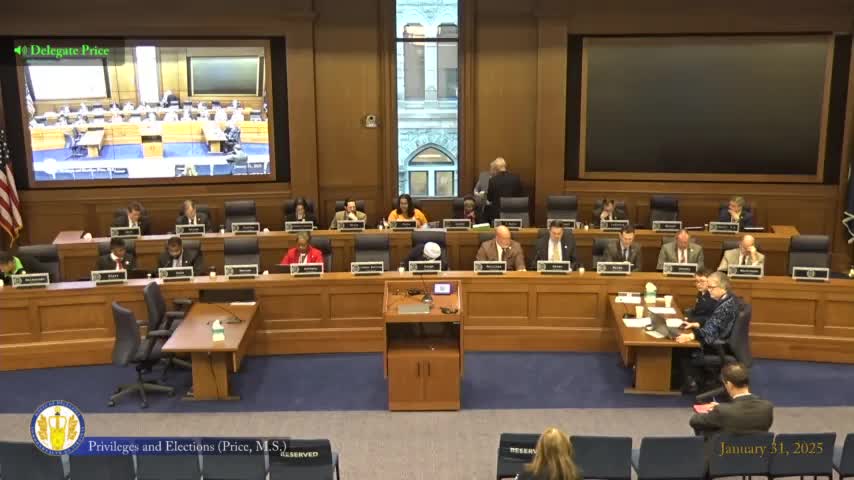
The House Privileges and Elections Committee spent its meeting acting on several Senate joint resolutions confirming gubernatorial appointments and advancing a series of election-administration bills.
Confirmations - The committee reported five Senate joint resolutions on gubernatorial appointments; recorded roll-call margins included 20-0 and multiple 21-0 votes on individual resolutions. The chair said, if confirmations move forward, the General Assembly would have confirmed thousands of Virginians to boards and commissions.
Election-administration bills and committee action (high-level) - House Bill 17-94 (primary-date alignment). Committee substitute reported; committee vote recorded 8-0. The bill changes timing for primaries held the same year as a presidential election and adjusts candidate petition and filing deadlines. - House Bill 25-13 (registrar cancellations tied to DMV/Driver’s License Compact notices). Reported in block with HB 17-94; committee vote recorded 8-0. The bill requires registrars to cancel registrations when DMV provides a driver’s-licence-compact notice, with specified mailing notice requirements to the voter’s new address if available. - House Bill 16-57 (voter-list removal programs and timelines). Substitute reported and referred to Appropriations; committee vote on committee report was 13-8 (referral to Appropriations followed earlier subcommittee action of 6-2). The bill tightens timing around name removals and extends certain processing timeframes in state law. - House Bill 19-38 (buffer around polling places). Substitute reported; committee recommended with substitute 4-3 in subcommittee and passed the full committee 11-10. The substitute sets a 100-foot zone (from an original 150-foot proposal) and adds a 500-foot designated area for specified activities outside polling places. - House Bill 20-56 (satellite absentee voting offices; local ordinance authority). The bill was considered and adopted with a line amendment that requires at least two weeks’ notice to general registrars; the committee reported the bill 12-8. - House Bill 22-77 (certification as ministerial duty; substitute considered). Substitute reported 12-8; language clarifies local certification responsibilities and coordination with removal/disciplinary mechanisms under related bills. - House Bill 26-68 (state-board removal authority / electoral-board removal). Substitute reported and passed the committee 18-3. The substitute allows the State Board of Elections to remove electoral-board members or general registrars by a two-thirds recorded vote after a public hearing for neglect, misuse of office, incompetence or similar standards; it also preserves an electoral board’s authority to remove a general registrar by unanimous vote after a public hearing. - House Bill 20-02 (limits on registrar cancellations; source data restrictions). Reported 11-9. The bill generally prohibits canceling voter registrations except on written request or state-approved data sources; it reinstates protections for certain uniformed-service registrants and their families. - House Bill 26-72 (party recommendations for electoral-board appointments). The bill changes the recommendation requirement from a floor of three to a ceiling of five recommended qualified voters; the committee reported the bill 19-2, with proponents noting practical barriers in small localities to producing multiple applicants.
Procedure and next steps Several bills were reported with substitutes; some were referred to Appropriations for fiscal review. Several bills the committee reported will proceed to floor consideration in the House, where further amendment and debate are possible.
Ending note Committee votes ranged from unanimous confirmations of governor’s appointments to close divisions on election-administration policy. Many bills convert settled subcommittee recommendations into full-committee reports; affected local election officials and party organizations may need to review substitute language and implementation timelines.