
Senate committee adopts amendments to Senate Bill 800, including nearly $1 billion tax rebate and Medicaid funding
Get AI-powered insights, summaries, and transcripts
Subscribe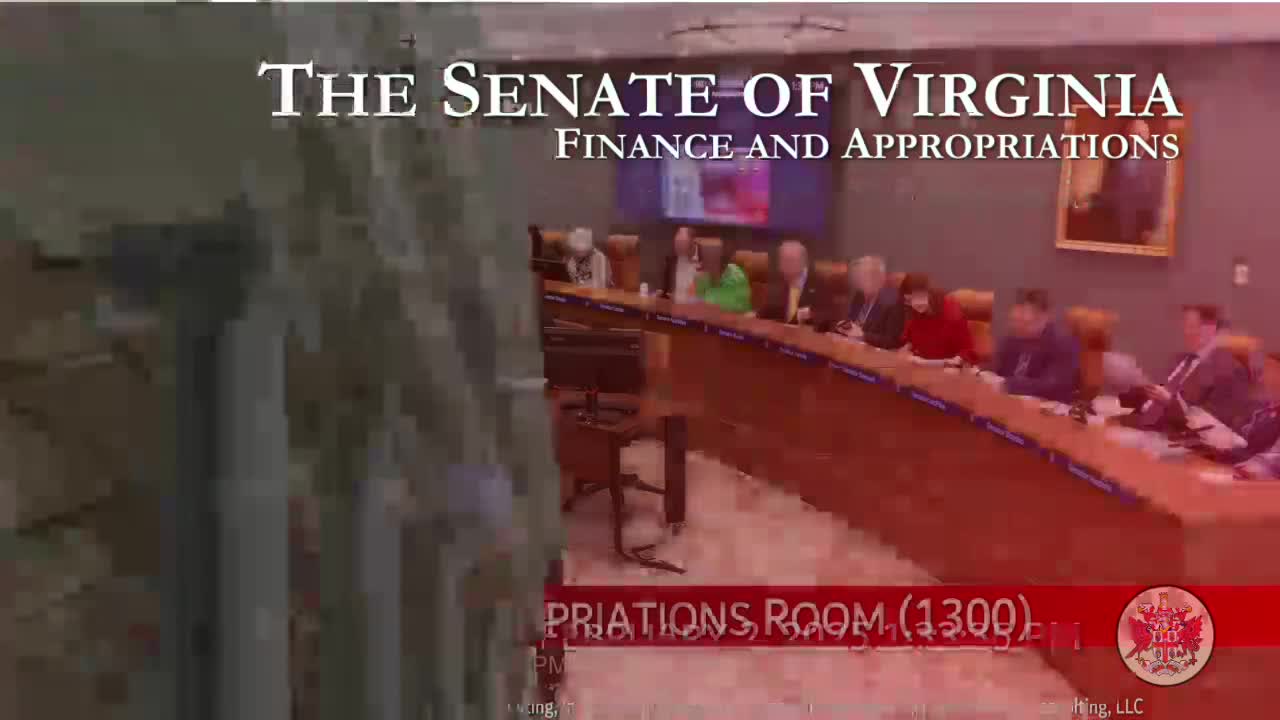
Summary
A Senate committee in Richmond adopted subcommittee amendments to Senate Bill 800 that would provide roughly $1 billion in one-time tax rebates, expand tax relief, and fully fund a large Medicaid forecast increase while forwarding the amended bill to the floor by a unanimous electronic vote, 15-0.
Senate committee leaders in Richmond on Thursday adopted a package of subcommittee amendments to Senate Bill 800 that would send roughly $1 billion in one-time tax rebates to Virginians, expand state tax relief policies and fully fund the recent Medicaid forecast increases, the committee reported.
The committee’s action followed reports from seven subcommittees that recommended changes to the governor’s introduced budget and culminated in an electronic roll-call on the amended bill that recorded 15 ayes and 0 noes.
The committee chair (unnamed) opened the meeting saying she was “eager to share the details of the budget that the committee will present today,” and asked that Senate Bill 800 be amended in accordance with the subcommittee reports and reported out of committee.
Why it matters: The amendments rework the state’s tax and spending picture for the upcoming biennium by sending one-time rebates, extending and increasing standard deductions, making the state earned income tax credit more generous and refundable, and covering a large Medicaid cost forecast. The changes affect state aid to schools, health and human services programs, public safety grants, capital projects and targeted one-time investments across agencies.
Major provisions and committee findings
Tax relief: The committee’s package includes an appropriation described in committee remarks as “almost a $1,000,000,000 for a tax rebate,” with checks or direct deposits to be sent around Oct. 15. The plan described individual filer rebates of $200 and married (joint) filer rebates of $400. The package also extends a prior, temporary increase in the state standard deduction for two years and proposes a further increase of $250 for individual filers (to a total standard deduction described as $8,750) and $500 for married filers (to a total of $17,500). The committee also recommended making the state earned income tax credit (EITC) fully refundable at 20% of the federal credit.
Education: The education subcommittee, reported by Senator Locke, recommended $208,800,000 in additional general fund support over the biennium relative to the introduced budget and cited a combined state investment of more than $758,100,000 when paired with the governor’s package. The subcommittee recommended $222,900,000 to restore pre‑recession caps on funding for support positions and $52,800,000 for special education needs. The report also includes a one-time bonus payment of up to $1,000 to teachers and instructional staff by June 1 that requires no additional local match; $25,000,000 for an early childhood pilot partnering with business to expand child care slots; and $99,000,000 in additional higher-education general fund support (described as part of $241,100,000 combined with the introduced budget) for need‑based aid, workforce credential grants, tuition assistance grants and operational support for institutions.
Health and human resources: Senator Deese reported the Health and Human Resources subcommittee’s recommendations to meet the Medicaid forecast by adopting $632,200,000 from the general fund to cover increased Medicaid costs over the biennium. The subcommittee also prioritized maternal health with line items described in the report including funding for mobile maternal health clinics, $2,200,000 for remote patient monitoring for pregnant women, reimbursement parity for certified midwives, an education and awareness campaign for perinatal and postpartum depression, and funding to support doulas and other maternal‑health interventions. Behavioral-health investments listed by the subcommittee included $7,800,000 to support crisis co‑response programs and other line items to expand access to licensed behavioral health professionals.
Housing, community resilience and disaster mitigation: The economic development and natural resources subcommittee recommended one-time investments for community resilience and disaster mitigation (the package cited $100,000,000 overall) and included $15,000,000 for rental-relief programs, $5,000,000 for community capital access pilots, and a recommendation supporting a proposed $40,000,000 capital investment for the Stormwater Local Assistance Fund in the capital budget.
Public safety and claims: The public safety and claims subcommittee recommended $8,500,000 to support rising costs for local criminal justice agencies, $7,000,000 in additional funding for community violence-reduction strategies (building on existing grants), and $3,000,000 for victim-service agencies. The subcommittee also recommended removing introduced‑budget language that would have withheld funding from local law enforcement agencies for noncompliance with proposed immigration‑related requirements, according to the subcommittee report.
Capital outlay and transportation: The capital outlay and transportation subcommittee reported endorsements for pay‑as‑you‑go capital funding and one‑time general‑fund capital allocations described in the report as $1,300,000,000 in general‑fund cash for capital projects with no additional tax‑supported debt. The committee recommendation described funding for planning a new state office building at the VDOT annex site, funding to match local stormwater projects ($440,000,000 referenced as a matching amount), life‑safety and deferred maintenance funding across agencies, and targeted general‑fund support for WMATA operations.
General government and workforce: The general government subcommittee recommended one‑time bonuses for state employees (described in the report as a 1.5% bonus totaling $83,100,000 general fund) to be included in the June 16, 2025 paycheck, study language on pension plan transitions, and $131,000,000 for replacement of the Department of Taxation’s core tax processing system to enable broader electronic filing options.
Committee process and votes
Each subcommittee presented a report and moved to adopt its recommended amendments. Subcommittee chairs moved adoption of their reports on the floor and the committee agreed by voice vote in each instance. After the subcommittee reports were adopted, a motion to adopt the amendments to Senate Bill 800 (as amended by the subcommittees) was made on the floor of the committee and the committee recorded an electronic vote: ayes 15, noes 0. Senator McDougall and other members praised cross‑party cooperation in preparing the package; Senator McDougall said the committee “can come to agreements” even where members “don’t love” every item.
Votes at a glance: HHR subcommittee report — motion to adopt moved by Senator Deese; voice vote recorded; outcome: adopted. Education subcommittee report — motion to adopt moved by Senator Locke; voice vote recorded; outcome: adopted. Economic Development and Natural Resources subcommittee report — motion to adopt moved by Senator Morrison; voice vote recorded; outcome: adopted. Public Safety and Claims subcommittee report — motion to adopt moved by Senator Evan; voice vote recorded; outcome: adopted. General Government subcommittee report — motion to adopt moved by Senator Serraville; voice vote recorded; outcome: adopted. Capital Outlay and Transportation subcommittee report — motion to adopt moved by Senator McPike; voice vote recorded; outcome: adopted. Resources subcommittee report — motion to adopt moved by staff (April Keyes); voice vote recorded; outcome: adopted. Final motion to adopt committee amendments to Senate Bill 800 — motion moved on the floor of the committee; electronic roll call: ayes 15, noes 0; outcome: adopted and reported out of committee.
What committee members said and next steps
Committee members repeatedly framed the package as a mix of short‑term, one‑time relief and targeted ongoing investments. The chair asked that the introduced Senate Bill 800 be amended in accordance with the subcommittee reports and reported; several senators thanked staffers by name for preparing the reports. Senator McDougall told colleagues that, despite partisan differences, the committee “was able to work together and come up with solutions” on large items including tax relief.
With the committee’s report adopted and the committee amendments approved, the amended Senate Bill 800 will proceed to the Senate floor for consideration and further action according to the legislative calendar.