Get Full Government Meeting Transcripts, Videos, & Alerts Forever!
Get email alerts on the Housing Permitting topic
No spam. Unsubscribe anytime.
Subcommittee tables bill to make plats and plans administrative; supporters say it would speed housing approvals
Summary
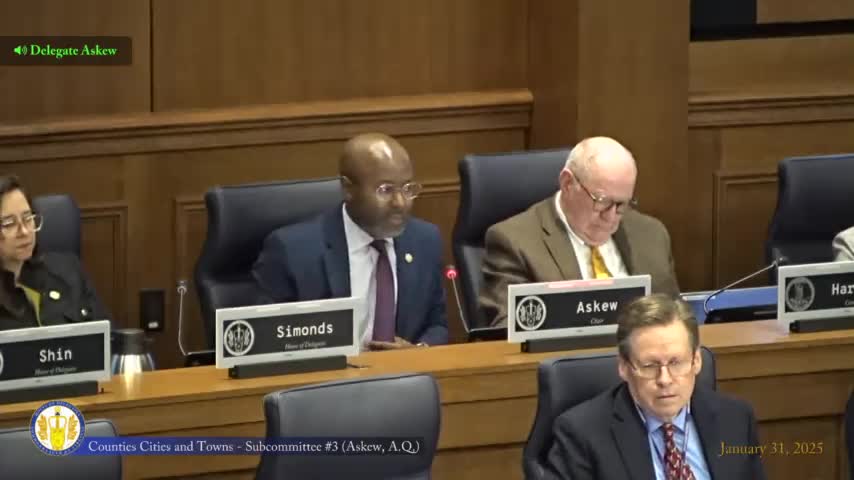
Delegate Franklin Pointer presented HB 2293 to the County, Cities and Towns Subcommittee No. 3, saying the measure would move approvals of plats and final plans into an administrative, ministerial review process to accelerate housing development.
Delegate Franklin Pointer presented HB 2293 to the County, Cities and Towns Subcommittee No. 3, saying the measure would move approvals of plats and final plans into an administrative, ministerial review process to accelerate housing development.
"The bill I have before you this morning really stems from work that's been done nationally, the National League of Cities, the Home Builders Association, American Planning Association, they've worked together on several public policy proposals in order to, accelerate housing production and lower costs," Delegate Pointer said. He emphasized the bill "does not impact zoning at all" and "has nothing to do with" public input on land use; instead, it would change how post-zoning, technical approvals are handled.
Supporters said the change would reduce duplicative steps and speed building. Andrew Clark of the Home Builders Association of Virginia told the committee, "This is simply the administrative process and helping to cut out kind of the, unnecessary duplicative processes and really trusting our local planning staff with the responsibility of, you know, ensuring compliance with stormwater, ensuring compliance with setbacks, buffers, and all things like that." Randy Grumbine, representing the Virginia Manufactured and Modular Housing Association, also said the group was "in support as well."
The committee did not approve the bill. After debate and a substitute motion, the subcommittee voted to table HB 2293 on a 5-3 roll call. The motion to table was moved by Billy Carlson; the clerk recorded the roll as 5 to 3 in favor of tabling. The committee record shows the substitute was offered and the committee proceeded to a nondebatable motion to table.
Nut graf: The bill sought to reclassify approval of plats and final plans as ministerial (administrative) acts rather than discretionary decisions, a change supporters say would shorten permit timelines and lower costs for housing production while leaving local land‑use decisions (zoning) intact. The panel’s decision to table leaves the measure alive for further work but pauses its immediate advance before crossover.
Background and details: Delegate Pointer framed the bill as aligning with national best practices developed by consensus groups including the National League of Cities and the American Planning Association. He described plats and final plans as "schematic maps" that "show the location of buildings, parking lots, roads, utilities, and the review and approval of those are considered ministerial. Do you match what our ordinance says? It's a yes or no." Andrew Clark said the bill previously passed the Senate by a large margin, and described the change as limited to administrative procedure rather than changing substantive land-use policy.
What the subcommittee decided: The committee’s tabling motion (5-3) halts immediate movement of HB 2293; tabling is not a formal rejection but an action that removes the bill from the committee’s active calendar unless revived.
Support and opposition: Witnesses who spoke in favor were from the home‑building and manufactured‑housing sectors. The transcript records no organized opposition speakers in the room or online during the hearing.
Next steps: Because the bill was tabled rather than defeated on the merits, supporters may seek amendments or additional outreach to address remaining concerns before it returns to the calendar.
Ending: The subcommittee moved on to other bills after tabling HB 2293; the committee recorded its procedural votes and closed that portion of the calendar.