Get Full Government Meeting Transcripts, Videos, & Alerts Forever!
Get email alerts on the Utility Wildfire Mitigation topic
No spam. Unsubscribe anytime.
Panel advances bill encouraging utility wildfire-mitigation plans, limits strict liability
Summary
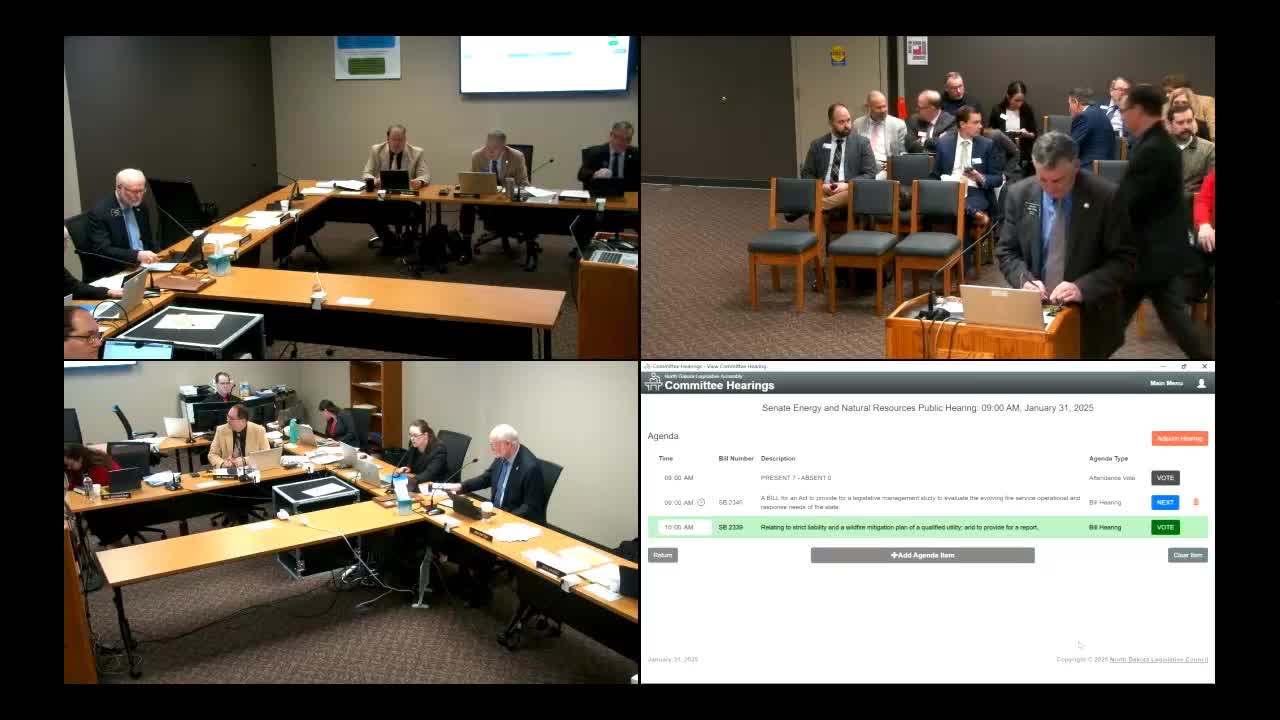
The Senate Energy and Natural Resources Committee adopted amendments and recommended a do-pass on Senate Bill 2339, a measure that encourages utilities to prepare wildfire mitigation plans and limits strict liability for qualified utilities, after testimony from investor‑owned utilities, cooperatives and regulators.
The Senate Energy and Natural Resources Committee adopted amendments and voted to recommend a do-pass on Senate Bill 2339, legislation that encourages utilities to prepare wildfire mitigation plans and limits application of strict liability to qualified utilities.
Senator Greg Kessel, sponsor of SB 2339, said the bill "prioritizes public safety by addressing wildfire risk and ensuring utilities develop and implement effective wildfire mitigation plans." He told the committee the measure balances public-safety protection with utilities' financial stability. (Sen. Greg Kessel)
What the bill does: SB 2339 allows qualified utilities to prepare wildfire mitigation plans (WMPs). If a utility files a WMP and follows it, the bill makes that compliance "evidence, subject to rebuttal," that the utility exercised a reasonable standard of care. The bill also limits application of strict liability to qualified utilities for wildfire damages — requiring plaintiffs to prove negligence rather than holding utilities strictly liable for wildfire-related damages. Supporters said codifying the standard reduces litigation risk that has driven utilities into insolvency in other states.
Support from utilities and cooperatives: Xcel Energy, Montana‑Dakota Utilities (MDU) and the North Dakota electric cooperatives testified in favor. Anne Sherwood of Xcel described a set of mitigation measures — "situational awareness, system resiliency, operational mitigations, and customer support" — and said the company's goal is to "prevent catastrophic wildfires before they happen." Xcel cited tools including enhanced meteorology, weather stations, artificial‑intelligence cameras, fire‑spread modeling, tree‑trimming, asset inspection and operational measures such as enhanced power‑line safety settings (EPSS) and, as a last resort, public‑safety power shutoffs (PSPS). (Anne Sherwood, Xcel Energy)
MDU's Rebecca Naslund described steps her utility has taken to increase situational awareness and operational control, including a distribution SCADA deployment and an outage-management system implemented in January 2024. She told the committee those systems help the company monitor and respond to outage and fire‑risk conditions. (Rebecca Naslund, Montana‑Dakota Utilities)
Liability and legal background: Dennis Pathrock, representing a coalition of power companies, explained the legal distinction between strict liability and negligence and said North Dakota courts already have limited the application of strict liability to electric infrastructure (citing Meyer v. Mackenzie Electric). He said codifying the limitation will provide regulatory certainty for creditors, insurers and rating agencies and avoid the kinds of bankruptcy risks seen in other states where strict liability was applied to utilities.
Amendment and committee action: The committee adopted an amendment to expand coverage to municipal electric utilities and municipal joint action agencies and made some drafting changes (motion to adopt amendment by Senator Greg Kessel; second by Senator Beard). The amendment passed on a 7–0 electronic vote. After amendment adoption the committee voted 7–0 to recommend a do-pass on SB 2339 as amended. Senator Kessel volunteered to carry the bill to the floor.
Discussion vs. decision: Committee discussion included whether filing a WMP should be mandatory (the bill uses "may" to permit utilities to file plans) and how compliance with a filed plan would affect liability standards. Witnesses said utilities that file and follow plans will have evidence of meeting a reasonable standard of care; those that do not file may have less demonstrable protection in litigation.
Ending: Supporters framed the bill as a preventative, risk‑management approach that both reduces wildfire risk and protects customers from higher long‑term costs that can arise if utilities face insolvency from wildfire litigation. The committee's do-pass recommendation moves the measure to the full Senate with broad, bipartisan committee support.