Get Full Government Meeting Transcripts, Videos, & Alerts Forever!
Get email alerts on the Foreign Ownership And National Security topic
No spam. Unsubscribe anytime.
Committee hears competing views on bills to curb foreign ownership; constitutional, trade concerns raised
Summary
Senators debated two related measures — SB 2337 (lowering an ownership threshold to 25% and extending a sunset) and SB 2361 (extending the current law and authorizing a study modeled on House Bill 1209). Witnesses warned of federal preemption, equal-protection risks and economic impacts; proponents defended the need to act while studies continue.
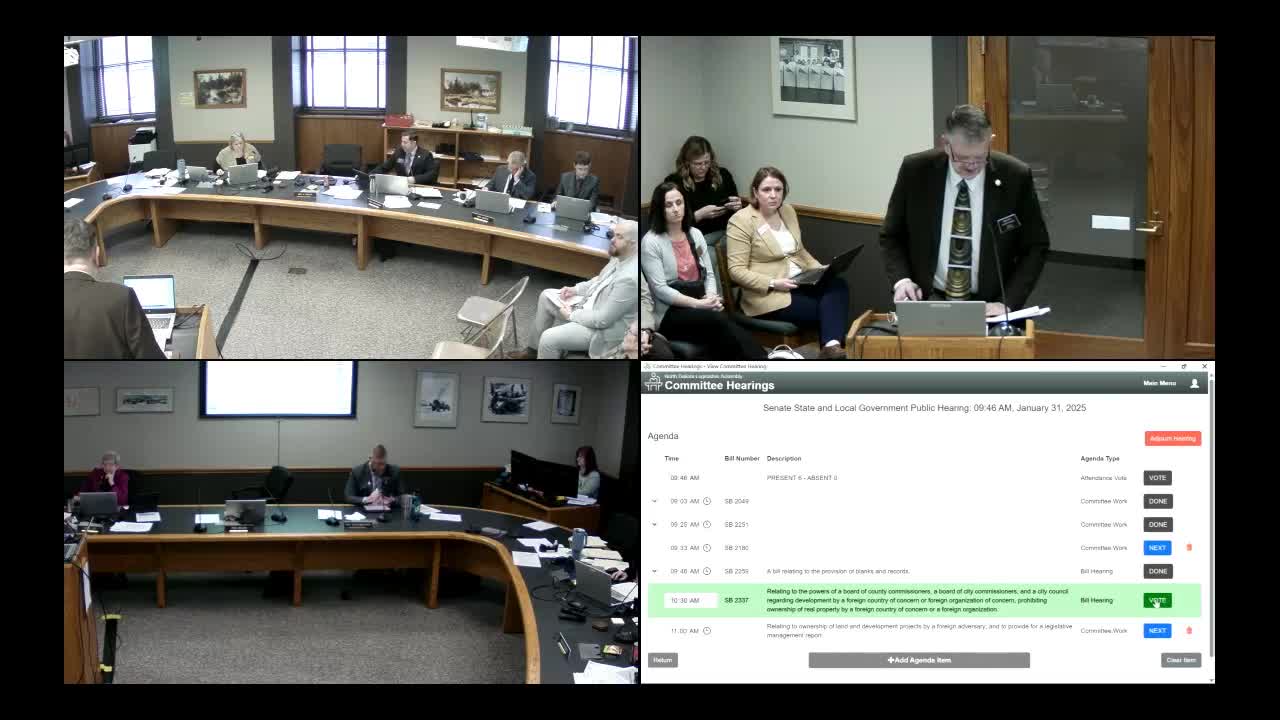
The State and Local Government Committee held hearings on two related measures aimed at limiting certain foreign ownership of North Dakota real property and extending related statutory authority: Senate Bill 2337 and Senate Bill 2361.
Senator Chuck Wallen, sponsor of SB 2337, said the bill is a reworked version of a previously failed proposal and keeps a number of prior revisions while reducing the ownership threshold in some provisions from 50% to 25% and extending a sunset date from July 31, 2025, to July 31, 2027. Wallen said he removed a section that would have required additional record-keeping filings by the secretary of state and county recorders because "they're at the end of the row." He asked the committee to act now rather than wait on federal action.
Senator Jose Castillo, sponsor of SB 2361, told the committee the bill is intended as a hedge while the executive branch conducts a study of threats and vulnerabilities; SB 2361 would extend the current statute's sunset and incorporate a study framework that mirrors House Bill 1209, which the House had passed 91-1. Castillo said state resources could conduct the study and that section 4 contains sensitive material that may need protected handling.
Opponents warned of constitutional and economic risks. Blaine Johnson, chair of the State Bar Association's Real Property Section, argued that foreign affairs and foreign commerce are federally controlled and that state-level restrictions risk federal preemption. He cited U.S. Supreme Court decisions and the 1968 Oregon case that struck down similar state restrictions on foreign land ownership. Johnson said the bills' definitions diverge from federal terms such as "foreign adversary" and that lowering an ownership threshold to 25% risks prohibiting passive investors rather than entities that actually exercise control. "This bill is clearly overreaching, certainly vulnerable to legal challenges," he said.
Johnson and other witnesses also discussed the role of CFIUS (Committee on Foreign Investment in the United States) and OFAC (Office of Foreign Assets Control). Johnson noted that federal review mechanisms are confidential, targeted and not a blanket prohibition on foreign investment; he warned that the bills' reference points — regulations in the Code of Federal Regulations — can change and are not designed around real estate purchases.
The Greater North Dakota Chamber opposed SB 2337, saying lower thresholds could affect publicly traded companies and the state's ability to attract capital. The governor's office (represented by Christopher Joseph, general counsel) said it supports House Bill 1209 (the study) but opposed sections of the bills that could raise constitutional concerns, including restrictions based on alienage or national origin.
The committee did not record a committee vote on either bill during the hearing. Sponsors and several senators urged further study; others urged caution to avoid constitutional exposure and to preserve trade.
Key technical points from the hearing: SB 2337 reduces certain ownership thresholds to 25% (from 50% in prior law), removes some filing responsibilities from recorders/secretary of state language, and extends the sunset to July 31, 2027. SB 2361 would extend the current statutory sunset and add a study and threat-assessment framework modeled on HB 1209 (which the House approved 91-1). Witnesses repeatedly referenced federal regimes (CFIUS, OFAC and 15 CFR provisions) and warned that state action can be preempted if it intrudes on foreign relations or commerce.
Committee members directed attention to the House study (HB 1209) and said they would review testimony and legal advice before further action.