Get Full Government Meeting Transcripts, Videos, & Alerts Forever!
Get email alerts on the State Legislation Floor Actions topic
No spam. Unsubscribe anytime.
Senate passes solar, cannabis and virtual power plant bills after hours of debate on energy policy
Summary
The Virginia Senate on Jan. 31 passed a package of bills including a measure to expand distributed solar carve-outs (SB 1040), a framework for adult-use cannabis retail (SB 970) and a virtual power plant pilot (SB 1100). Lawmakers debated the cost and distributional effects of clean-energy rules and how cannabis tax revenue should be allocated.
The Virginia Senate on Friday passed Senate Bill 1040, a bill that raises the renewable portfolio standard carve-out for distributed solar and increases the cap for projects on previously developed sites, after a lengthy floor debate over energy costs and siting. The chamber also approved Senate Bill 970, a framework for an adult-use cannabis retail market, and Senate Bill 1100, directing certain utilities to seek approval for a virtual power plant pilot.
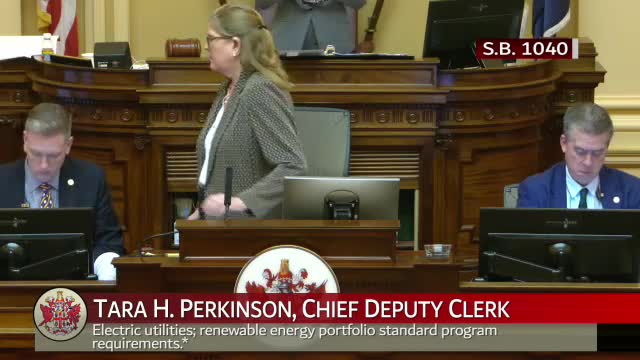
Senate Bill 1040, sponsored by Senator Glen Van Valkenburg, the senator from Western (Richmond) (Senator Glen Van Valkenburg), would raise the distributed-solar carve-out under the renewable portfolio standard from 1% toward 5%, increase the allowed size of a distributed resource from 1 megawatt to 3 megawatts, and raise the carve-out for previously developed project sites from 200 megawatts to 600 megawatts. Van Valkenburg told colleagues, "This is not about solar siding. This is about putting solar in places where people, all of us, I think, want to have solar." The bill passed, Ayes 26, Nos 14.
Why it matters: Sponsors said the bill spreads solar development into rooftops, parking lots and brownfields and seeks to reduce pressure on rural siting while offering ratepayer protections. Opponents pressed the projected cost to ratepayers under the Virginia Clean Economy Act and whether the state-level energy mandate disproportionately burdens certain areas.
Discussion and key points - Cost and distribution: Senator MacDougall, the senator from Hanover, argued that most large-scale solar deployment under the Clean Economy Act has been in rural areas and said the underlying structure is driving increased utility costs: "What is making ratepayers have to pay more? What is making it more difficult on our families to survive?" He cited a State Corporation Commission figure he summarized as roughly $9.6 billion over 10 years in Dominion's service territory and said that this raises questions about affordability and who bears the burdens of mandates. - Long-term benefits: Senator Marsden, senior senator from Fairfax, and others urged legislators to weigh long-term benefits such as avoided climate and resilience costs, saying investment now could reduce future expenses for flooding and public health impacts. - Policy detail: Sponsors emphasized ratepayer protections in the bill, a temporary in-state requirement extension to avoid deficiency payments, and strategic undergrounding provisions intended to improve resiliency.
Cannabis retail framework (SB 970) Senate Bill 970, carried by Senator Scott Rouse, junior senator from Virginia Beach, establishes a regulatory structure for adult-use cannabis including licensing, testing, transport and limits designed to support geographic diversity and public safety. "SB 970 establishes a regulatory framework for adult use of marijuana through a structured license application process," Rouse said on the floor.
Senator Adam Levin, the senator from Alexandria, supported the measure but warned about changes to the distribution of tax revenue from earlier legalization statutes. Levin noted that earlier provisions in the code directed roughly 40% of tax proceeds to pre-K programs for at-risk 3- and 4-year-olds and substantial shares to equity reinvestment and behavioral health programs. He urged caution before altering that formula, saying the state still has urgent pre-K needs. The bill passed, Ayes 21, Nos 19.
Virtual power plant pilot (SB 1100) Senator Hashmi, the senator from Richmond City, sponsored Senate Bill 1100 to require certain electric utilities to petition the State Corporation Commission to approve a 450-megawatt virtual power plant program. Hashmi described the bill as a stakeholder-crafted agreement involving utilities and environmental groups and said the program would coordinate distributed energy resources such as residential and commercial solar, battery storage, smart thermostats, water heaters, heat pumps, electric vehicles and school buses to meet peak demand. The bill passed, Ayes 22, Nos 18.
Votes at a glance (selected floor actions recorded Jan. 31) - SB 1040 (distributed solar carve-outs) — Passed (Ayes 26, Nos 14). - SB 970 (cannabis retail regulatory framework) — Passed (Ayes 21, Nos 19). - SB 1100 (virtual power plant pilot) — Passed (Ayes 22, Nos 18). - SB 779 (minimum train crew; freight movement penalties) — Passed (Ayes 21, Nos 19). - SB 948 (aircraft registration fees; up to three-year option) — Passed (Ayes 40, Nos 0). - SB 962 (procurement safety training, apprenticeships for capital projects) — Passed (Ayes 21, Nos 19).
What lawmakers said and next steps Lawmakers on both sides framed the energy votes around competing priorities: accelerating clean energy, ensuring reliability and limiting costs for households. Sponsors described SB 1040 and SB 1100 as incremental steps to expand distributed generation and to use new technologies to meet demand without building more large peaker plants. Opponents said the Commonwealth must weigh immediate cost impacts against long-term benefits.
All three bills now move to the House (or to any required follow-up steps as set by the legislative calendar). Sponsors and committee staff indicated that further rulemaking and State Corporation Commission proceedings will be necessary to implement technical parts of the measures.
Ending note Friday's floor session combined sizable policy debate on energy with recorded votes across a long slate of bills. Several measures passed unanimously or by wide margins on the uncontested calendar; other bills drew closer party-line votes on substantive policy choices that lawmakers signaled will continue through the session.