Get Full Government Meeting Transcripts, Videos, & Alerts Forever!
Get email alerts on the Fire Service Study topic
No spam. Unsubscribe anytime.
Senate committee advances study of state fire-service operations after large wildfires
Summary
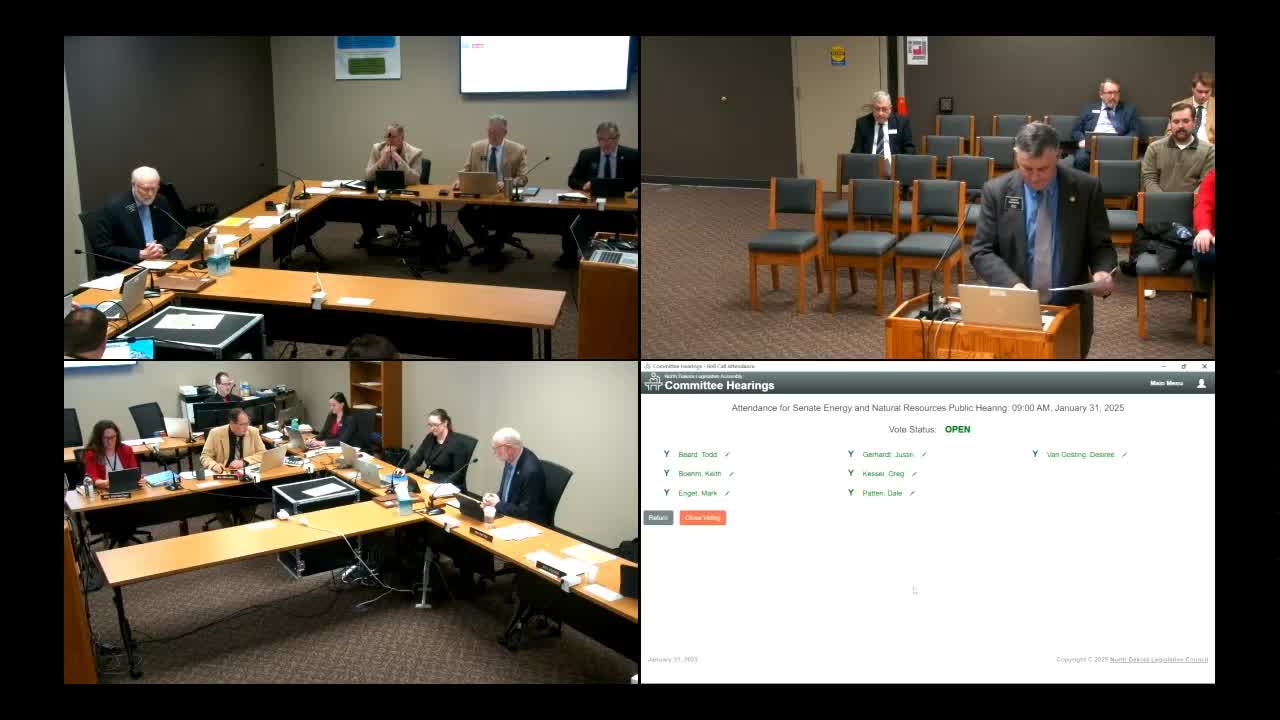
The Senate Energy and Natural Resources Committee recommended a "do pass" for Senate Bill 2340, a legislative-management study to assess North Dakota's fire-service operational and response needs after large October wildfires that stretched local and regional resources.
The Senate Energy and Natural Resources Committee recommended a do-pass for Senate Bill 2340 following a hearing in which firefighters, emergency managers and the State Fire Marshal described stretched resources and gaps in coordination during recent major wildland fires.
Senator Greg Kessel, sponsor of SB 2340, told the committee the bill would fund a comprehensive study to "assess current capabilities and identify gaps" and to develop "a road map to enhance the state's fire service preparedness and response capabilities." He opened testimony by saying, "The devastating October wildfires highlighted critical shortcomings in our state's emergency response capabilities." (Sen. Greg Kessel)
Why it matters: Committee testimony said local volunteer departments and county emergency managers bore the brunt of recent large fires, leaving little capacity to backfill other emergencies. Witnesses asked the Legislature to require a statewide sit-down of local, state and federal partners to identify training, mobilization, resource and communications improvements.
State Fire Marshal Doug Nelson described arriving at the October fires and seeing largely the same firefighters working long shifts days after the initial starts. Nelson asked, "Am I doing enough?" and described the State Fire Marshal's Office as having 10 staff, saying that the study would let agencies "stand back, get all partners to the table and all stakeholders to the table to make the best decisions for the fire service as we go forward." (Doug Nelson, State Fire Marshal)
Local chiefs and county emergency managers told similar stories. Williston Fire Chief Matthew Clark said his agency responded to a "90,000-acre" incident that required more than 25 agencies and described crews pushed to their limits: "we were sending crews upwards 5 to 6 miles ahead of the fire just to try to do what we could to catch it." (Dr. Matthew Clark, Williston Fire Chief)
Billings County Chief and Emergency Manager Kyle Shockley, and Williams County Emergency Management Director Mike Smith, described repeated multi‑agency responses, the need for regionalized protocols to backfill volunteer departments, and the large number of hazardous-material facilities in parts of the state. "North Dakota is made about 94% of volunteer firefighters," Shockley said, arguing the study could help develop protocols to backfill stations during high‑risk periods. (Kyle Shockley)
Watford City Chief Dave Bulick said his department and neighboring departments were tapped out during the October fires and urged creation of a regionalized system so local chiefs can call a single point of contact for resources. Carrington Volunteer Fire Chief Ken Wong described a separate July rail-derailment hazmat response that required extended personnel rotations and mutual-aid assets from across the region.
What the bill would do: SB 2340 would establish a legislative-management study to convene stakeholders — including local fire chiefs, Department of Emergency Services, the State Fire Marshal, Department of Forestry, National Guard and others — to evaluate training, mobilization, coordination, and resource needs, and to produce recommendations for operational and funding changes.
Discussion vs. decision: Committee discussion focused on whether the study should examine prevention as well as response. Senator Kessel and others said SB 2340 is intended as the response-side study, with a follow-up bill addressing prevention and industry engagement. The committee voted to recommend a do-pass on SB 2340.
Votes and next steps: The committee adopted a motion for a due-pass recommendation on SB 2340 (mover: Senator Beard; second: Senator Gearhart). The electronic vote recorded 7 ayes, 0 nays. Senator Greg Kessel volunteered to carry the bill to the Senate floor.
Ending: Supporters emphasized regional planning, clearer communication lines, and sustained funding and training for volunteer and career firefighters. Proponents said the study is the first step to produce recommendations lawmakers can use to improve readiness and avoid exhausting local resources in future large-scale incidents.