Get Full Government Meeting Transcripts, Videos, & Alerts Forever!
Get email alerts on the Market Based Sourcing Corporate Tax topic
No spam. Unsubscribe anytime.
Committee tables bill to move Virginia to market-based sourcing for corporate sales
Summary
The House Finance Committee tabled HB1866, a bill to shift Virginia from a cost-of-performance method to market-based sourcing for intangible and service income; proponents said it would improve competitiveness, opponents raised revenue and federal-contract complexity concerns.
The House Finance Committee on a recorded vote tabled HB1866 on market-based sourcing, a change to how Virginia attributes corporate income from intangibles and services that would align the commonwealth with most other states.
Supporters said market-based sourcing would make Virginia more competitive for tech and information firms that sell services across state lines, while opponents, including contractors for the federal government, warned the change could reduce revenue and create uncertainty for companies that serve federal clients.
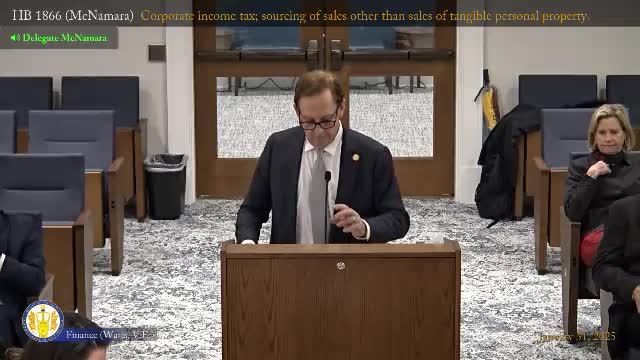
Delegate Patrick McNamara, the bill’s patron, told the committee HB1866 would replace Virginia’s current cost-of-performance method — which attributes income where the majority of the costs of performing the service occur — with a market-based approach that assigns income where the service’s benefit occurs. “If the majority of the cost of performing this income producing activity occurs in Virginia, then that income is attributed to Virginia,” McNamara said, and added that roughly 41 of 49 states with corporate income taxes use market-based sourcing.
Proponents and industry groups urged change. Emily Walker of the Virginia Society of CPAs said the shift was an equity and fairness issue and that surrounding states’ adoption supported Virginia making the change. Chris Lloyd of McGuireWoods Consulting, speaking for CoStar, said targeted prior exceptions for some industries had produced local investment in Richmond and argued a uniform rule would be broadly beneficial.
Opponents raised practical concerns. Heidi Abbot, representing Northrop Grumman, said the company’s largest clients are federal agencies and that it has difficulty identifying the geographic source of many contracts; she and other opponents urged clearer, code-based rules rather than leaving “reasonable approximation” decisions to the tax commissioner. McNamara acknowledged potential short-term negative revenue impacts and told the committee that the Department of Taxation could develop guidance over the following year and that some states apportion federal-contract revenue by population share.
After debate and a substitute motion to lay the bill on the table, the committee voted to table HB1866 by a tally reported as 12-8. The committee record did not publish individual roll-call votes beyond the tally. The bill’s proponents said the pause would allow Tax and stakeholders to refine rules; opponents said more study should precede a vote.
Votes at a glance: HB1866 — Motion to lay on the table: passed, tally reported 12 yes, 8 no; outcome: tabled.