Get Full Government Meeting Transcripts, Videos, & Alerts Forever!
Get email alerts on the Long Term Care topic
No spam. Unsubscribe anytime.
Committee backs bill to let Social Services seek receivership for troubled assisted living facilities
Summary
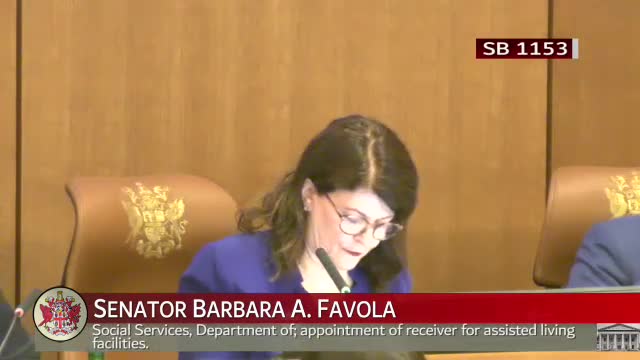
Senate Bill 1153 would give the Virginia Department of Social Services authority to petition for a receiver to manage assisted living facilities with serious life‑safety issues, mirroring existing authority for skilled nursing facilities; the committee adopted a substitute and reported the bill unanimously.
Senate Bill 1153, sponsored by Senator Mark Obenshain, would authorize the Virginia Department of Social Services (DSS) to petition a court to appoint a receiver to manage an assisted living facility when there are documented life‑safety and welfare concerns that place residents at risk. The committee adopted a substitute and reported the bill by voice vote, recorded as 15‑0 in committee.
Obenshain told the committee the measure responds to recurring incidents in which assisted‑living facilities had serious health and safety failures and state officials lacked an administrative mechanism to assume control and protect residents. “There is a statutory process by which they can do that in nursing homes,” Obenshain said. “But for a skilled assisted living facility, the Department of Social Services explained to me that because of due process concerns, they have to wait until somebody is actually convicted… which places these residents in severe risk.”
Under current law, DSS and the Department of Health have different legal authorities for nursing homes and skilled nursing facilities. The bill’s substitute makes technical and placement changes requested by DSS so the receivership process is aligned with the facilities most affected, the sponsor said. Committee staff and general counsel described the changes as technical in nature intended to place the text in the most appropriate code section.
Committee members asked about procedural safeguards, notification processes and judicial oversight. Staff confirmed that a judge would determine whether receivership is appropriate and that the substitute retains notification and other procedural protections. During discussion Senator Williams Graves and others described the bill as a needed “tool in the toolbox” for situations in which residents face ongoing danger; witnesses said one facility cited in testimony still housed about 40 residents.
The committee adopted the substitute and the clerk recorded the vote as 15‑0, reporting the bill to the floor.
ACTIONS: Motion to adopt substitute and report SB 1153; outcome: reported (committee voice vote recorded as Ayes 15, No 0).