Get Full Government Meeting Transcripts, Videos, & Alerts Forever!
Get email alerts on the State Revenue Forecast topic
No spam. Unsubscribe anytime.
JLBC projects modest revenue growth; $935 million projected ending balance before adjustments
Summary
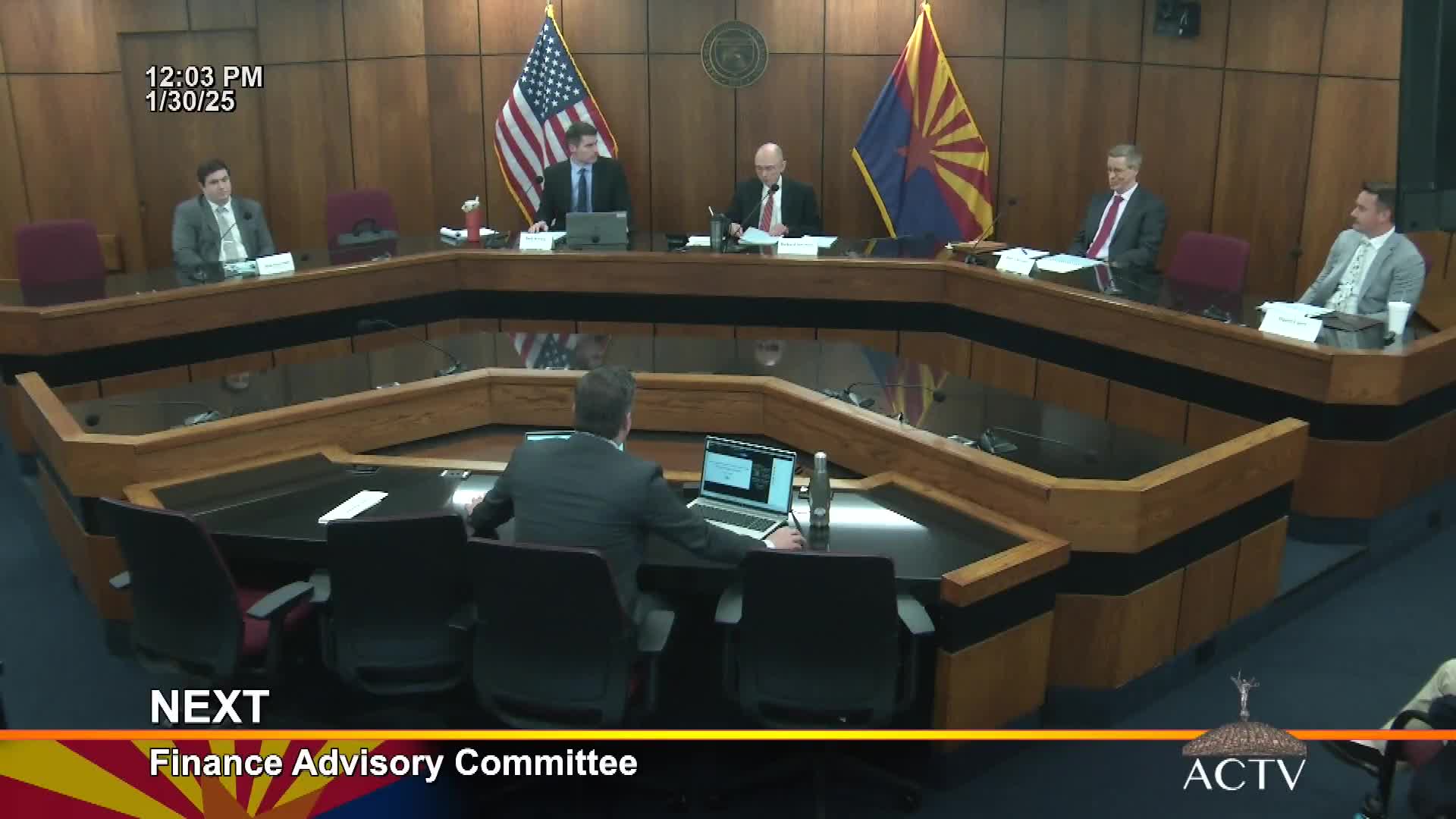
Arizona Joint Legislative Budget Committee officials told the Finance Advisory Committee that general fund revenue should grow slowly over the next three years, producing a projected $935 million ending balance for FY26 before set-asides and ongoing one-time items reduce that amount to roughly $560 million.
The Joint Legislative Budget Committee’s Finance Advisory Committee heard January briefings showing modest statewide revenue growth and continuing uncertainty about how much of recent gains are repeatable. Richard (JLBC staff) said the committee’s four-sector forecast projects general-fund revenue growth of 2.7 percent for the current fiscal year and gradual improvement through FY28.
The projections matter because state budgeting uses a three-year planning horizon. Richard said available resources for the FY26 plan start at $935,000,000 in projected ending cash but that staff proposed setting aside $50,000,000 as an ending-balance reserve. He also said two recurring items — school facility repairs and subsidies to the state employee health insurance system — together account for roughly $183,000,000 and $140,000,000 (as shown on the slides), reducing what the committee regards as freely available one-time dollars to about $560,000,000.
Hans Lisonbee, chief economist for JLBC, summarized the four-sector process used to form the baseline forecast and the near-term performance of major tax categories. "For the current fiscal year, GF revenue is projected to grow by 2.7 percent," Lisonbee said, adding that the office expects gradual improvement to 3.4 percent in FY26 and 4.8 percent in FY28.
Year-to-date comparisons to the budget enacted for FY25 show mixed results: Richard reported that individual income-tax receipts are about $126,000,000 above the forecast (with withholding up about 7.4 percent year over year), corporate collections are roughly $97,000,000 above forecast (about 11 percent growth), and sales-tax collections are up about 3.4 percent year to date, roughly in line with the enacted forecast. The JLBC noted more than 60 percent of the $425,000,000 positive variance in FY24 collections came from non-tax sources, including likely one-time Medicaid reimbursements.
The JLBC baseline includes a $557,000,000 spending increase in FY26 when combining ongoing formula-driven increases and the removal of some one-time appropriations; staff estimated general-fund spending at about $16,600,000,000 for FY26 versus $17,500,000,000 in forecast revenue before set-asides. The committee also noted the state's budget stabilization fund (the rainy-day fund) holds approximately $1,600,000,000 and is excluded from the general-fund cash-balance figures discussed.
Jack Brown (JLBC staff) reviewed differences between the JLBC baseline and the executive budget. On a cumulative basis for FY25–FY28 the executive’s forecast shows roughly $360,000,000 more revenue than the JLBC baseline, and the executive budget also proposes several policy changes that would affect the general fund. Brown listed three tax-policy proposals in the executive budget: increase and extend the low-income housing tax credit (from a current $4,000,000 annual award limit and extending the program through calendar year 2031 while raising the annual limit to $10,000,000), a new corporate income-tax credit (estimated at $1,000,000) to subsidize employer-provided childcare assistance, and a one-time transfer of $75,000,000 from the prescription drug rebate fund to the general fund.
No formal committee votes or statutory changes were taken during the meeting; presenters described forecasts, assumptions and policy options for legislators to consider ahead of upcoming budget deliberations. The committee plans its next forecast update in April.