Get Full Government Meeting Transcripts, Videos, & Alerts Forever!
Get email alerts on the Alcohol Regulation topic
No spam. Unsubscribe anytime.
Senate committee advances temporary reduction in mixed-beverage food-to-alcohol ratio after hours of testimony
Summary
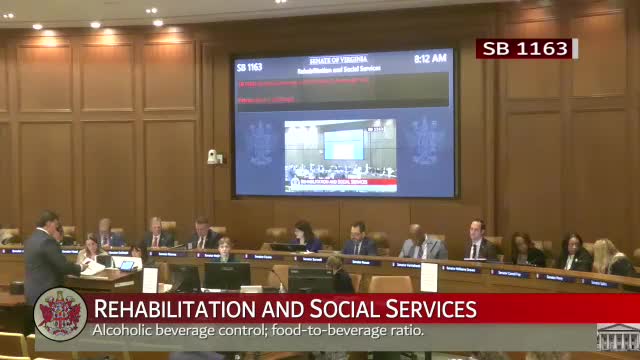
Senate Bill 1163, which would lower Virginia’s mixed‑beverage food‑to‑alcohol ratio to 30% under a two‑year pilot, was advanced by the Senate Rehabilitation and Social Services Committee on a 14‑1 vote.
Senate Bill 1163, which would lower Virginia’s mixed-beverage food-to-alcohol ratio to 30% for a two-year pilot and require a post‑pilot report to the General Assembly, was advanced by the Senate Rehabilitation and Social Services Committee on a 14-1 vote.
The bill’s patron, Senator McDougall, told the committee the change responds to a shift in consumers toward higher-priced distilled‑spirit cocktails and to pricing changes since the ratio was last set. “We are trying to deal with the fact that pricing has changed, not only in the industry, but the Commonwealth,” McDougall said during his presentation.
The bill would codify several regulatory practices in statute, require restaurants to have at least as many table seats as counter seats, reduce the ratio to 30% for establishments that meet a monthly minimum of $4,000 in food sales, and include a July 1 effective date and a two‑year sunset so the legislature can review collected data.
Supporters included restaurateurs and industry representatives who described tight margins in the restaurant business and said the pilot would let regulators collect real data. Tom List, an attorney who has represented restaurants across Virginia, said the measure provides needed flexibility and “protects public safety because it does say you must be open in the kitchen and serving food as long as you’re serving alcohol.” Restaurateur Donnie Glass said smaller establishments can be forced into difficult pricing choices and described the bill as “a very reasonable compromise.” David Hallock of 2 Capital Consulting urged the committee to use the two‑year period to gather evidence on market effects.
Opponents, including the Virginia Restaurant Association and other restaurant owners, said the change would permit more bar‑style operations and could undercut existing restaurants. Matt Betko of the Virginia Restaurant Association warned the bill would “create bars in this state” and urged a fiscal and market impact review. Several individual restaurant owners said meeting food‑sales requirements is currently straightforward and that lowering the ratio to 30% risks creating competitive imbalances and encouraging fraud.
Committee members pressed on operational details such as whether kitchens must remain open when alcohol is served and how much data the two‑year pilot would yield. Senator Serveau asked whether the statutory change would require kitchens to stay open until closing; patrons and staff replied that current ABC regulations require food to be available up to 30 minutes before closing and that the bill seeks to codify that practice. McDougall said the bill’s data collection will start as ABC implements the change and that the two‑year sunset was a negotiated compromise.
The committee adopted a substitute and voted 14-1 to report the bill to the Senate floor. The substitute retains the $4,000 monthly food minimum and the 30% ratio, and adds the two‑year sunset and the reporting requirement to the committee chairs.
The bill drew more than an hour of testimony, including more than a dozen industry and community speakers. The committee’s action sends the measure to the full Senate for further consideration.
ACTIONS: Motion to adopt substitute and report SB 1163 to the Senate floor; outcome: reported (vote recorded in committee: 14 ayes, 1 no).