Get Full Government Meeting Transcripts, Videos, & Alerts Forever!
Get email alerts on the Jail Funding Infrastructure topic
No spam. Unsubscribe anytime.
Committee weighs new jail fund versus existing infrastructure loan fund; Bank of North Dakota briefs members on capacity and limits
Summary
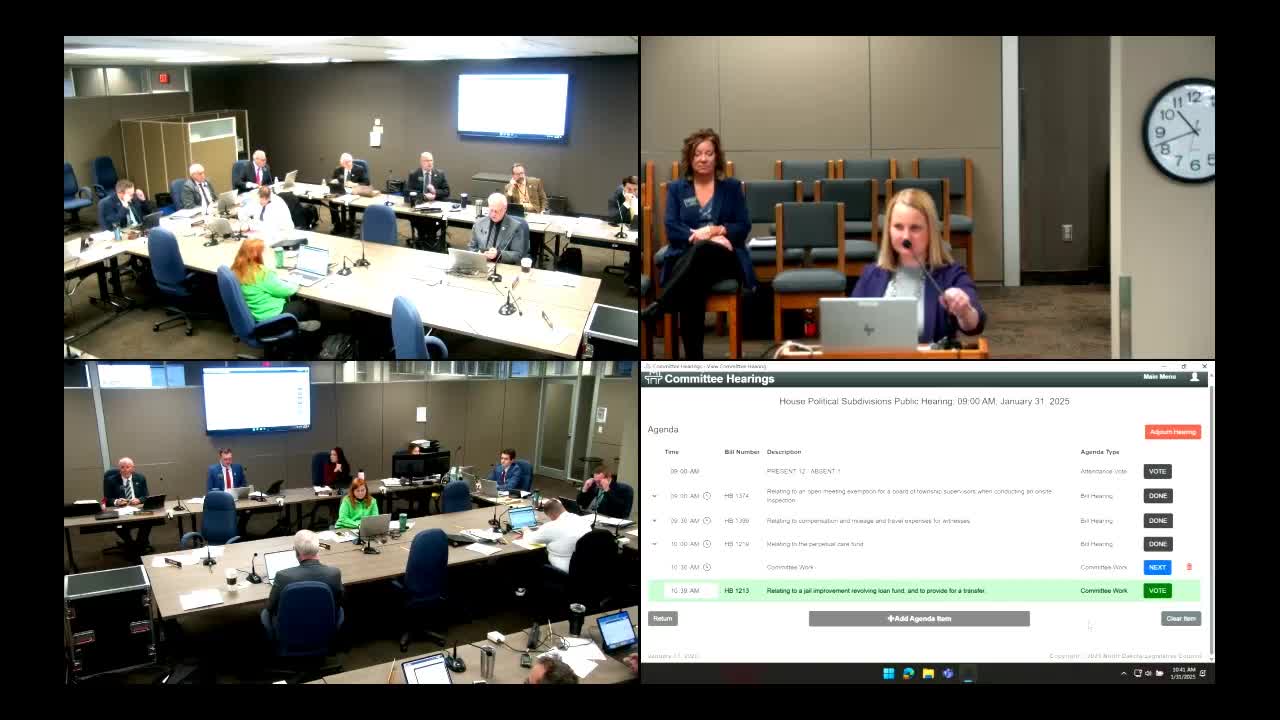
Lawmakers discussed House Bill 1213 (jail improvement revolving loan fund) and House Bill 1197 (proposed $50 million in grants) and heard from the Bank of North Dakota that counties can already borrow for jails from the state infrastructure revolving loan fund but that the fund currently has limited available cash.
Committee members spent an extended portion of the hearing evaluating proposals to fund jail construction and renovation, hearing from the Bank of North Dakota about existing borrowing options and limits.
Kiley Merkel, a business banker with the Bank of North Dakota who works with legislatively directed loan programs, told the committee that political subdivisions can already borrow from the state infrastructure revolving loan fund for essential buildings and infrastructure; a jail generally qualifies as an essential building. Century code imposes a $20 million cap in outstanding loans per qualified applicant, Merkel said, and the revolving fund offers a low interest rate (the infrastructure fund is administered at about a 2% rate; a bill proposal had contemplated 1% in one draft). Loan terms can reach up to 30 years or the useful life of the asset.
Merkel said the combined administered funds (the active infrastructure revolving loan fund plus a legacy infrastructure fund used for liquidity) currently have about $7 million available for new loans; the legacy fund authorizes up to $150 million in transfers over time and roughly $100 million has already been transferred into the active fund, with capacity to transfer additional amounts as prior loans are repaid.
Representative Kathy Fralick, sponsor of House Bill 1213, asked the committee to consider a dedicated jail improvement loan fund and a separate oversight committee to recommend allocations and priorities. Other lawmakers cautioned about the size of proposals under consideration — including earlier drafts that contemplated hundreds of millions in authorization — and urged the committee to consider either (a) enlarging the existing infrastructure revolving loan fund or (b) directing appropriators to consider a specific set aside for jails rather than creating a large new vehicle.
Members debated whether grants or loans would be preferable: House Bill 1197 proposed a $50 million grant transfer from a strategic investment fund to support jail projects, while the revolving‑loan approach would require local repayment sources such as sales tax or property tax votes to demonstrate capacity to repay. Bank staff said loans are typically approved only after a project demonstrates an ability to repay, and the applicant must begin drawing on an approved loan within one year of approval.
Committee members discussed a mix of short‑term remodeling needs and long‑term capacity planning, including whether regional facilities could reduce per‑bed costs and address staffing shortages. Some members recommended converting one or both pending bills into a focused study that would generate an implementation plan and funding options rather than advancing a large appropriation immediately.
No committee vote was taken on either House Bill 1213 or House Bill 1197 during this hearing; members asked staff and Bank of North Dakota officials for more information and signaled interest in coordinating with appropriations and broader policy study efforts.