Get Full Government Meeting Transcripts, Videos, & Alerts Forever!
Get email alerts on the Witness Reimbursement topic
No spam. Unsubscribe anytime.
Committee recommends increasing prosecution witness reimbursement and allows counties to share unused funds
Summary
The committee voted 12–0, 1 absent, to give House Bill 1399 a do‑pass recommendation. The bill raises the attorney general’s per‑county reimbursement cap for prosecution witness expenses from $25,000 to $30,000 per biennium and allows counties to enter written agreements to transfer unused funds to other counties with AG approval.
The House Political Subdivisions Committee recommended a do‑pass for House Bill 1399 after hearing testimony that some counties routinely exceed the current reimbursement cap for prosecution witness expenses.
Representative Killemin introduced the bill on behalf of the North Dakota State’s Attorneys Association. The proposal would increase the statutory cap on county prosecution witness reimbursements from $25,000 to $30,000 per county per biennium. Under current practice, counties submit incurred prosecution witness expenses to the attorney general’s office for reimbursement; the attorney general’s office maintains the fund that reimburses those costs.
Rosa Larson, Ward County state’s attorney, told the committee Ward County routinely exceeds the current $25,000 cap and provided examples from 2023 and 2024 in which multiple homicide prosecutions produced large witness lists and substantial travel and per‑diem costs. Larson said one 2023 trial required a change of venue, producing more than $17,000 in witness costs for that case alone, and that a three‑week trial expected in March led her to budget roughly $40,000 for costs tied to travel and per diem.
"Ward County exceeds that amount every single biennium," Larson said, describing large homicide cases and the associated number of subpoenaed witnesses as primary drivers of costs.
Tasha Gerdy, an accounting manager with the attorney general’s office, told the committee the office’s budget for witness reimbursements historically has been far below the sum of the statutory per‑county caps: the AG’s office budgets roughly $95,000 per biennium for the program and typically requests a deficiency appropriation because expenditures exceed that budget. Gerdy said the fiscal note for the bill shows a potential increase of $265,000 per biennium if the cap rises by $5,000 for each of 53 counties.
The bill would also allow a county that needs additional funds to enter into a written agreement with another county to obtain that county’s uncommitted funds; those transfers would be subject to the attorney general’s approval, supporters said, to avoid coercion or inappropriate use.
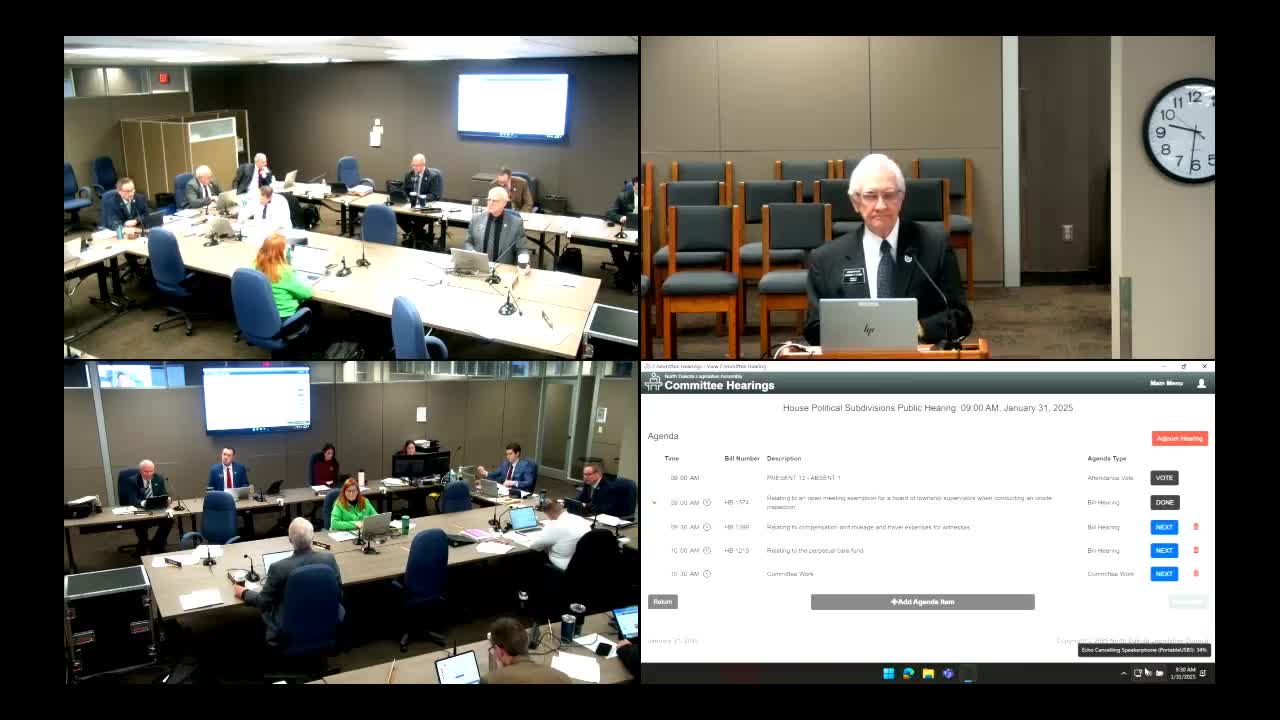
Representative Hager moved a do‑pass recommendation; Representative Haddleston seconded. The committee voted 12 yea, 0 nay, 1 absent, not voting. Committee members also discussed referring the bill to appropriations because of the fiscal impact; committee staff noted the fiscal note will travel with the bill.