Get Full Government Meeting Transcripts, Videos, & Alerts Forever!
Get email alerts on the NAGPRA Repatriation topic
No spam. Unsubscribe anytime.
UND president, tribal leaders ask for $5 million to support NAGPRA compliance and repatriation
Summary
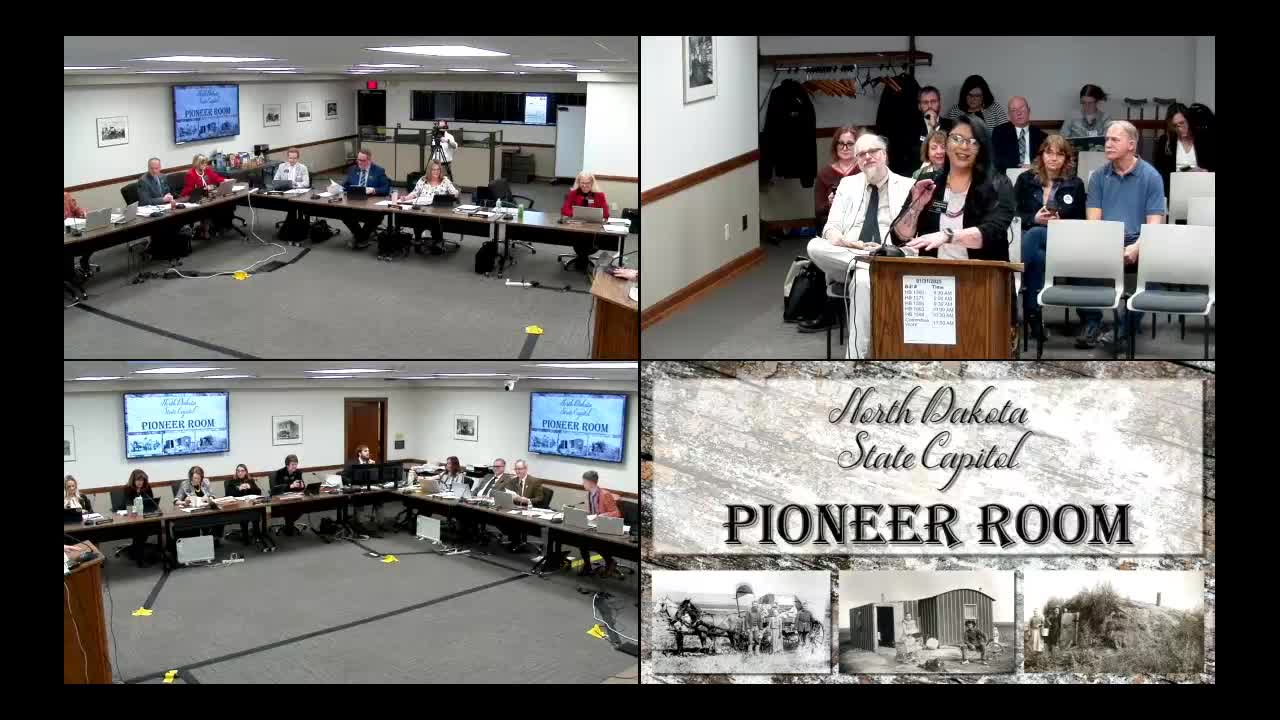
Representative Colette Brown and University of North Dakota President Andy Armacost told the Government and Veterans Affairs Committee that House Bill 1603 would create a state fund, administered by the State Historical Society, to help institutions and tribes cover costs associated with Native American Graves Protection and Repatriation Act
Representative Colette Brown (District 9) introduced House Bill 1603, a proposal to appropriate $5,000,000 to the North Dakota State Historical Society to assist tribal nations and state institutions with compliance under the Native American Graves Protection and Repatriation Act (NAGPRA). The proposal would fund inventories, consultations, travel, expert consultants and related repatriation work.
President Andy Armacost of the University of North Dakota described UND’s multiyear repatriation work and said the principal barrier to meeting NAGPRA obligations is expense: specialists, consultants and travel for tribal leaders. “Our tribal nations will be at the center of this time‑consuming and exhausting work, and establishing a repatriation fund will help them and will help the North Dakota institutions…to execute their responsibilities under NAGPRA,” Armacost said. He said UND had spent about $2.5 million to date on its own repatriation work and that the proposed statewide fund would help smaller institutions and tribes meet obligations.
Nut graf: The bill would create a dedicated appropriation to support repatriation efforts across the state; tribal representatives and cultural liaisons urged the committee to allow additional drafting time so tribal historic preservation officers could offer technical amendments to strengthen repatriation procedures.
Tribal leaders and representatives testified in favor. James Dakota, cultural liaison for the Turtle Mountain Band of Chippewa, called the appropriation a step toward justice and cultural healing. Rep. Lisa Finley DeVille (representing the Mandan, Hidatsa and Arikara Nation) requested additional time to amend the bill because the MHA Tribe’s THPO staff were ill and had technical input the tribe wanted to add.
Other witnesses — including UND alumnus and researchers — urged the committee to act to stop ongoing harms and speed the return of ancestors and sacred objects. Alicia LeCount, general counsel for the Turtle Mountain Band, said repatriation work is often time‑consuming but central to community healing, and that federal NAGPRA already requires institutions to return items; state funding would remove a financial barrier.
Ending: Committee members closed the hearing after extensive supportive testimony and a request from tribal representatives for more time to propose technical amendments. No committee vote is recorded in the hearing transcript; sponsors indicated they would accept amendments to strengthen repatriation timelines and consultation procedures.