
Architects, state officials present revised Jamestown state hospital design, target $300 million budget
Get AI-powered insights, summaries, and transcripts
Sign Up Free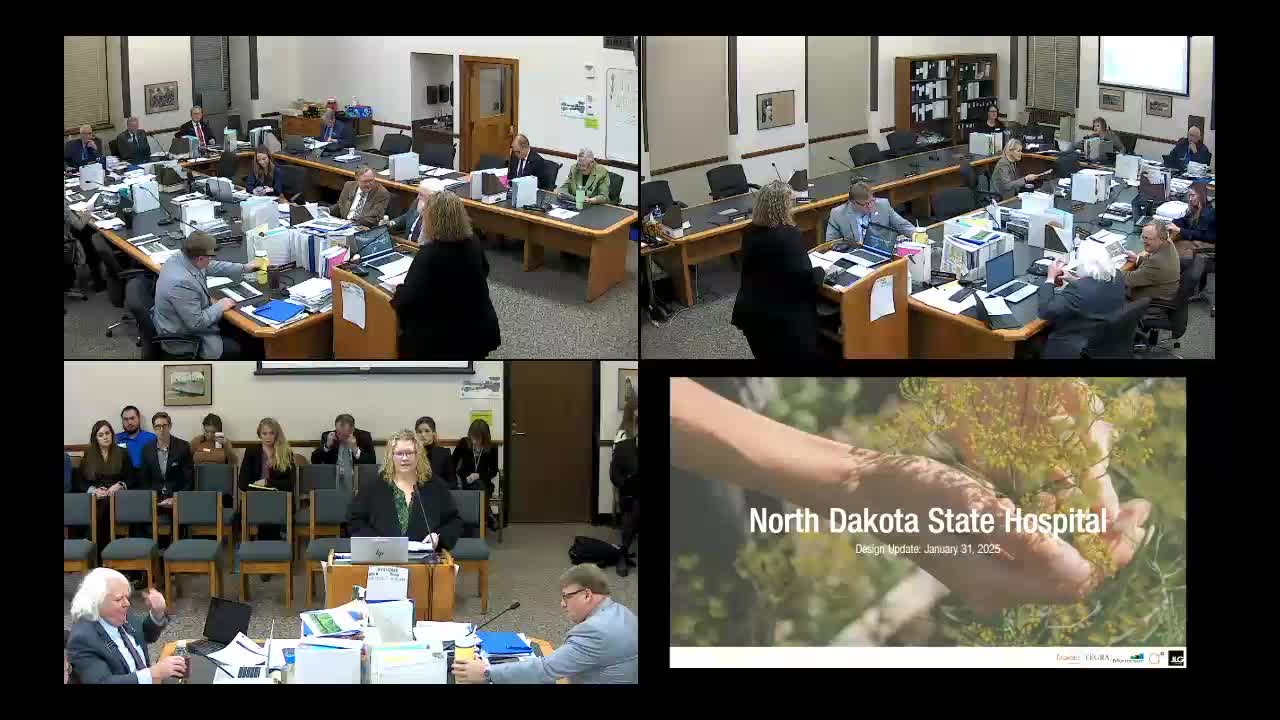
Summary
The House Appropriations Committee’s Human Resources Division received a detailed update from architects and state hospital leaders on a proposed replacement of the North Dakota State Hospital in Jamestown, including a target $300 million total project budget, a 141‑bed program and a planned construction start in July or August 2025.
The House Appropriations Committee’s Human Resources Division received a detailed update from architects and state hospital leaders on a proposed replacement of the North Dakota State Hospital in Jamestown, including a target $300 million total project budget, a 141‑bed program and a planned construction start in July or August 2025.
The presentation, led by Pam Sagness, executive director of Behavioral Health at the Department of Health and Human Services; owner’s representative Mike Van Clie of TIGER Group; architect Mark Hunze of JLG Architects; construction manager Joanna Slominski of Mortenson; and others, described design decisions intended to consolidate roughly 546,000 square feet across 30 existing campus buildings into a modern facility of about 295,000 square feet. The team said the budget target reflects value engineering and scope reductions, and that occupancy is planned for December 2027 if the schedule holds.
Why it matters: planning officials said the new facility would reduce long‑term maintenance and utilities costs, improve therapeutic space and staff efficiency, and replace buildings with documented deferred maintenance. The committee heard that the design balances inpatient capacity with community services already expanding across North Dakota.
Design, site and program The team said it evaluated about 25 sites and settled on a location immediately west of the existing state hospital campus in Jamestown, adjacent to Interstate 94, to keep the project contiguous to the community and to leverage existing state utilities and services. Todd Med of JLG described the plan as a “house–neighborhood–downtown” model intended to support rehabilitation: private patient rooms, courtyards, a clinic spine, therapy and vocational spaces, and a downtown‑style commons with a bank and salon for practice of community skills.
Architect Mark Hunze said the project is built around guiding principles including recovery, safety, reintegration and efficiency. He told the committee the design would replace more than 540,000 square feet of aging campus buildings with about 295,000 square feet of new construction.
Budget, schedule and scope adjustments Mortenson’s Joanna Slominski summarized cost benchmarking and validation work and said the construction portion of the current design is budgeted at about $248 million; total project outlay (soft costs, furniture, tech, contingency) is being managed to a $300 million total project budget. "Right now, that current budget is at 248," she said.
The team reported they reduced scope from an earlier design to reach the $300 million target. The largest single change was removing one full adult inpatient unit (24 beds) from the earlier plan, a move the design team said saves about $9 million in construction costs while preserving flexible unit design elsewhere. Additional scope reductions under consideration (two of six exterior courtyards, a separate maintenance building and a greenhouse/therapy space) were estimated to yield roughly $12 million more in savings, bringing design scope in line with the $300 million figure.
The committee discussed alternatives to accelerate work. Van Clie and other presenters said an early bid package strategy would let sitework and foundations begin in late summer 2025 while remaining design details are finalized, and they reiterated the team’s schedule goal: begin construction July–August 2025 and aim for occupancy in December 2027.
Beds and flexibility The revised program presented to the committee would include 141 beds divided as follows in the design team’s breakdown: 40 SOTEP (sex‑offender treatment), 25 gero‑psychiatric beds, 25 forensic beds, 26 admissions beds and 25 adult psychiatric rehabilitation beds. The team emphasized that many areas are being designed for flexibility so spaces can be converted between inpatient and residential uses if needs change.
Medical director Eduardo Yabut, MD, endorsed design choices intended to support treatment: he said private rooms are essential for recovery and dignity and called the decision for all private bedrooms “non negotiable, the private room thing in my opinion.” The design team and Yabut also described clinic spaces intended to allow basic medical, dental, podiatry and x‑ray services to be provided on‑campus rather than routinely transporting patients to off‑site hospitals.
Operations, costs and long‑term savings Mark Hunze told the committee the state’s new building could cut plant operations costs approximately $3.1 million per biennium (he compared about $5 million biennial costs for the existing campus to a projected $2 million for the new facility). The team also said deferred maintenance on campus currently totals roughly $47 million for the buildings being replaced.
Funding history and next steps Presenters noted the design was funded with a $12.5 million appropriation for design in the previous legislative session and that HHS used those funds for surveys, geotechnical work and design development; the department also used a roughly $3 million emergency capital fund to close a shortfall in the preconstruction budget. The $300 million total project budget in the executive recommendation would be financed by bonding, the team said, and the presenters asked the committee for continued support so early bid packages and procurement can proceed.
Follow‑up and outstanding items Committee members asked for more detail about what would change if the budget were constrained further, how staffing would differ in the new facility versus the current campus, and how local subcontractors would be engaged in bidding. Pam Sagness told the committee staff would provide an updated document with the financials the committee requested. The design and construction team said they will provide additional benchmarking, staffing projections and a list of subcontractors and outreach done to date.
What’s next: the project team said it will continue design and cost validation work, provide updated financials to the committee, and proceed with early procurement planning to enable site work this summer if funding and approvals advance on schedule.