Get Full Government Meeting Transcripts, Videos, & Alerts Forever!
Get email alerts on the Environmental Management topic
No spam. Unsubscribe anytime.
Canton Township staff outlines five mitigation options in proposed tree and woodland preservation ordinance
Summary
Canton Township planning staff presented five mitigation options in a draft tree and woodland preservation ordinance, from on‑site replacement plantings to an individualized ecological assessment using i‑Tree software.
Canton Township planning staff presented draft mitigation standards for a proposed tree and woodland preservation ordinance and described five mitigation options staff recommends making available to applicants, ranging from simple replacement planting to a detailed, individualized ecological assessment.
The discussion focused on balancing predictable, administrable options for routine development with a more technical, site‑specific mitigation pathway for large woodlands. The commission did not take formal action; staff said it will return with scenario analyses and mapping to refine exemptions and thresholds.
Why it matters: the mitigation approach will determine how the township weighs the environmental and public‑health benefits of existing trees against development needs. The draft ties mitigation to quantifiable benefits in some cases and explicitly allows credits where developers already plant trees required elsewhere on a site (for example, stormwater pond landscaping).
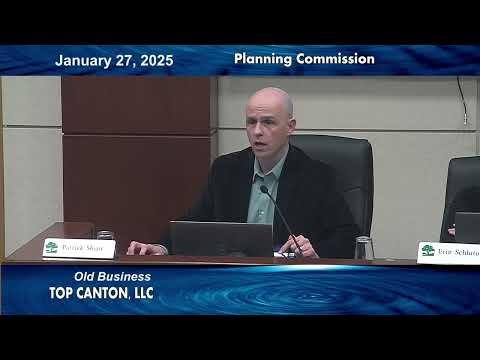
Five mitigation options: Patrick (Planning Department staff) walked commissioners through the proposed options: 1) On‑site tree planting using a replacement formula (proposed 2‑inch caliper replacement trees to improve survival rates) and allowing credits for landscaping trees already required under separate landscape standards; 2) Planting required replacement trees on township property with township agreement; 3) Planting in homeowner‑association common areas where the HOA agrees to accept and maintain plantings; 4) Proportionate payment into a township tree fund with a cap tied to the assessor’s land value (staff proposed a maximum payment capped at 50% of parcel land value); and 5) An individualized mitigation calculation using ecological assessment software (staff demonstrated an i‑Tree analysis for a 27‑acre Canton property and described outputs such as carbon sequestration, air‑pollutant removal and avoided runoff gallons).
Exemptions, credits and implementation: staff explained the ordinance would exempt dying or hazardous trees, invasive species on an exempt list, and trees within utility or drainage easements from mitigation. The draft also proposes credits so trees planted to meet landscape or stormwater requirements can offset mitigation obligations where appropriate. Patrick told commissioners the individualized option (option 5) is more technical and time‑consuming but offers a means to quantify hydrological, air‑quality and carbon benefits and to set mitigation schedules (for example, a 10–15‑year horizon to achieve projected benefits from replanting).
Commissioner comments and next steps: commissioners asked how exemptions and small‑lot thresholds would work in practice and requested mapping of parcel sizes (quarter acre, half acre, two acres) and scenario planning; Patrick said the department will prepare maps and examples and return to the commission before a public hearing. Staff also said payment calculations will rely on the most recent Canton Township assessor land‑value figures.