Get Full Government Meeting Transcripts, Videos, & Alerts Forever!
Get email alerts on the Residential Contractors Recovery Fund topic
No spam. Unsubscribe anytime.
Committee advances cut to residential contractors' recovery-fund assessment if fund balance remains high
Summary
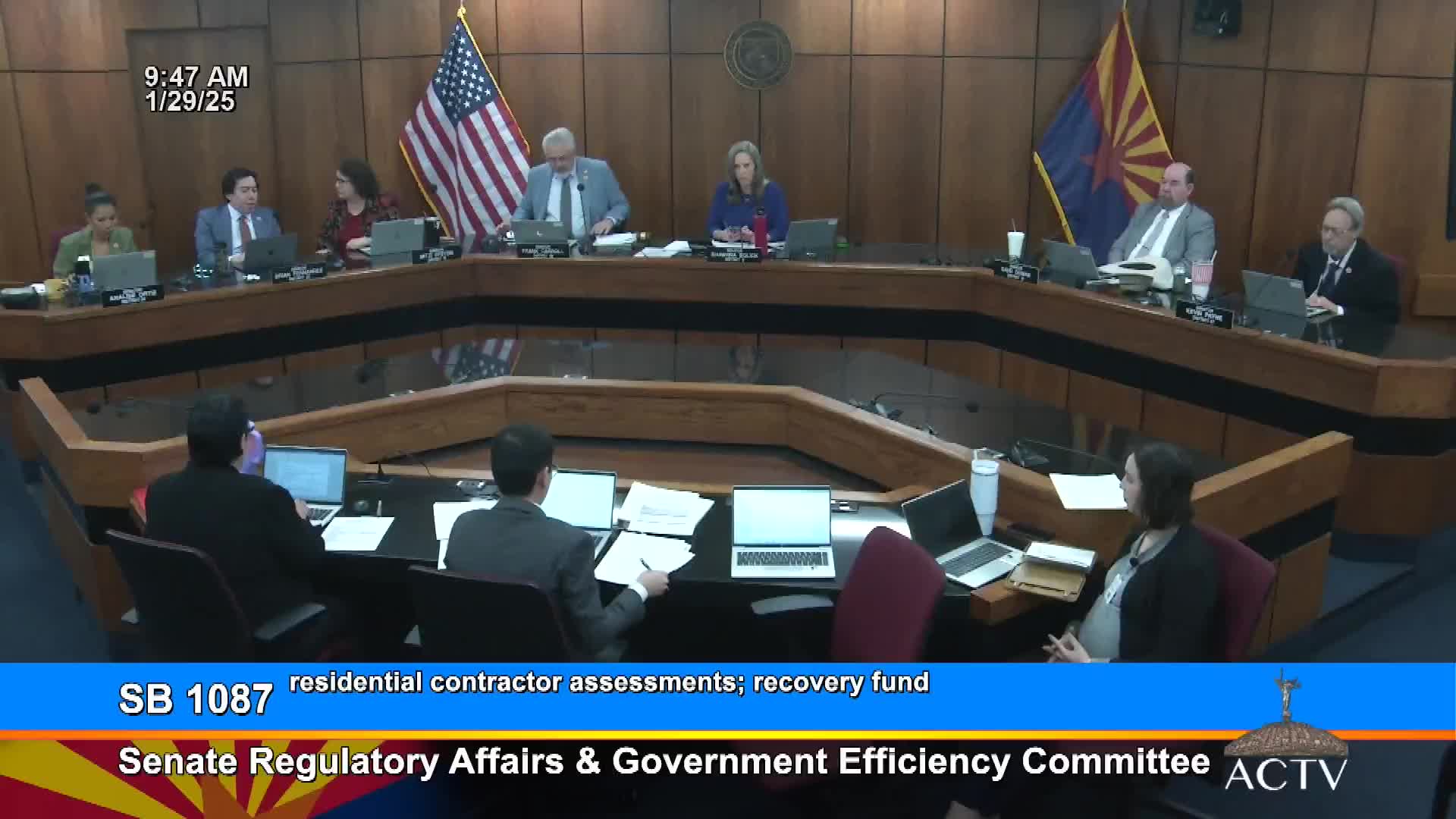
Senate Bill 1087 received a due-pass recommendation after debate over fund thresholds and consumer protections; the bill would lower statutory assessment caps for the Residential Contractors Recovery Fund if the fund balance remains above set thresholds.
Senate Bill 1087 received a due-pass recommendation from the committee after sponsor testimony and questions about fund levels, consumer protections and appropriate numeric caps.
The bill would reduce the assessment residential contractors pay into the Residential Contractors Recovery Fund every two years by changing statutory maximums: for initial licensure the statutory maximum would be reduced from $600 to $370, and for renewal from the statutory maximum to $270. The bill further requires the Register of Contractors to reduce the assessment by 50% if the RCRF balance exceeds $15,000,000 at the end of a fiscal year, and to reinstate original amounts if the fund later drops below $10,000,000.
Committee staff summarized current fund statistics and historical collection practices: the fund’s year-end balance for 2024 was reported as approximately $27.6 million and the fund paid about $6.7 million in claims in the referenced year. The sponsor, Senator Hoffman, described the fund as having several years of operating runway and argued that existing assessments have routinely over-collected compared with annual claims paid. Senator Hoffman said current statutory maximums exceed the actual assessment set in administrative code (noting administrative-code assessment amounts of $370 for new licenses and $274 for renewals), and argued the proposed statutory caps more closely reflect administratively set levels.
Several senators asked how the numeric thresholds were determined and urged actuarial study rather than legislative guesswork. Senator Epstein said she favored the bill’s concept but opposed the specific dollar caps without an actuarial analysis and cited prior pension-fund mistakes as a cautionary example. Another member expressed concern that the $30,000 maximum individual award from the fund and rising construction costs mean consumer recoveries may be insufficient and urged a review of award limits before altering assessments.
The sponsor and supporters said the bill protects consumers while returning excess collections to contractors and reducing what they described as a de facto tax on tradespeople. After discussion, a motion to return SB 1087 with a due-pass recommendation passed; the committee announced a 4-3 vote in favor.