Get AI Briefings, Transcripts & Alerts on Local & National Government Meetings — Forever.
Committee advances competing proposals to redraw Maricopa County boundaries and create new counties
Loading...
Summary
Two competing proposals to redraw Maricopa County — one creating three new counties and one transferring parts of Maricopa into existing neighboring counties — were advanced by the committee after extended debate about population, costs and transition logistics.
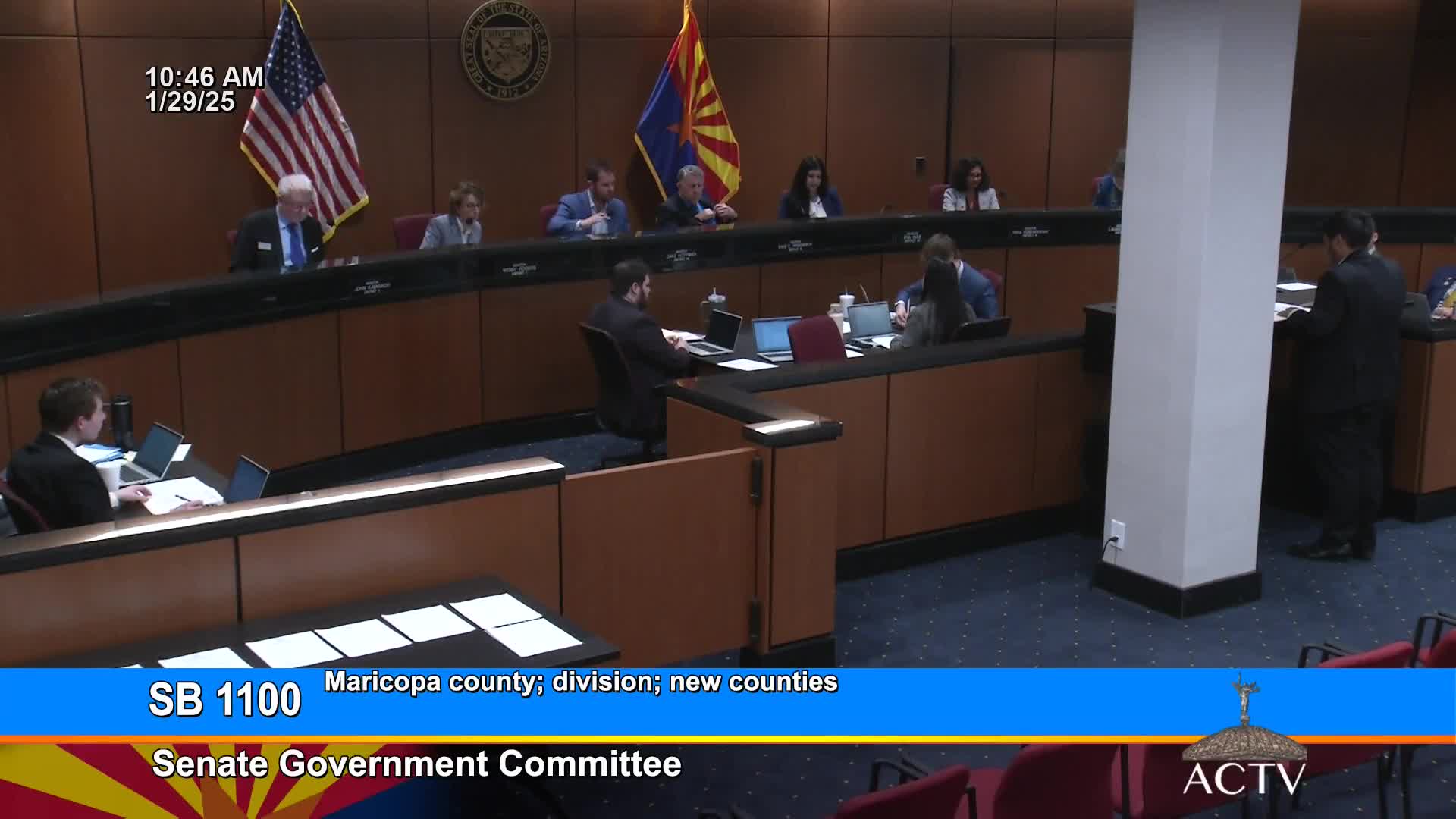
The Senate Government Committee advanced two competing bills that would change Maricopa County’s boundaries and governance. SB 1101 would create three new counties from portions of Maricopa; SB 1100 would transfer parts of Maricopa to adjacent counties (Pinal, La Paz, Yavapai, Yuma and Gila under the proposal). The committee adopted a sponsor amendment to SB 1101 (a date change) and subsequently gave both bills due‑pass recommendations by recorded votes of 4 ayes and 3 nos.
Sponsor rationale: The sponsor argued at length that Maricopa County is disproportionately large — the committee record cites a current Maricopa population of roughly 4.7 million (about 65% of the state) and projected growth that could put the county at 7.5 million in 30 years if current trends continue — and said the state needs more representative, local governance. The sponsor presented maps showing two approaches: (1) SB 1101’s option to carve Maricopa into a smaller Maricopa plus three new counties (named in the sponsor’s materials as Odom, Mogollon and Hohokam in the sponsor’s map) and (2) SB 1100’s approach to have adjacent counties absorb sections of Maricopa by “clawing in.”
Opponents’ concerns: Committee members and others raised several practical concerns. Senator Cooney and others flagged potential costs (committee references included an estimate cited by Maricopa County of roughly $155 million for reconfiguration), legal and operational issues (superior‑court judges must reside in the county they serve, special taxing district continuity, community college governance), and the risk that increased distances to county seats could reduce public participation. Members also questioned whether adjacent counties had been consulted and whether the resulting counties would have sustainable tax bases to support service levels.
Sponsor response and implementation pathways: The sponsor said the bills include transition provisions (SB 1101 contains a multi‑year transition period and intercounty oversight board in the draft) and suggested runways and intergovernmental agreements (IGAs) could smooth the transition for shared services, special taxing districts and community colleges. The sponsor also argued that option 2 (boundary transfers to adjacent counties) would require less new infrastructure because existing county facilities and staff could serve transferred areas.
Committee action: The committee adopted the six‑page Hoffman amendment to SB 1101 (a drafting change to an implementation date) and then advanced SB 1101 as amended by a 4–3 vote. SB 1100 also advanced 4–3. The sponsor said these bills are intended to begin a longer public and legislative conversation; she acknowledged significant implementation work would be required and that the current governor would likely not sign them in the present term.
What’s next: Both bills will proceed to subsequent legislative consideration. Key follow‑up topics for staff and stakeholders include transition costs, IGAs for shared services and special districts, impacts on judicial residency and election timing for new county offices.
(End)