Get email alerts on the Victim Protections topic
No spam. Unsubscribe anytime.
Legislators unanimously advance bill to bar incarcerated people from contacting victims by new tech channels
Summary
House Bill 2108 would update existing restrictions on inmate communications to include modern channels such as text and email; the Judiciary Committee gave it a unanimous 9–0 due‑pass recommendation after testimony from Maricopa County Attorney’s Office and victim‑advocacy groups.
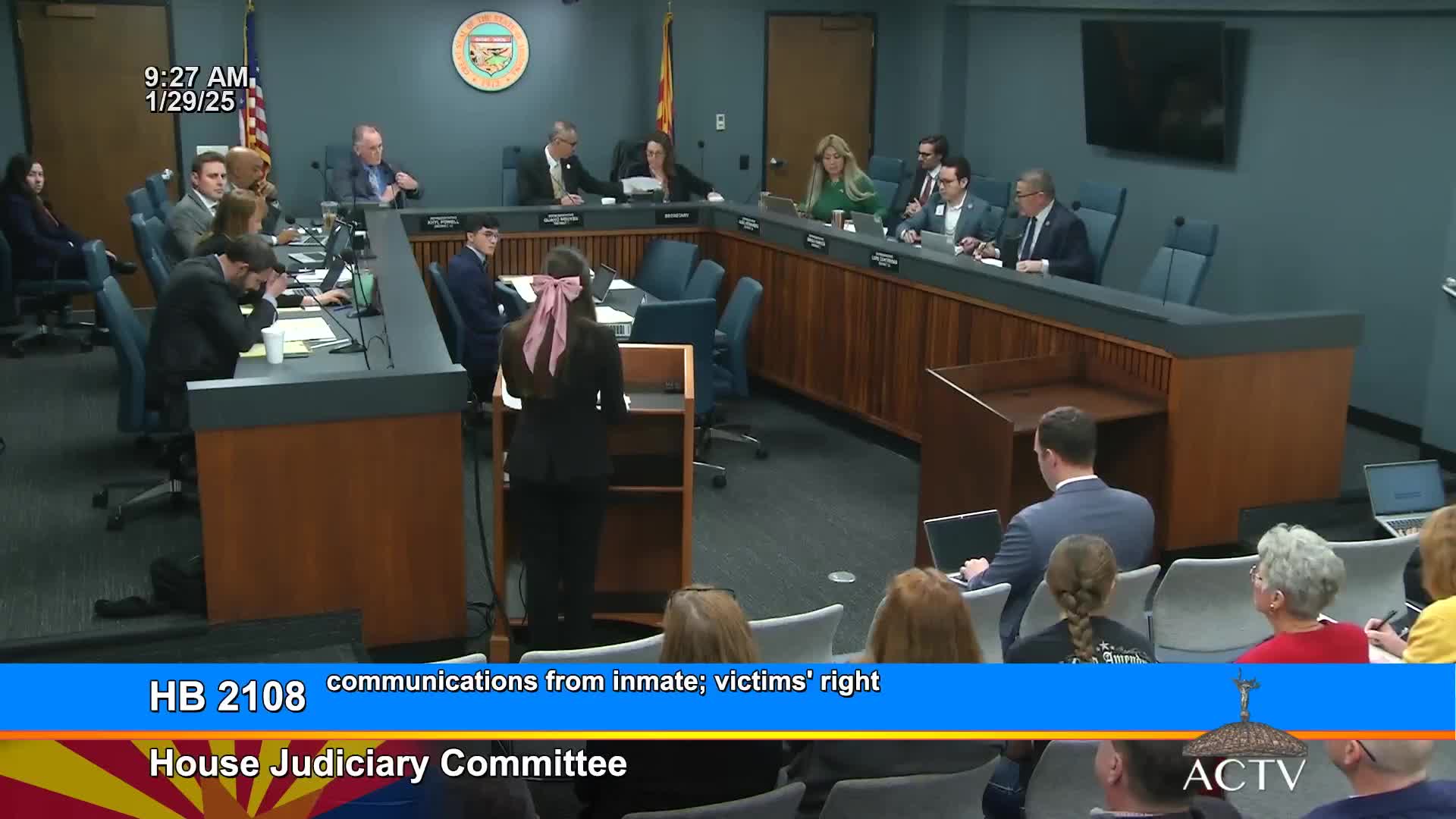
House Bill 2108, which the House Judiciary Committee advanced unanimously Friday, amends Arizona law to bring inmate‑to‑victim communications rules up to date with current technology.
The bill expands existing restrictions that historically covered written mail to explicitly bar an incarcerated person from communicating with a victim or the victim’s household through contemporary channels including cell phone calls, text messages and email, the committee was told.
Why it matters: County prosecutors and victim‑advocacy organizations said the change responds to technology upgrades in correctional settings — notably tablet distribution and other inmate access to digital communications — which have created opportunities for harassing contact that existing statute did not clearly forbid.
Testimony Rebecca Baker, legislative liaison for the Maricopa County Attorney’s Office, told the committee the statute — last amended in 1999 — needs updating so victims can effectively enforce a stay‑away request under modern communication methods.
Natalia Brown of the Arizona Coalition to End Sexual and Domestic Violence said distribution of tablets and other digital access exposed survivors to unwanted contact; victims could be harassed or retraumatized when an incarcerated perpetrator could contact them by new means. She called the bill “essential” to ensure protections are applied consistently.
Committee action and vote Following the testimony and brief discussion, the committee voted 9–0 to return HB 2108 with a due‑pass recommendation.
Ending: The bill proceeds to the full House; sponsors and advocates said it is a technical update to ensure victims’ requests not to be contacted are enforceable across modern communication platforms.