Get Full Government Meeting Transcripts, Videos, & Alerts Forever!
Get email alerts on the Building Codes topic
No spam. Unsubscribe anytime.
Committee debates bill to bar local limits on residential building materials amid housing-cost fight
Summary
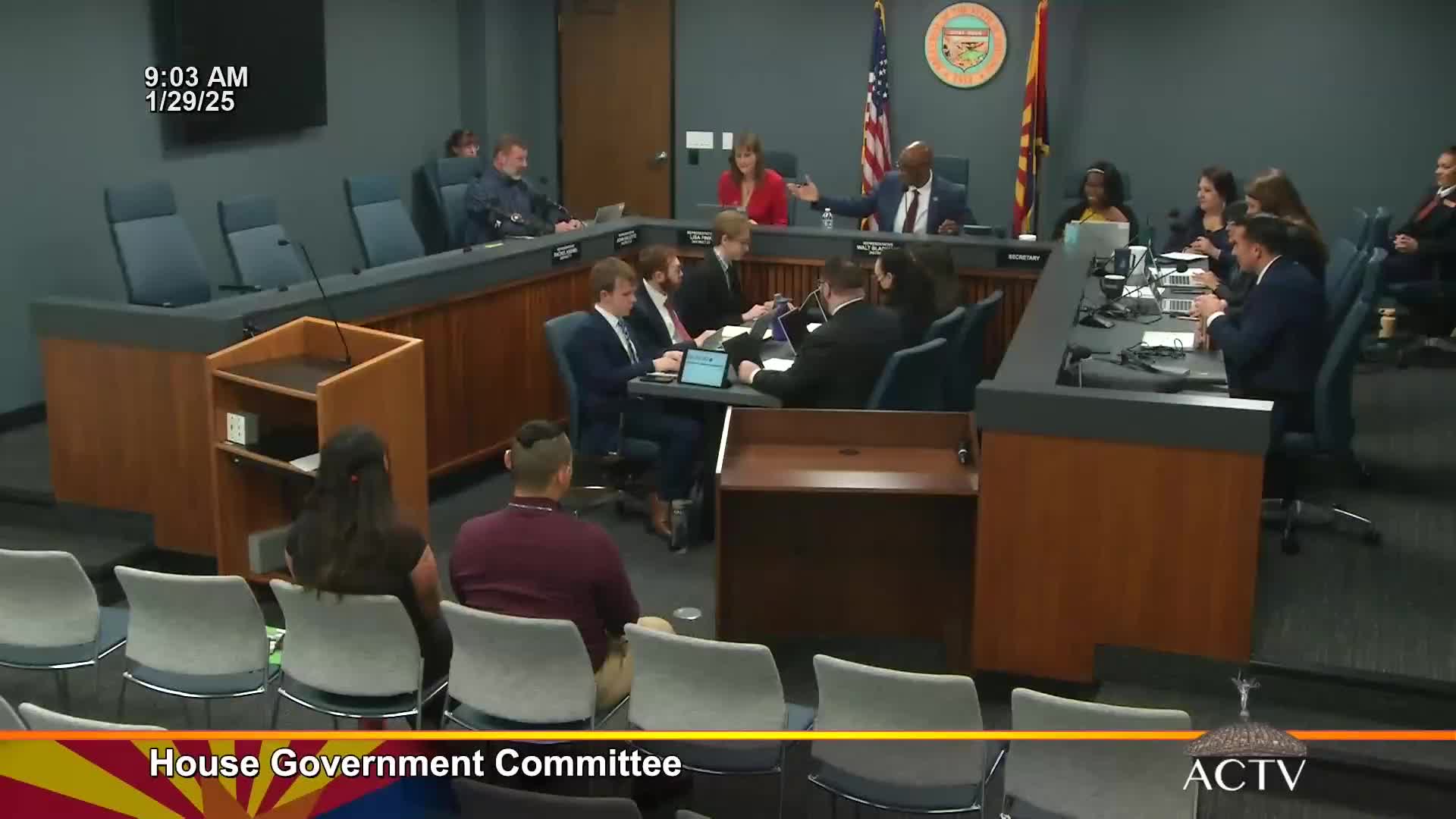
A House Government Committee in Phoenix heard testimony and debate on HB 2317 on Jan. 29, 2025, a bill that would prevent cities and towns from forbidding the use of products that are listed in residential building codes.
A House Government Committee in Phoenix heard testimony and debate on HB 2317 on Jan. 29, 2025, a bill that would prevent cities and towns from prohibiting the use of products that are recognized in residential building codes.
Sponsor Rep. Quinton Gillette (sponsor) told the committee the measure is intended to protect homeowners’ property rights and keep construction costs down by preventing local governments from imposing material requirements beyond the code. "If I'm building a residential dwelling of my own construct and the products that I use are currently in the building code, I shall be able to use them," Gillette said. He framed the bill as protecting "the fruits of my labor" and said health and safety requirements would remain intact under the code.
Supporters told the committee the bill addresses affordability by preserving lower-cost, code-approved options. Spencer Camps of the Home Builders Association of Central Arizona said builders rely on national code testing and local adoption cycles and that restricting code-approved materials can raise costs. "All this bill says is if a product is allowed in the code, a city can't prohibit you from using it," Camps said. Jake Hinman of the Arizona Neighborhood Project likewise said the bill would not remove local authority to adopt a code: "If they adopt that code ... then that's the code. You won't run into the fact because again, this goes both ways."
Opponents included municipal and water-sector representatives who said the bill, as written, could undercut local conservation and safety adaptations. Barry Aarons of the Arizona Municipal Water Users Association said the measure could prevent cities from encouraging or requiring water-conserving fixtures (for example, certain water-efficient appliances or rainwater/graywater systems) even when those items are not listed in model code. "Our concern is that this might prohibit our ability to [implement] certain water-conservation projects," Aarons said. Tom Savage of the League of Arizona Cities and Towns said the bill could limit communities’ ability to tailor building-material and wildfire- or climate-related standards to local conditions.
Several public speakers raised practical examples. Proponents pointed to PVC drainage pipe as a cheaper, easier-to-maintain alternative to clay pipe and said some local ordinances have required more expensive alternatives. Opponents noted cities sometimes adopt supplemental standards—such as water-savings measures—not always found in model codes. Representatives from both sides agreed on the importance of the code-adoption process, but differed on whether the bill would improperly restrict local discretion.
Committee members pressed sponsors and witnesses on geographic and climate differences across Arizona. Rep. Villegas and others asked how the bill would account for snow loads, insulation and other regional building requirements; proponents responded the bill applies only to residential building codes and that model code cycles and local amendments already reflect local conditions. Several members urged continued stakeholder talks to refine language.
Outcome and next steps: The sponsor said he would meet with stakeholders to pursue adjustments; the committee's chair encouraged parties to continue discussions. The bill was moved in committee with a due-pass recommendation and the committee took steps to retain the bill on the calendar to allow amendment and further stakeholder meetings. No final enacted law resulted from this hearing.
The debate showed a split between concerns about lowering construction costs to improve affordability and municipal and water-sector interest in preserving local tools for water conservation and community character. The sponsor and several witnesses agreed to continue negotiations on clarifying language to avoid inadvertently limiting conservation measures or locally tailored safety standards.