Get Full Government Meeting Transcripts, Videos, & Alerts Forever!
Get email alerts on the Capital Budget topic
No spam. Unsubscribe anytime.
Planning committee recommends $62.625 million, with $5.04 million in year one, to Board of Education
Summary
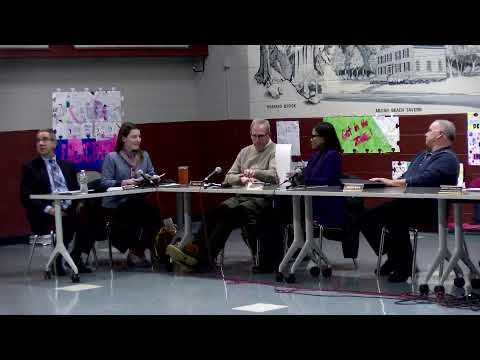
The Cheshire School District planning committee voted to send a five-year capital expenditure plan totaling $62,625,000 to the full Board of Education, asking for $5,040,000 in year one and detailed allocations for years two through five.
The Cheshire School District Planning Committee voted to recommend that the Board of Education approve a five-year capital expenditure plan totaling $62,625,000, with $5,040,000 requested for the first year.
The recommendation, approved by the planning committee at its February meeting, included a year-by-year funding schedule: $5,040,000 in year 1; $12,200,000 in year 2; $16,895,000 in year 3; $13,115,000 in year 4; and $15,375,000 in year 5. Committee members moved and seconded the recommendation and the motion was approved in committee; the full board will consider the plan at its February meeting.
The five-year plan groups about 60 projects by priority. Committee members emphasized three immediate safety- and code-related priorities for initial funding: replacement of the high school fire alarm control system, reconfiguration of the Cheshire High School south parking/loading area, and improvements to the maintenance garage. Rich, the district’s director of facilities, described those and other priorities and provided project-level detail in several areas, including window replacement, masonry restoration, playground equipment, and HVAC design work.
Rich said the maintenance garage at Cheshire High School requires site reconfiguration and better office and storage space; the district has carried the need for several years and last renovated portions in 2005. He noted the district currently stores salt under a tarp and needs improved facilities to support year-round operations. On the fire alarm replacement, Rich said a recent commissioning at another building cost just under $500,000 and estimated the high school upgrade at roughly $1.1 million to reach current code coverage and device counts.
Committee members discussed three year‑one funding scenarios presented by staff: an “aggressive” scenario (roughly $7.7 million), a “moderate” scenario (about $7.4 million), and a “conservative” scenario that funds high‑priority items only (about $4.5 million). The committee ultimately moved a package that brings year‑one funding to $5,040,000 by adding a $500,000 placeholder for athletic-complex improvements to the high-priority list.
Several projects in the packet were highlighted as candidates to be included in an energy performance contract (EPC) — for example, rooftop units, HVAC controls and other HVAC-related projects — and were marked in green in the district’s packet. Staff said projects potentially absorbed into an EPC would reduce the year‑one appropriation pressure if later included in a guaranteed‑savings contract.
The planning committee noted that some items in the packet are referendum items and others are not; staff said the $800,000 south parking‑lot reconfiguration, the $1.1 million fire alarm control system, and $500,000 for high‑school window replacement would be referendum items. Other projects would be single line items if approved.
The planning committee will forward the recommended five‑year plan to the Board of Education for consideration at its February meeting. The committee asked staff to re‑order the high‑priority list to show the district’s top urgent needs first (the committee identified the fire alarm, the south parking lot reconfiguration, and the maintenance‑garage redesign as the highest‑urgency projects). The board and town council will continue discussions on the final package and timing, including which items proceed as referendum requests and which may be advanced via other funding mechanisms.
Votes at a glance: The planning committee voted to recommend approval of the full five‑year capital plan (total $62,625,000) with year 1 at $5,040,000. The motion was seconded and the committee chair called the motion approved. The formal vote tally was not read into the record.