Get Full Government Meeting Transcripts, Videos, & Alerts Forever!
Get email alerts on the Community Violence topic
No spam. Unsubscribe anytime.
UMB Center for Violence Prevention and LifeBridge—s Center for Hope describe hospital‑linked prevention and intervention efforts
Summary
University of Maryland—s new Center for Violence Prevention and LifeBridge Health—s Center for Hope told the committee about statewide training, trauma‑informed services and hospital violence intervention teams that serve thousands annually and aim to reduce violence and its downstream health impacts.
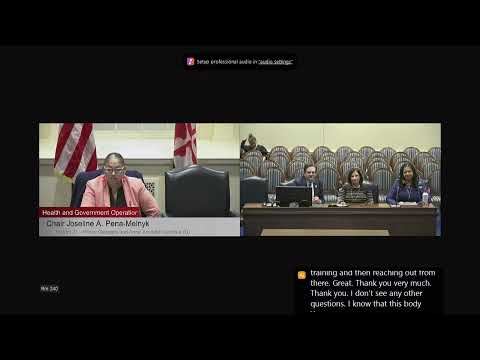
The University of Maryland Baltimore—s Center for Violence Prevention and LifeBridge Health—s Center for Hope briefed the House Health and Government Operations Committee on Jan. 31 about clinical, research and community interventions designed to prevent and respond to community violence.
"The violence that's plaguing Baltimore City, the state of Maryland, and our country writ large is already a nightmare," said Dr. Nadine Finnegan Carr, executive director of the UMB Center for Violence Prevention. The center, she said, aims to "interrupt and intervene on all incidents of and all forms of violence," with goals in research, community partnerships and training.
Programs and capacity
- UMB staff described an established training and technical assistance relationship with Maryland's Department of Human Services and Social Services Administration on child trafficking and mandatory training for social workers under the federal Preventing *** Trafficking and Strengthening Families Act. Dr. Finnegan Carr said the university team rolled out required training to social workers in 2017 and continues as a training provider for Maryland's Regional Navigator Program.
- LifeBridge Health described the Center for Hope, a consolidated hub launched in 2022 that brings child advocacy, hospital violence intervention teams, domestic‑violence services and the city's human trafficking navigation together. Adam Rosenberg, executive director of the Center for Hope, said the center and its network provided about 5,000 interactions last year across 11 sites and that programs include bedside violence‑interruption teams, forensic interviews and trauma‑informed therapy.
Impact and metrics
- Rosenberg said hospital‑linked violence interruption work and community mediations appear associated with reductions in gunshot wound admissions in some service areas: "[T]here was a 52 percent reduction in gunshot wound admissions since at Sinai Hospital," he told the committee, and the system's safe‑streets sites reported low or zero homicides in several neighborhoods for extended periods.
- LifeBridge officials said their programs serve a range of ages and needs, including crisis intervention, forensic medical exams, counseling and legal advocacy; the system also supports family stability by providing transportation and childcare to remove barriers to therapy.
Why officials said the work matters
- Both presenters described violence as a public‑health problem that causes chronic trauma, increases downstream need for hospital and behavioral‑health services, and contributes to recurrent emergency department use. They argued that hospital‑based intervention plus community wraparound services keeps people healthier and reduces future acute care demand.
Discussion vs. decision
- Discussion: Officials reviewed program services, training and evidence from local pilots.
- Direction: The presenters invited legislative oversight and said their centers are available as resources for state agencies and local jurisdictions.
Ending: Committee members thanked the presenters and asked for follow‑up on funding sources and the feasibility of replicating elements of the Center for Hope in other jurisdictions. No legislative action was taken at the hearing.