Get Full Government Meeting Transcripts, Videos, & Alerts Forever!
Get email alerts on the Ed Wait Times topic
No spam. Unsubscribe anytime.
State launches ED Wait Time Reduction Commission; HSCRC and hospitals name capacity, post‑acute gaps and pilot fixes
Summary
A new Maryland ED wait time commission has been formed with subcommittees on access, data, hospital capacity and best practices. HSCRC, hospitals and CRISP said the problem is multi‑factorial and identified pilot interventions such as full‑capacity protocols, discharge lounges and expanded mobile crisis teams as immediate responses.
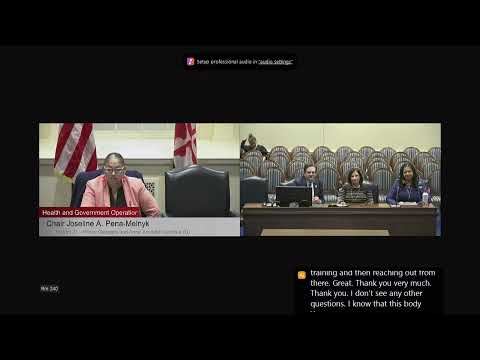
Maryland officials, hospital leaders and the state—s health information exchange briefed the House Health and Government Operations Committee on Jan. 31 about a newly formed ED Wait Time Reduction Commission and a range of operational pilots aimed at shortening how long patients wait in emergency departments.
"This is a challenge that we've faced for many, many years," John Crum, executive director of the Health Services Cost Review Commission, told the panel. Crum said the commission is focusing on hospital capacity, bed distribution, staffing and ED volume as the main in‑hospital drivers of prolonged emergency department stays. He added that non‑hospital factors such as skilled nursing facility capacity and behavioral health access also lengthen stays.
Commission structure and data work
- The commission, created by statute, has subcommittees on access to non‑hospital care (primary and post‑acute), hospital best practices, capacity operations and staffing, and a data subcommittee tasked with compiling new data elements and driving regional analysis.
- Tina Simmons, associate director of quality methodologies at HSCRC, said the data work aims to move beyond statewide averages to regional and hospital‑level analysis: "This is where we're starting to look at levers to move those as well... identifying and recommending improvements in the collection and submission of data."
Operational pilots and hospital best practices
- Hospitals described operational pilots already in use or under active study: full‑capacity protocols that move patients into identified inpatient spaces to free ED beds more quickly, discharge lounges that allow clinically ready patients to vacate inpatient rooms while final paperwork and transport are arranged, and targeted triage procedures that separate lower‑acuity patients from those needing admission.
- Andrew Nicholas of the Maryland Hospital Association described a statewide throughput collaborative that compiled more than 50 strategies across three categories—input (EMS handoffs and triage), throughput (bed turnover and capacity management) and output (post‑acute discharges and social services connections).
Non‑hospital solutions
- State and departmental presenters emphasized work to expand community services that can prevent unnecessary ED use: MDH described an expansion of mobile crisis teams and brick‑and‑mortar crisis stabilization funded with approximately $13 million, and an expanded Assistance and Community Integration Services pilot for housing‑related wraparound supports.
- Craig Bamford, representing CRISP, said the health information exchange will be central to measuring outcomes: "The data will allow us to focus on population initiatives and then also make sure that we are improving health, not just some of these utilization measures." He highlighted links between clinical, social and behavioral datasets to drive targeted interventions.
Monitoring and incentives
- HSCRC added ED length of stay measures to its quality incentive program so hospitals have a financial quality signal tied to improvement. Representatives said incentives are one tool among many and not a stand‑alone solution.
Discussion vs. decision
- Discussion: Committee members and agencies discussed contributing drivers, specific pilots and the collection of more granular data.
- Direction: HSCRC, MDH, CRISP and hospitals will continue commission meetings and subcommittee work; agencies plan to publish materials and share best‑practice summaries.
- Decision: No regulatory changes were made at the hearing; HSCRC said it will proceed with the incentive measure and the commission will continue scheduled meetings.
Ending: Officials asked the committee for continued oversight and invited lawmakers to observe pilots; the commission has a calendar of frequent meetings through 2025 to deliver interim findings and recommendations.